
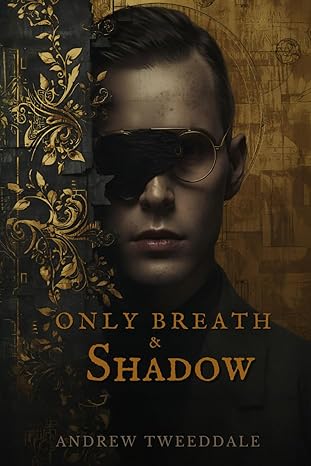
Only Breath and Shadow is the third book in the Castle Drogo series by Andrew Tweeddale, but it also functions as a standalone novel in its own right. I read it knowing nothing about the first two novels in the sequence, but this did not impair the reading experience. The story is set in Vienna between 1934 and 1939 and charts the rise of the Nazis and the impact of that phenomenon on the whole of Europe in general and the Jewish population in particular. It focuses on the protagonist, Christian Drewe, an upper-class English veteran from World War1 who has been left blind and emotionally and psychologically traumatised by his experiences as an officer. Tweeddale uses his blindness as a metaphor for his emotional detachment from society and his difficulties in allowing himself to open up to anyone else. This sabotages the potentially life changing relationship with Claire Astor, an American actress, dancer and singer, that presents itself as the novel unfolds. His inability to express his emotions and to declare his love for her derails their relationship several times, leading to periods of estrangement.
Running alongside the potential romance between Christian and Claire is the narrative thread concerned with the fate of the Jewish characters we encounter, including the children of some of Christian’s friends, Otto and Anna Friedman. This becomes the main narrative driver of the story in the second half of the book. Having slowly established the main characters and their relationships in the first half, Tweeddale accelerates the pace of the story, turning it into a page -turner that gallops towards the end, with the reader breathlessly clinging on. He uses the well- established facts of the period to add jeopardy to the narrative. As each chapter runs through the months and years, getting ever closer to May 1939, the tension is ratcheted up, notch by notch. It’s given an additional dimension by the sections Tweeddale employs from the point of view of Ernst Schmidt, a major in the Gestapo. These are very effective in giving the reader an insight into the psychology and motivations of the Nazis, and their implacable hatred of those they consider to be degenerate inferiors. By the end, most readers will be desperately hoping Schmidt gets the justice he deserves, but this is not a book for those who require simplistic happy endings.
In a sense, history has provided Tweeddale and many other writers with a gift that cannot fail to deliver. The story of the Second World War, and the rise and fall of the Nazis, has an unshakeable grip on our imagination. Its influence on the present is undeniable, and the battle between Fascism and Liberalism continues today. Indeed, it has never been more relevant than now, when it seems all of the old battles that we old liberals thought had been finally won are being refought all over again. With that in mind, Tweeddale’s command of the subject is impressive. Clearly, much research has gone into the preparation of the novel, but Tweeddale wears his scholarship lightly. The story always takes precedent over history. This is first and foremost a novel dealing with characters, relationships and issues. We read it, not because we want to learn something about the rise of the Nazis in Germany, but because we are invested in the characters and their relationships and we want to discover what happens to them. A deeper understanding of a dark period of twentieth century history is a welcome by-product, but the story is the thing.
It’s a story well worth reading. You can buy it here: https://www.amazon.co.uk/Only-Breath-Shadow-Gathering-Sacrifice-ebook/dp/B0GKQSPDLN?ref_=ast_author_dp&th=1&psc=1

