Caledonian Road

O’Hagan triumphs with that rare beast – a State of the Nation novel with heart.

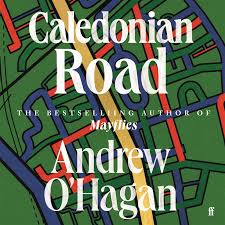
The latest novel from Andrew O’Hagan, Caledonian Road, is a big beast, in every sense of the term. Physically, it’s got some heft. 640 pages of hard back book makes demands on the wrists. It’s also dealing with weighty, contemporary issues, so all told, the experience of reading it provides a holistic mind and body workout. Sounds like a week at a Spartan health farm, where the motto is no pain, no gain, but fear not dear readers, this novel also provides pure pleasure.

O’Hagan handles the intermingling of the personal and political with real skill and delicacy. A lesser novelist would have eschewed ideology and party politics for fear of committing the ultimate sin in the eyes of the serious, sensitive, superior and above-the-fray Literature Critics, that is the sin of taking sides. Ideology is both vulgar and limiting in this fragrant, lofty world. Evenhandedness is much more mature, much more subtle, much more human, darling. Perhaps. It’s certainly much more boring, in my opinion.

O’Hagan says a hearty bollocks to that and has dived in headfirst to this dissection of contemporary London society, and the power structures that both drive it and destroy it. He does it primarily through great storytelling. The novel succeeds first and foremost on that fundamental, primary level. The characters, their relationships, triumphs and disasters are memorable and compelling, even the utterly ghastly ones. Maybe especially the ghastly ones.

For the protagonist, Campbell Flynn, O’Hagan treads well-travelled paths. Working class lad done good, from the grim dereliction of 1970s  Glasgow, Flynn at the time of the novel’s start is an academic, a cultural commentator, and a media darling down in that there London. Not a million miles away, obviously, from O’hagan’s own background, material previously plundered in his exquisite Mayflies. And not just London, but very specifically Kings Cross, an area recently reinvented by money and gentrification, but one which has pungent resonance for any refugee from the North. As a first entry point for East Coast  Scots and Northerners, its streets, legends, and institutions retain a powerful grip on those arriving wide eyed from the sticks. Judd Street, the Eight till Late, the Scala, Peabody housing, Squats and Short Life flats, ULU, one hour rooms in lines of seedy hotels, kicking used syringes and condoms to one side leaving one’s flat in the morning – they are all part of the memory kaleidoscope conjured by the name Kings Cross.

As a big beast, the novel is teeming with characters, so much so that O’Hagan thoughtfully provides a cast list of two fully crammed pages. It’s essential if you want smooth passage through this behemoth, and a trick that Dickens himself could have profitably employed. The plot is multi-stranded and brilliantly handled, so that by the time the book has reached the halfway point, every time a new section of the book begins, there’s a sense of excitement at the resumption of that particular plot thread. That happens for all of the separate threads. That’s a real achievement. Usually, there’s always at least one thread that the reader has less engagement with, where you feel you’re treading water and sticking with, out of a sense of obligation. Here, all of them sing.

It’s a novel with laudable ambition, tackling big, serious issues. Any analysis of the current, woeful state of the UK would examine these topics in some depth, and O’Hagan looks them straight in the eye and explores them with both a pitiless forensic gaze and nuance, which allows him to eschew simplistic judgements and portray the issues and the characters with multilayered complexity. These are not the scribblings of a naive schoolboy marxist. He manages to cover

  • People trafficking
  • Cancel culture
  • British exceptionalism
  • The aristocracy
  • Public Schools
  • Russian money laundering
  • Social Media
  • Celebrity Culture
  • Gentrification
  • Housing 

All of this produces an excoriating picture of the malign influence of the British establishment, their sense of entitlement and superiority, and the devastating impact they have had on destroying Civil Society for everyone except the super rich. The “freedom” this class espouses becomes simply freedom for millionaires to become billionaires without the state interfering.

There will be readers at this point who are thinking, “Bloody hell, this sounds far too political for me. I don’t understand this stuff and/or I just want a story about people and relationships” Keep the faith, you apoliticals! O’Hagan delivers on that front as well, with a huge range of individuals and families, all of whom, even the nasty Tories, are portrayed sympathetically. It’s Dickensian in that sense, and similar in many ways to Zadie Smith’s White Teeth. An energetic, densely populated romp set in multicultural, class-riven contemporary London, it is, like Dickens, a serious work masquerading as an entertainment. Or the other way round.

There was one dud note for me at the beginning. His portraits of Media stars, the establishment, and the political classes all rang true and had the hallmark of authenticity. I found, at first, his depiction of knife wielding, estate dwelling, drug dealers less successful. It felt as if he had spent some time eavesdropping on an unfamiliar underclass and had produced a two dimensional portrayal. By the end, however, I was convinced and O’Hagan had totally won me over. This is A Great Novel, and I can’t wait for the adaptation, film or TV. Already commissioned, apparently.

My Novel of the Year – by a mile.

Cloud Cuckoo Land by Anthony Doerr

A review

Doerr’s latest novel is his first since the Pulitzer Prize winning All the Light We Cannot See. That book was a particularly happy accident for me. I found it lying around the house, and knew nothing about it, so began it with no expectations. After about thirty pages or so, I knew I was dealing with something special. I browsed this new one in Waterstones in the run up to Christmas and rejected it. It just didn’t sound like my cup of tea: three separate stories spanning several hundred years, including a sci fi section, all linked together by a fictional fragment of a Ancient Greek text. No, thank you very much, I’ll pass on that.

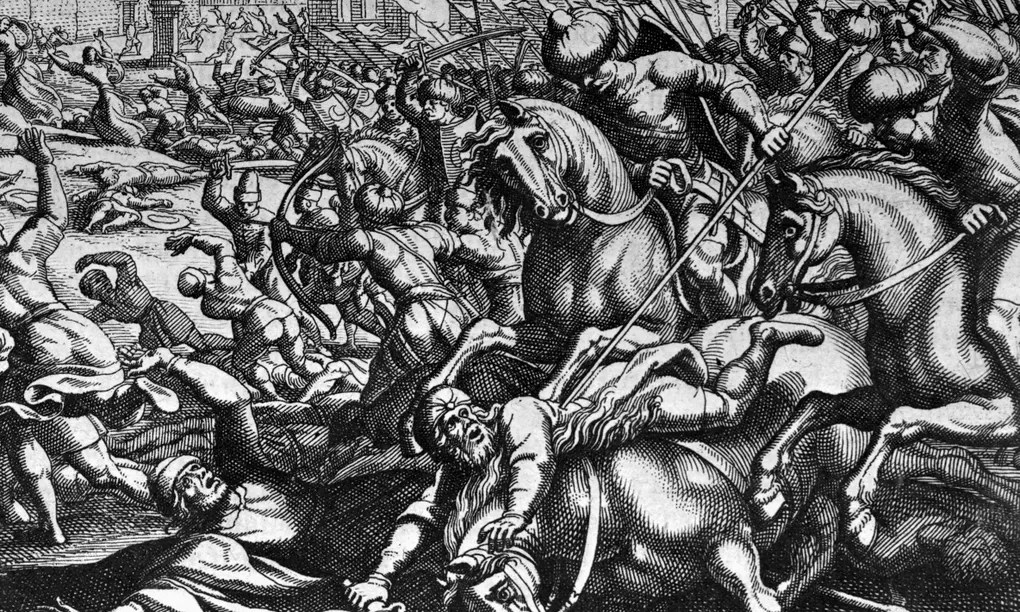
How wrong I was. This is a singularly brilliant novel, one of the best I’ve read for years. Each section is perfectly realised: the stories of two of the little people on opposite sides of the siege of Constantinople in 1453 (pictured right) , Omeir and Anna is beautifully done in luminous prose. I’ve read some criticisms about the sentimentality and implausibility of this story, but you would have to have a heart of stone not to be moved by the outcome, after years of hardship and personal tragedy. 

The contemporary section, which tells the story of a teenage eco-terrorist bomber, who is “radicalised” by a shadowy online presence that exploits his vulnerability and his disbelief at what we are doing to our planet, is the starting point for the whole novel. Each section as it is threaded through the bigger narrative, slowly ratchets up the tension of the unexploded bomb in his rucksack at the local library. The library is empty except for a group of young teenagers who are rehearsing a theatre production of the Ancient Greek text, Cloud Cuckoo Land, that  holds the whole thing together.

The links extend to the sci-fi section that is set in a spaceship of humans escaping a world destroyed by global warming. You might think that such a variety of settings would jar, and that the author would naturally display a weakness in the realisation of at least one of the stories, but the reverse is true. There is no sense that, in fact, these are three entirely sparate stories that have been clumsily welded together. The whole thing feels seamless, with each section being part of an organic whole. The plotting, linking all of these disparate parts is exquisitely done. Improbable, but done with authority, credibility and artistic integrity. Each section enhances the others, and the sequencing and pacing of the sections turns a heavy weight literary novel of ideas into a page-turner of real dramatic power.

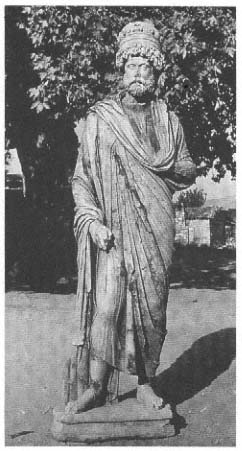
A further structural embellishment is the regular punctuation of the text with extracts from the fictitious Ancient Greek “novel” by the classical writer, Antonius Diogenes. (pictured left) Each extract is short, with the gaps in the text, supposedly  produced by the passage of time,  represented by missing words, scholarly guesses and question marks. For a while, these sections work well. They are strangely poetic and they are a welcome pause for the reader, providing an opportunity to digest the main sections of the overall narrative. After a while, however, I must admit that I began to skim read these bits, but that was because I was so invested in the main story, I really wanted to press on to get to the resolution of the whole thing. So even the weakest aspect of the book is actually an indication of its great strength.

Doerr himself describes the book as “my attempt at a literary-sci-fi-young-adult-historical-morality novel”. Guess what? He succeeds. It reaffirms the value and power of literature as a cultural endeavour that is capable of producing  great beauty and great insight. Immersive, big stories like this that tell us something about ourselves and our world continue to be important. In many ways,  the book is very explicit about that. It is a celebration of the significance of stories, of texts, (like the imaginary Cloud Cuckoo Land of Diogenes) and their ability to endure over the centuries so that they  continue to speak to people in the future. 

Literature, and story-telling in general, does a lot of cultural heavy lifting in our society, whether it’s a comic, a novel, a movie or the latest Netflix series. It can soothe, entertain, reassure, divert, excite. At its best, it can illuminate and make you see the world afresh, while doing all of the above as well. 

Cloud Cuckoo Land is literature at its best.

A review of “Sorrow and Bliss” by Meg Mason

Sorrow and Bliss is one of those much-touted novels that seem to gain traction in the Spring so that many people select them as one of their Summer holiday reads. Then you get tweets and Instagram posts from influencers saying how wonderful it was, to which in their turn, in the time -honoured, strange, traditions of twitter, followers gush back, agreeing how amazing it was and the churn of interest continues. Good marketing, I suppose. And, of course, I wouldn’t be complaining if one of my books was at the centre of such a fabricated whirlwind of interest. But there’s more than sour grapes to this less than enthusiastic review. Many of these books represent a triumph of marketing over substance and I’m afraid Sorrow and Bliss is another that disappoints.

It’s targeted at women readers so single-mindedly that it might as well have a pink cover. The quotes on the inside cover are all from famous women, apart from a couple that are just attributed to a publication. There are two large quotes highlighted on the front cover, one from Ann Patchett and the other from Jessie Burton – both female writers surfing a certain zeitgeist at the moment. A comparison with Fleabag is also heavily underlined. That’s like comparing The Tempest to Love Island because it’s got people in it and it’s set on an island. Waller Bridge is a gloriously talented writer and Fleabag is funny, refreshing and moving – everything that Sorrow and Bliss isn’t but wants so desperately to be. The only thing missing are references to Sally Rooney, the media’s favourite young darling. Maybe there are contractual barriers to that, but I’m sure the publishers would have been falling over themselves, to get that agreement over the line. Maybe Rooney comes at too high price these days to be even mentioned in publicity puffs, who knows. But then Rooney’s last book did brilliantly and convincingly portray working class characters that were recognisably human. And we don’t want that sort of thing to catch on, do we?

Haven’t we got over this kind of thing yet? I know you’ve got to have a consistent message and aim mercilessly at your target audience, but this is 2021 and personally, I find the concept of women’s books and men’s books (oh no, sorry, obviously men don’t read at all) rather insulting and hopelessly out of date. At a time when the debate is about gender fluidity and all of that, this stuff seems positively antediluvian.

Meg Mason

Sorry, I digress. Back to the book. Well, let’s deal with the good stuff first. It is genuinely funny at times. On a couple of occasions, I laughed out loud, and that is not something you can fake. Some of the observations about relationships and family dynamics are acute and amusing, and Mason can clearly write. As an experienced journalist you would expect no less, but not wanting to be churlish, she is more than competent at structuring the narrative and balancing dialogue and description, but then so are many Sixth formers. If that is meant to be enough, we’re setting the bar extremely low.

And that’s really all the good stuff. The main problem is that the characters and their dilemmas are so crashingly dull and unbelievable. I’m sure this won’t stop someone snapping this up for a three episode mini-series, but the appeal there, will be, to my mind, the book’s greatest weakness. It invites us to care about the emotional dramas of a white, highly privileged woman from the English upper classes. An endearingly eccentric posh family who live in the middle of London and whose friends and relations are movers and shakers in the Art world, or Finance, or Government or whatever. After one in a series of traumas (discovering that her hastily married husband is an abusive control freak. Sorry, but marriage is important enough to do due diligence surely?), one such family treasure scoops up Martha, the protagonist, takes her to Paris and then lets her live rent free in his fabulous bijou appartement, somewhere very bohemian and rive gauche.

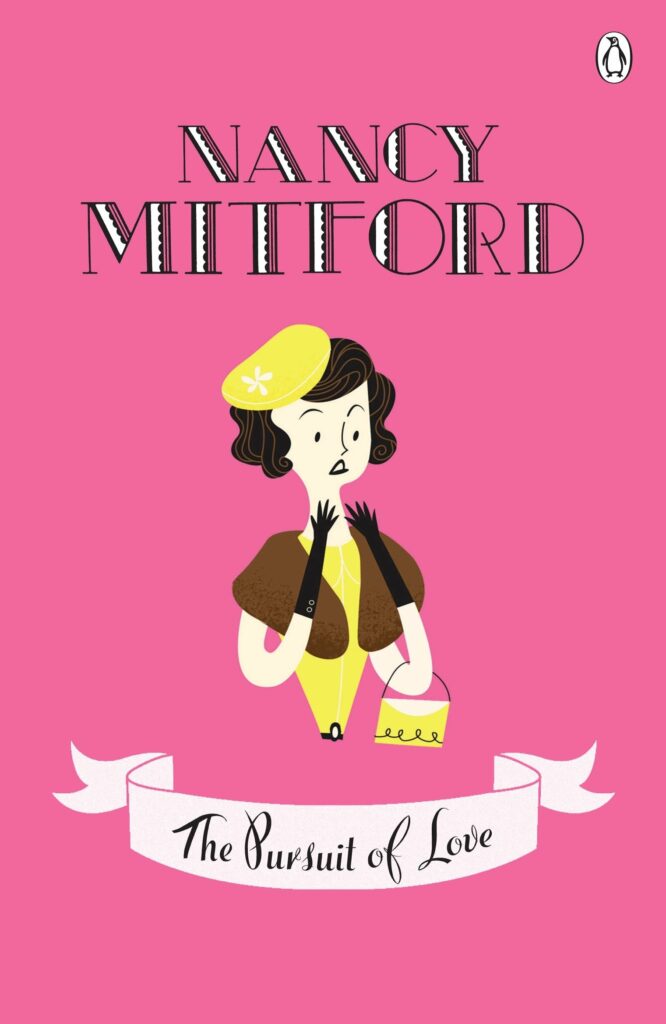
If only all women escaping abusive men and disfunctional families could just slip across La Manche. Why can’t people stand on their own two feet and rely on their family rather than the nanny state? Then we wouldn’t have to pay for ruinously expensive housing benefit etc. Excuse my sarcasm, but this is so out of touch with reality it’s painful. It reminded me a little of “The Pursuit of Love”, the Nancy Mitford novel that was serialised in the BBC earlier this year. That was brilliant, and gave the impression that the author was to some at extent at least, satirising the idle upper classes. Mason, on the other hand, gives no clue about any glimmer of social awareness. Instead, she creates the impression that she is writing about a familiar social milieu, one that she assumes everyone inhabits. Or everyone that reads books, that is. And I suppose that for Meg and her chums, journalists for The Sunday Telegraph, The Financial Times, Vogue, Marie Claire and Elle, it is very familiar.

But enough of class war, back to literary analysis. The husband in this dismal scenario, the nice one that is, married after Martha has escaped from the clutches of Husband 1, Mr Nasty, is a chap called Patrick. That’s where his resemblance to a human being in 2021 begins and ends. There is nice and nice. Patrick is NICE. He puts up with a lot of shit because Martha is very high maintenance and Patrick, as a black adoptee in a very posh family seems to feel that it would be impolite (the greatest British upper class sin) to have any views, feelings, thoughts, standards about anything that might cause any upset. And throughout the novel, he is treated abysmally by absolutely everyone. By the end, I found him so annoying and unbelievable, I really wanted to be casually vile to him as well.

He does, to be fair, provide the only narrative driving force of the novel, which is the desire to see them get married in the first place and then to see them and their marriage survive. Well, OK, maybe “driving force” is a little misleading, because it suggests that I gave a toss about either of them. Maybe narrative meander would be more accurate, a reason to keep going to the end before losing consciousness.

The final piece de resistance of this whole sorry debacle was the treatment of mental illness, a topic so fashionable it squeaks. I got the feeling that the spectre of Martha’s unspecified condition was meant to excuse the whole range of her excesses. Certainly, it features heavily in the largely positive reviews of the book. You know you’re on dodgy ground when depiction of mental illness is described using the word “brave”. This anything but brave. The deliberate vagueness around the condition is thought by many to be a glittering triumph, but I found it yet another cop out. Mason even includes a note at the end of the book: “The medical symptoms described in the novel are not consistent with a genuine mental illness. The portrayal of treatment, medication and doctors advice is wholly fictional”

What? You wouldn’t do that with a physical illness so why do it with a mental one? It smacked of someone slightly out of their depth and who couldn’t really be bothered to do the research. It’s always possible of course that I’ve got this wrong and Mason has had personal or family experience of mental illness, in which case I apologise sincerely. All I can say is that it didn’t ring true for me – a clumsy plot device, rather than an artistic decision.

So once again I find myself out of step with mainstream opinion. Sorry if you loved it but it just did not speak to me convincingly at all. This was definitely a case of mainly Sorrow, little Bliss.

This review was first published at www.rjbarron.co.uk

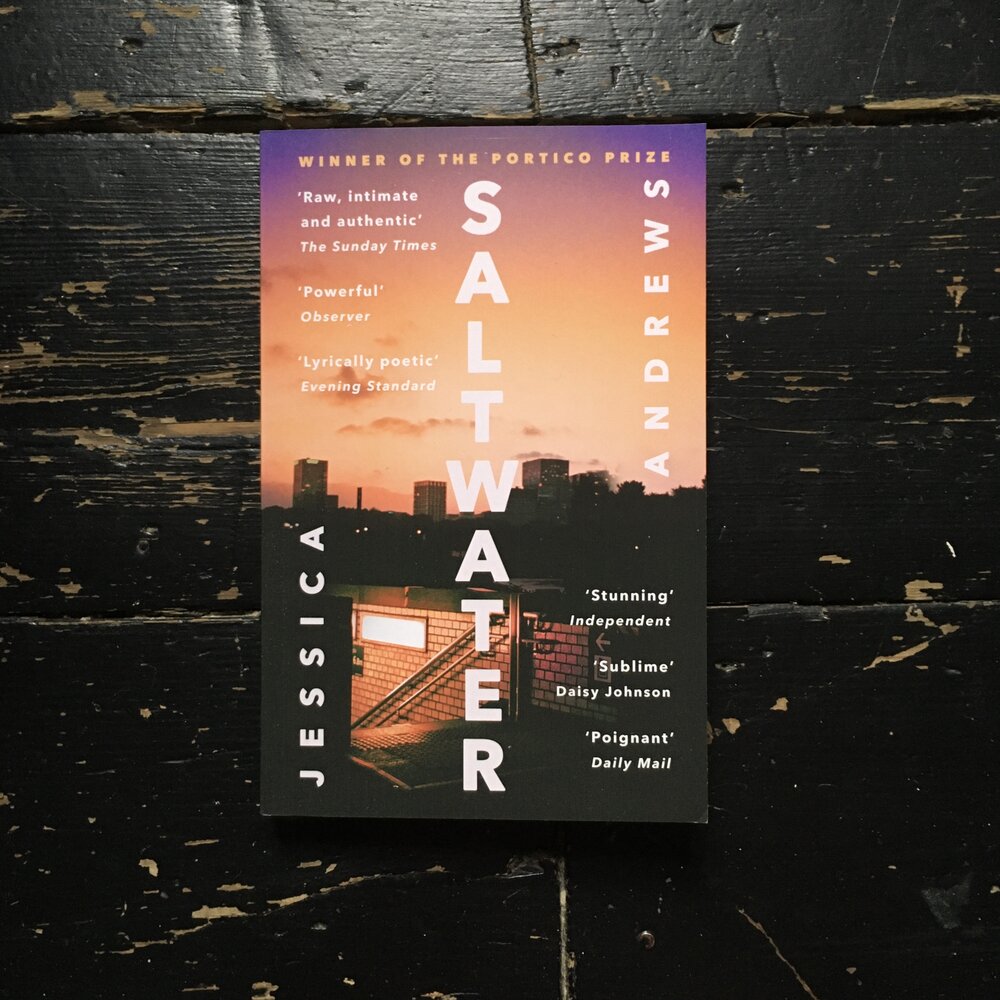
Saltwater – Jessica Andrews

This debut novel by Sunderland writer Jessica Andrews won the Portico Prize for fiction in 2020, an award explicitly about representations of The North. As an exiled Northerner, and a North -Easterner like her at that, the idea has a lot of traction for me. The North is a different country, even in these days of the crumbling Red Wall, and is generally either underrepresented or misunderstood. The other pull of the novel is that it is about a working-class woman’s experience of university education, of moving away from her Sunderland home to live and study in London, and her struggles to adapt to a very different set of people, with different assumptions, beliefs and values.

Even in 2021, literary representations of working-class life are as rare as hen’s teeth (Shuggie Bain a notable recent exception), so a new one like this is to be welcomed. What makes it even more special is that it’s so good. So very good. The novel is structured to tell the story of Lucy in three distinct parts: her upbringing in the North East, with family connections in Ireland, her experiences in London as a student, and her flight back to Ireland, undertaken as an escape when the contradictions of her two worlds become too difficult to handle. It’s a first person narrative, but unlike so many examples of that most fashionable of styles, it is expertly done. The first person voice is authentically that of the character, not of a literate and well-educated author, and it takes us to the heart of the matter. That is what it is usually intended to do, but so often it fails miserably.

The three separate story strands are intertwined, and the reader has to do a lot of work to untangle them. In the same way, there is the usual obliqueness that is de rigeur in contemporary literary fiction. (Heaven forbid that anyone should ever just tell a linear story any more. Now that would be truly shocking) Sometimes that technique is tiresome and serves only to make rather dull material (characters, relationships, settings, themes, incidents) a little bit more interesting because as a reader you are transformed into something of a detective. An absence of anything as old fashioned as a plot is replaced by the efforts of the reader to discover a story for themselves.  Very often the effort of textual sleuthing isn’t worth the effort for what is eventually uncovered, but here, nothing could be further from the truth. The melange of techniques works beautifully, and embellishes the story, makes it more vivid and meaningful. There’s a poetic sensibility at work in Andrews’ exquisite prose which is by turns spare, rich and luminous. It gives the material, clearly rooted in autobiography, a sparkle such that at times it sings off the page. The technique of intertwining the stories is interesting as well, with a little touch of Kerouac in it. Apparently, Andrews wrote three entirely separate stories, printed them off and then cut them up and spread them around the floor of her house before experimenting with the sequence. Who needs a word processor?

The end result is a debut novel that is a shimmering triumph. Working class alienation via education is an old theme of the post war years, but here it is transformed into a thing of beauty. Andrews is clearly someone we will be hearing more of in the future. Personally, I can’t wait for her next one.