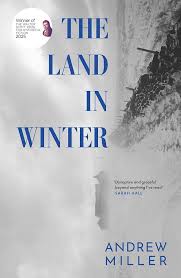
The Land in Winter – by Andrew Miller

I’ve always believed the hierarchy of fictional respectability is just another manifestation of keeping the oiks in their place. Like the concept of a fine palate when it comes to food, having good literary taste is a device to be able to confidently feel and express your own superiority over the lumpen masses. At the top of this pyramid of worth, sits Literary Fiction, smoking a fat cigar, and flicking the ash at the lower classes s/he straddles: reading group fiction, detective novels, romance, horror, sci fi, through an ever-multiplying collection of genres and subgenres, ending in the sludge of graphic novels and comics.

You just need to give your head a shake to see that literary fiction is just another genre, with its own conventions and expectations. Language is privileged over plot, obscurity is King (or Queen), ideas rub shoulders amiably, sides are resolutely not taken, and difficulty is wholeheartedly embraced. If you can make the reader feel they are missing the point, that they just don’t get it, you’re on your way to the shortlist of some prestigious literary competition or other.

But then, every now and again, a literary novel comes along that stops me in my tracks and gives pause for thought, as previously unshakeable theories begin to teeter and the cracks spread. This one is the latest offering from Andrew Miller, The Land in Winter. He’s carved a niche for himself as a writer of historical fiction, comfortably sitting at the literary end of the spectrum, rather than the Brother Cadfael end. Novels such as Pure, and Now We Shall Be Entirely Free showcase his undoubted talent as far as establishing interesting characters and subtly drawn relationships in an entirely authentic and credible historical setting.

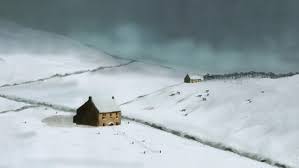
He’s done it again in The Land in Winter, but this time he has chosen an era still within living memory: the early 60s. To be more precise, his novel is located in the winter of 1962/63, a period that has entered the myth of our island story as the hardest winter since the frost fairs of the early 19th century.

This was a time when the whole nation was cut off under Impossibly deep snow drifts for months on end, from December until March/April. I was about six years old at the time and have vivid memories of walking to school through trenches dug in the snow on the pavements that went above my head.

It was a time before the swinging sixties. Pre-Beatles too, at least as far as their impact on broader society. Miller captures the grim, narrow atmosphere perfectly. This was a black and white England, before technicolor, still uncomfortably close to rationing, still in the grip of deference, hypocrisy and snobbery.

The book starts obliquely, in the grand tradition of literary fiction, with one patient at a residential psychiatric hospital, unable to sleep in the middle of the night, discovering the body of another, a patient who has committed suicide. Then they disappear from the novel completely. They do reappear, much later, after four other characters have claimed centre stage for themselves. By the time they do come back, the book has turned into something rich, deep and powerful via Miller’s quiet, subtle prose.

They are two recently married couples, Eric and Irene Parry, and Bill and Rita Simmons living in the middle of the countryside in the west country. Eric is the village doctor, Irene a middle-class Londoner more used to a life of art galleries and literary discussions. Bill Simmons is a farmer, trying to make a go of his recently acquired smallholding with his recently acquired wife. His father is an Eastern European immigrant, vaguely connected to London gangland, who has tried to remove all traces of his origins, while Bill is trying to cut himself off from his family and set out on his own. His wife, Rita, a working-class girl who met Bill when working as an escort in a dodgy bar in Bristol is troubled by the voices she hears, left alone on the farm all day as Bill works all hours to try and make a success of what is likely to be a doomed venture. The two women, bored and lonely, become unlikely friends.

The stresses that Miller has rippling beneath the surface become heightened as the snow falls and an isolated community is even more cut off than before. everyone is confined to their own homes and the stifling conformity and boredom reaches a pitch.

Everything is set up for a drama centred on women being oppressed by conventional men, but one of the novels great strengths is its subtlety. There’s a lot more going on here than that. Each of the four characters is given equal weight – there are no victims, no baddies and goodies here. Miller manages to create sympathy for each of them.

It’s also, for all of its quiet understated subtlety, a book that, by the end, has been full of action. The difference here, though, is that in Miller’s hands, there’s not a whiff of melodrama over twists and turns that wouldn’t be out of place in a soap opera. The plot developments are all the stronger, and more impactful, because he turns the volume down. It’s an object lesson in getting the balance right: plot, character, ideas and language are complementary threads in a pleasing whole, producing a novel that continues to resonate long after the last page is turned. So, yes, there’s life in the old dog yet. Literary fiction can still prove its worth and relevance – just don’t diss the rest while you’re enjoying it.

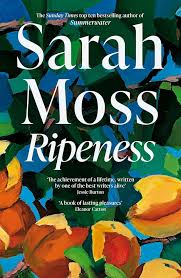
Ripeness by Sarah Moss

Professional Reader

What a lovely novel this is, from someone writing at the top of their game. Structurally and stylistically, it’s a treat, with alternating sections telling the stories of the same character, Edith, fifty years apart. The younger Edith tells her own story, in the first person, through the device of a lengthy letter to a child, to be read in the future, explaining the circumstances of the child’s birth and subsequent life. The sections dealing with the older Edith are set in rural Ireland and are told in the third person.

The sense of a whole life is given real substance by this technique, with the gaps and inconsistencies generating as much authenticity as the threads that clearly stretch unbroken through the fifty years that separate the two portrayals. What is the relationship between each of us and our younger selves? How much of our lives could have been predicted by the clues provided by our beginnings?

The book uses the two settings, 1960s Como and Ireland in the 2020s, to explore some weighty themes: Antisemitism and the fallout from the holocaust, refugees and immigration, what constitutes nationality and a sense of belonging, family bonds, conventionality versus bohemianism. All of it, though, is firmly rooted in character, relationships and drama. There are two major plot strands, but plot is not the narrative driver here.

It’s Moss’ gorgeous prose that drives the reader on. Well, this reader anyway. (although in the second half, there were a couple of occasions when I felt the reflective lyrical writing slowed the narrative down. I’m nitpicking, but hence the four stars, rather than 5). Beautiful descriptions of both the countryside around Como and small town/village life in the Republic are subtly blended with Edith’s reflections on first growing up and then getting old. Both are done brilliantly – her awkward, self conscious sense of being out of her depth in the artistic commune in Tuscany is as wonderful as her sense of self and certainty as an older single woman still grasping life with both hands. It’s a very compelling portrayal of that truth that one of the joys of later life is the liberation of not giving a toss what other people make of you, and doing it without being a boor or a reactionary old fart.

Honestly, this is a must read book. Beautiful and thought provoking.

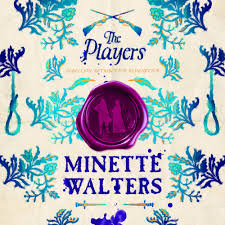
The Players by Minette Walters

An ARC review for Netgalley

Oh dear, what a disappointment this turned out to be. I hadn’t read Minette Walters for years, not since The Scold’s Bridle and Fox Evil. They were excellent: taught, tense thrillers/ whodunnits with real pace and verve.

After something of a hiatus, Walters, now 75, has turned her hand to historical thrillers. This latest one is set in  the 1680s in the dying days of King James II’s reign, taking in the Monmouth  rebellion, the Bloody assizes of Judge Jeffreys, and the peaceful transition to William and Mary. A fascinating, dramatic few years of British history that does not often feature in historical fiction. It should be a gift to a skilled and experienced novelist but Walters manages to turn this literary gold into something dull and dreary.

The main characters are excellent, (with some caveats): Lord Granville and his mother are scarcely believable as liberal aristos, whose driving concern is always for the little people, ensuring they get justice, no matter what the risk to them personally. It’s as ludicrous as the portrayal of above stairs folk in Downton Abbey who just love the plebs downstairs. It’s so well done however,and the two are such appealing characters, that disbelief is willingly suspended, and the reader finds themselves willing them on to succeed. The character of Lady Althea is also beautifully drawn as Walters explores 17th century attitudes to disability. The love interest is really well done, with Althea’s shyness and reluctance to believe in Granville gradually overcome. It’s a bit of a cop out however, as Walters shies away from any scenes where love is declared and we are left a little cheated as we are simply presented with the aftermath in the epilogue.

The main problem here is that Walters seems to be obsessed with her research into the period, hence the number of reviews that home in on that. “Immaculately researched” is always a bad sign in my opinion. It shows that research has become an end itself, rather than serving the story. There are interminable scenes where she goes through the mechanics of the legal system, transportation, local and regional, explaining in great detail how those people awaiting trial for sedition could be sprung from captivity. Perhaps Walters is too big a figure to be edited, but this is exhibit A for assertive intervention. Without it, we’re left with a novel that’s at least a hundred pages too long. Shame – the characters, plot and historical scenario promised much but deserved a lot more. Maybe next time.

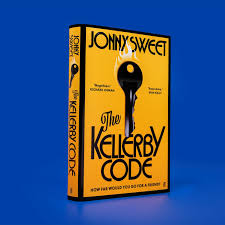
The Kellerby Code by Jonny Sweet

Writer walks into windowless, dusky room and switches light on. Room gets darker. The End

I’d been meaning to read The Kellerby Code since the beginning of Summer. I’d noticed a few references to it in the weekend supplements, and then it began to be more heavily promoted with Richard Osman’s one word verdict: Genius. On further investigation, it seemed that the book was a comedy, set in a Country House, with shades of Evelyn Waugh and P G Wodehouse. It sounded delicious, just right for two weeks away in the Mediterranean sun.

Such is the power of marketing – selling a book in shedloads, even though it falls apart virtually the minute you begin to read it. Its only possible virtue is its future role in Creative Writing courses as a manual on how not to write a novel.

I know this sounds cruel. After all, it is Mr Sweet’s debut novel and budding writers need gentle encouragement, but I really think you can put away your sympathy and save it for more deserving cases. He has, after all, sold millions, made a fortune, and has nicely set up a second career to slot alongside his night job as a Stand Up comedian, probably now with a multi book follow up deal.

The TV adaptation can’t be far away. And, to be honest, that will probably be much better than the book, because no one would have to read it and…….How can I put this politely? This is very, very badly written. Thankfully for you, dear reader, I’ve already read it, so that you don’t have to.

SPOILER ALERT!

(But actually, dont worry, You’re never going to read this book…)

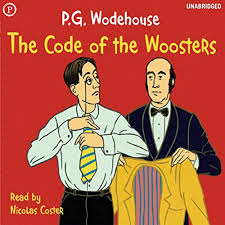
Although both Brideshead and  Blandings are both referenced in the book, and the title is an echo of The Code of the Woosters, the real comparisons are with the film, Saltburn, and Patricia Highsmith’s The Talented Mr Ripley. It’s about a lower middle class young man, Edward Jevons, who falls in with a posh, entitled, aristocratic set at Oxford, whose leader, Robert, takes him under his wing and simultaneously patronises and exploits him. The gilded crew naturally fall into highly paid jobs in the arts and finance, via their discreet network of patronage and influence, while Edward, embarrassing oik that he is, is reduced to tutoring the ghastly offspring of the Chelsea and Knightsbridge elite. His real job, however, is to be Robert’s unofficial factotum and gopher, being expected to fulfill a myriad of trivial bits of domestic administration, unpaid, at the drop of a hat. This is done under the heading, Friendship, apparently, because Robert is grappling with the higher problems of being an up and coming theatre director and has no time to wipe his own arse and he doesn’t much care for getting his hands dirty.

Edward is completely besotted with this world, leaving his roots behind him, and is completely blind to the fact that his new posh friends actually despise him, and refer to him as Jeeves behind his back. The situation is complicated by the fact that he is totally in love with Stanza (yes, really), more posh entitled totty who treats him like dirt and things really begin to take off when Robert starts going out with her and eventually marries her. The second half of the book brings a murder, which is the trigger for Edward’s descent into nervous breakdown territory and several more, ludicrous murders.

The plot  is actually quite engaging, and even when the coincidences and hugely overblown prose threatened to make me chuck the book against the wall and admit defeat, wanting to have narrative resolution kept me going. The characters are uniformly ghastly. I read the whole book without incurring any warm feelings or concerns about anybody – not the vile poshos, and certainly not the wholly pathetic Edward, whose whinings and self pity produced a dreadful toxic cocktail of a personality that was more repellant than sympathetic. In the end, I felt the Bullingdon club crowd were actually too nice to him

The “twists” and “turns” of the plot were laughably poor. At times we were asked to believe that Edward, presumably our hero, had never read or seen a contemporary detective drama and was completely unaware of CCTV, DNA, fingerprints or even the basic fact that the police might ask him some questions and then triangulate his answers against what other witnesses/suspects had said. None of it matters though – there are so many loose ends and plot holes, so many inexplicable decisions made, that the real pleasure of the book was seeing what the next ridiculous plot twist was going to be. The concept of suspending disbelief was taken to new heights, such that in the end it became not a matter of suspension of disbelief but total disappearance of belief. This is a book that rests entirely on blind faith, like a religion, but without the rewards religion purports to offer. Textual Fundamentalism is the way forward. It stops hard pressed writers having to give a second thought to all those tiresome ideas about credibility, motivation, or authenticity.

But the worst is yet to come. My God, the prose, dear reader, the prose. The analogy that pushed its way into my consciousness, as I was ploughing through this car crash of a book was that of the IKEA flat pack piece of furniture. You get the damn thing home and open it up, and then diligently read through the language-less instructions.

Bolts and screws of various sizes are included in separate plastic bags, but it’s not until you have nearly constructed the thing that you realize that it doesn’t fit together and that you’ve used the wrong screw for the wrong bit of MDF. Here, Mr Sweet discovered that he’d been sent a big bag of commas and a tiny bag of full stops.

Sentences stagger on, many clauses lashed together by commas, desperately searching for a full stop, until they collapse, bleeding and exhausted. This is someone with a nice turn of phrase and a vocabulary that they are secretly very proud of, but who is determined to show you everything they can do. In every sentence. Every time. As a former GCSE and A level English teacher, my greatest priority was to impress upon my students the utter beauty of the short sentence, and the absolute necessity of a variety of sentence lengths and structures, so that there was some sense of rhythm to the whole thing. So that it sounded good when read aloud and felt nice in the mouth. Here, it sounds like radio static and tastes like a mouthful of Brylcreem. Back in the day, if little Jonny were one of my students, his submission would have tested my powers of constructive feedback and diplomacy. 

My sincere suggestion to you, dear reader, is don’t bother with this. Watch Saltburn instead. Or watch and read The Talented Mr Ripley. And for advice on how to write sublime sentences, read some Wodehouse. You know it makes sense.