Book 2 in the Yngerlande Variations trilogy published by Burton Mayers books
The long awaited sequel to “The Watcher and The Friend” by R J Barron is published this Friday by Burton Mayers Books. “A Cold Wind Blows” is the second book in the trilogy, The Yngerlande Variations, set in the parallel world of Yngerlande in 1796. Here is the synopsis of the story so far. Warning! Spoiler Alert! Don’t read the summary if you have not yet read the first book and want to do so.
Tom has been summoned to help Silas and his allies defeat the relatives of the old King, Oliver and Jacob, who want to overthrow Queen Matilda and take the country back to a time when racism and discrimination were ever present. His task is made more complicated by the fact that he discovers that his sister, Grace, is alive and well in Yngerlande and is living there as a reward for her service when she was the Friend of Yngerlande. After many adventures and dangerous scrapes, they succeed, and Queen Matilda maintains her rule of peace, love and equality.
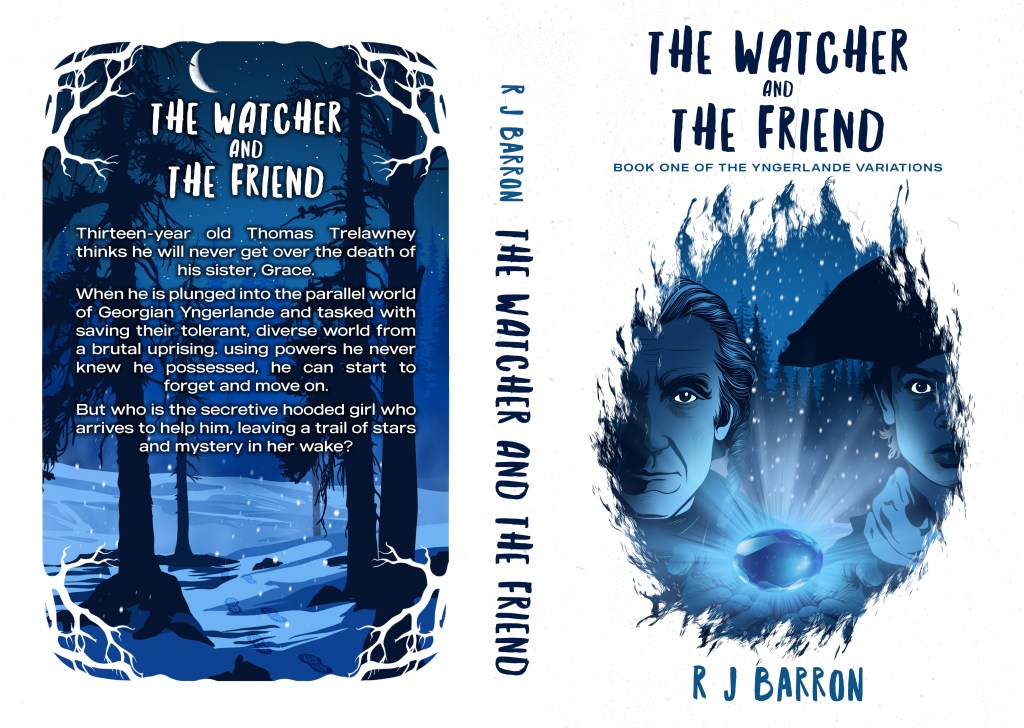
In “The Watcher and The Friend”, the first book in the trilogy, thirteen-year-old Thomas Trelawney is spending Christmas at an old Rectory on the North Yorkshire coast. It is the family’s first holiday since the death of Tom’s sister Grace. Here, Tom discovers a portal to another world and travels through it to Yngerlande, in 1795, with his cousin, Dan. Yngerlande is a parallel world to England, but is a much more diverse, equal society.
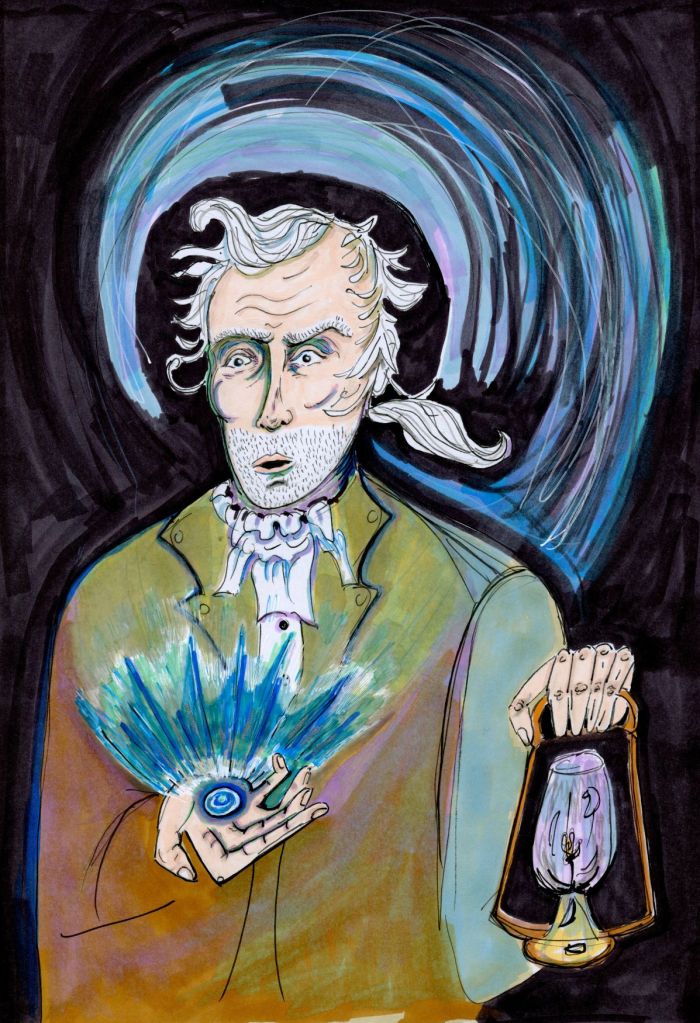
He meets Silas Cummerbund, who is The Watcher, the mysterious character who guards the portal between the two worlds. He tells Tom that he is the new Friend, the person whose role is to act as the link between the two worlds. This second book continues the story, as Oliver and Jacob return with another attempt to take back the crown of Yngerlande, only this time they are more dangerous and better prepared.
Silas has spent the summer training Princess Gaia, aka Clara to use her magic powers to their full extent, to be ready for any further threats to Yngerlande, but they are taken by surprise by the boldness of Oliver and Jacob’s new plan. A mysterious new character, Shrike, is introduced. He is by turns charming, dangerous, and duplicitous. Whose side is he really on? Even by the end of the book, that question is not clearly answered. One thing is certain, however. Thomas Trelawney is recalled from England to Yngerlande when everything looks lost. He does not trust Shrike, not least because Grace has fallen in love with him. Does Shrike have feelings for her, or is he just playing a clever game for his own ends?
“A Cold Wind Blows” begins eight months later.
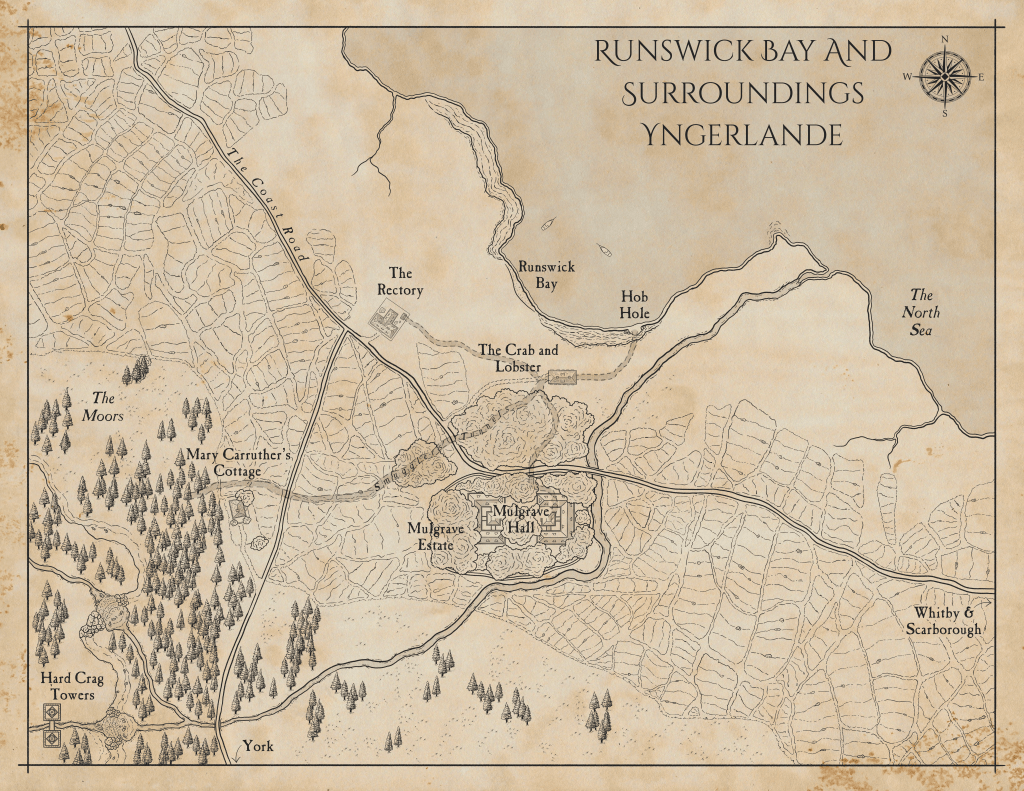
The story takes in the wild North York Moors, Runswick Bay, Mulgrave Hall, the crumbling ruins of Hard Crag Towers, with its menagerie of bats, steedwings and owls, and the ancient city of York. It’s full of adventure, peppered with cross dressing, betrayal, vengeance, disguise and murder, with a liberal sprinkling of romance, friendship and love.
This is a must-read YA adventure, that is aimed at everyone from 9 to 90 who loves Fantasy novels. It’s available from the following links:
Regular readers of this blog will know that, if nothing else, it is eclectic, covering the highways and byways, the nooks and crannies of human interest. Fiction, Politics, Football, Writing, Theatre, Film, Music, original short stories – all human life is here. So you will forgive me, I’m sure, if this latest blog is unashamedly devoted to self-promotion. After a hiatus of a couple of years, my podcast Telling Stories has returned. When the kids move back out, the old recording studio moves back in. I’ve used it to contribute to Librivox, which in essence is an audio book version of The Gutenberg project. Anyone who passes the technical recording test can volunteer to read books that are out of copyright, and there is a vast library of free audio books, produced by said volunteers.
If you like listening to audiobooks, give this a go. It’s barely publicised, and the quality of the readers is varied, but with a bit of trial and error, you’ll be able to find something to your taste, that doesn’t offend your rigorous standards of fiction, technical specs and reading voice. It’s a really worthy project and deserves more support. Check it out at Librivox
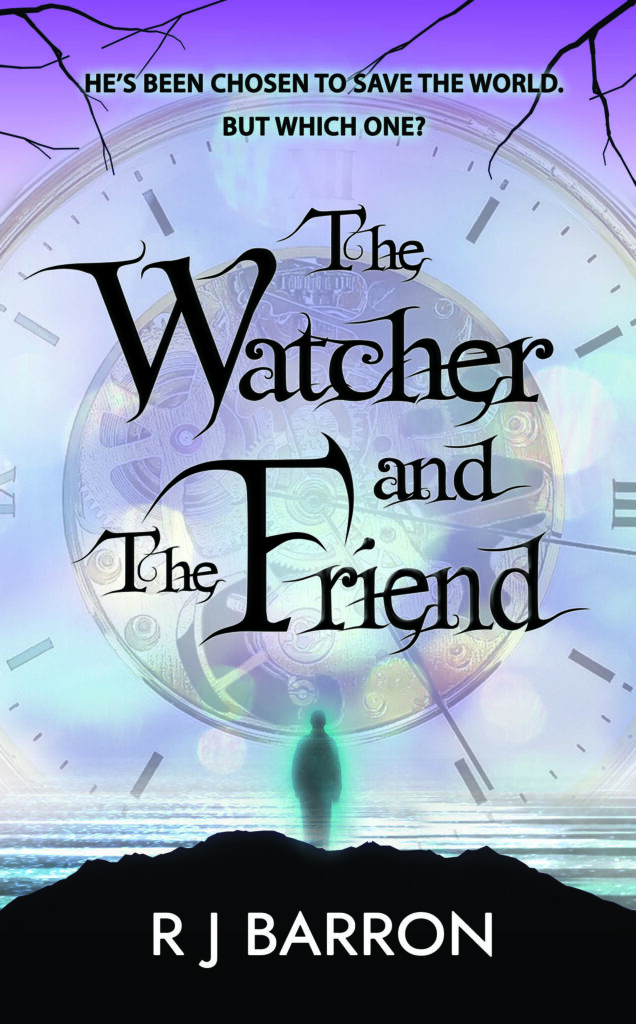
Another project even more worthy of support is my Podcast. I’ve resumed the momentous task of turning my YA book, The Watcher and The Friend into an audio book, via regular recordings on my podcast, Telling Stories. I’m trying to post a weekly chapter. Have a look at the ones I’ve done since the new studio arrived. The links are here. Try it and pass it on if you like it. Or even if you don’t.
Make Sure you listen to the episodes in the right order! If you havent started yet, follow the links to the beginning and click follow on the Spotify Podcast page
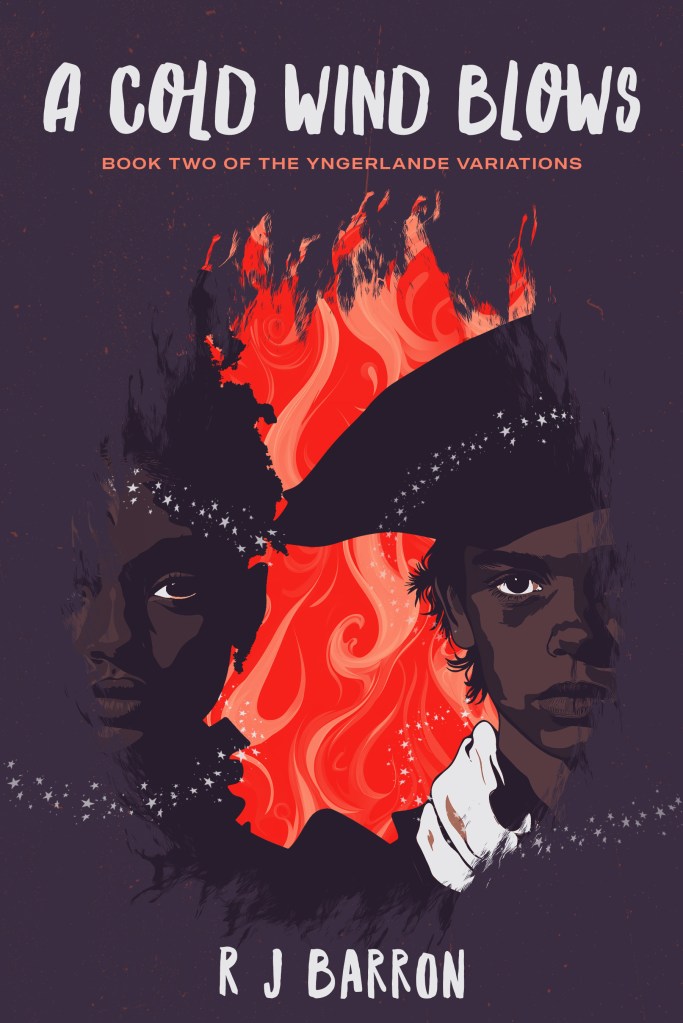
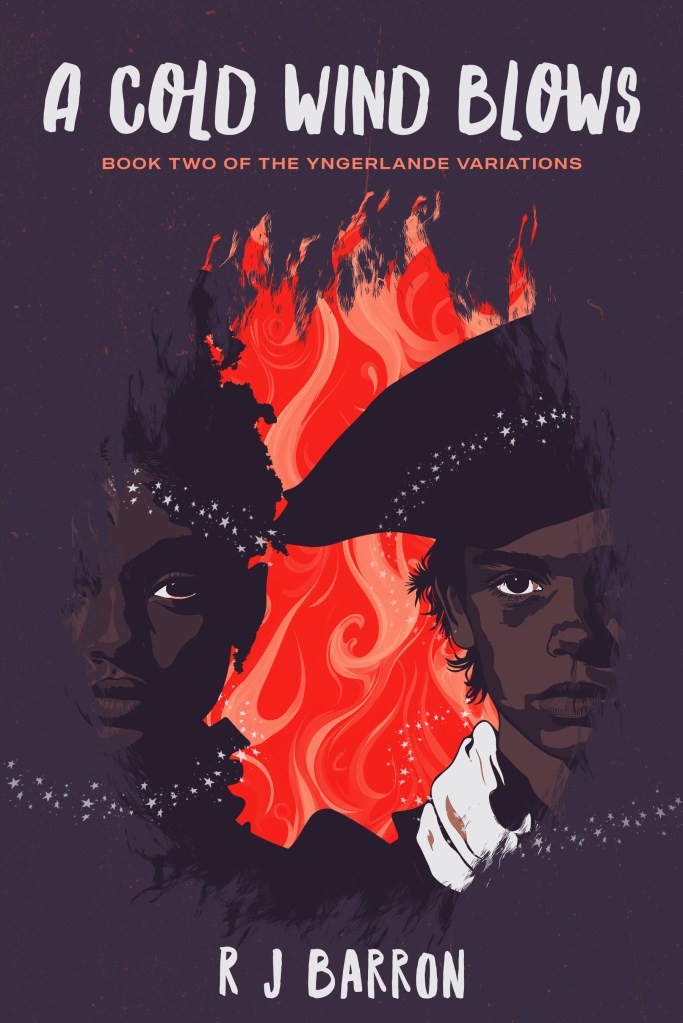
A Cold Wind Blows – Book 2 of The Yngerlande Variations
Finally, some exciting news. The sequel to the book is scheduled to be published later this year. It’s called A Cold Wind Blows, and I’m very pleased to be able to give you a sneak preview of the new cover – designed by me and produced by the very talented Youness Elh. More on this later!
How what we read always bubbles up into what we write, even when we aren’t aware it’s happening
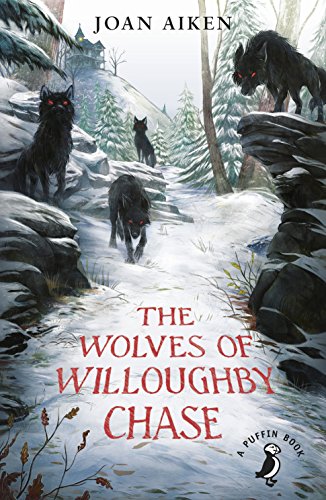
A guest appearance in the blog today from children’s author, R J Barron, writing about the links between his new novel, The Watcher and The Friend and the work of Joan Aiken, in particular, The Wolves of Willoughby Chase. The connections between what we read and what we write, even years later, are mysterious and powerful. Read on for more
Standing on the shoulders of giants
In the first part of this blog, I wrote about my serendipitous discovery, over many years, as a teacher and a parent, of Aiken and the Wolves Chronicles. Here, I’m going to look at the links between her wonderful books and my own children’s debut, “The Watcher and The Friend”.
It wasn’t until much later, after my book was written, that I realised the connection. Even when my editor had explicitly asked me about the inspiration, and the books I would compare it with, I did not come up with “Wolves of Willoughby Chase”. Budding writers will be familiar with this part of the process. Agents are thinking about selling, marketing, promoting. And that leads them to think about genre. What other books is your book like, so we can directly appeal to lovers of those books in the hope that they will give your book a punt? I said Narnia (The Grandfather Clock) His Dark Materials (parallel world, moral dilemmas, emerging feelings between young protagonists), Thomas Kempe (ghostly messages written across time and space). And it’s true, there is a connection between all of those books and my own. Originality is a very overrated quality in my opinion. Everything is connected, and ideas breed other ideas. The Jim Jarmusch quote is a useful guide here: “Authenticity is invaluable; originality is non-existent.” In other words, whatever you steal, make it your own. If you’re alive in the world, it’s impossible to produce something original. You’d have to lock yourself away for a lifetime to achieve that, like a jury in a murder trial. And for what? Instead, we should celebrate the connections between our own work and that of others, even connections that have emerged from the sub-conscious.
And the sub-conscious was exactly where my ideas lurked, in the shadows, skulking. But now they are out, wide-eyed and blinking in the sunlight, the connections are perfectly clear to me. Here they are:
Alternative History
In Aiken’s novels, the strength of the parallel world she creates is the fact that England’s real history has been tweaked only very slightly, as if an acetate copy has slipped on top of the original. The effect is disconcerting. The reader feels as if they are standing on shifting sand and everything, including the things we take for granted, has to be re-assessed, re-evaluated in some way. The power comes not from the precision of the words themselves, but the suggestions held by the white spaces in between the words. Everything seems to be at once familiar and strange at the same time.
The time shift in “The Watcher and The Friend” is different. At first it appears that Tom has simply gone back in time, to the Runswick bay and North York Moors of 1795. The clue first appears in Tom’s reaction to historical England, as we are told that there was something not quite right about it, something he couldn’t put his finger on, but which jarred, or irritated like a tiny pebble in one’s shoe. The reason he couldn’t work out what it was the fact that it was something so familiar to someone who lives in South London in the early twenty first century – the absolute diversity of the population. All kinds of people from all over the world, living relatively harmoniously together. This state of diversity and equality is extended in The Watcher to all groups – women hold positions of power, same sex relationships are commonplace and so not worthy of comment. As we subsequently learn from an amused Silas Cummerbund, Tom has journeyed not to England in 1795, but to Yngerlande, a parallel world, also in 1795, where there is perfect equality. There has been no history of Empire, colonisation or slavery, and therefore power relations have not developed in the same toxic way as in our own world.
Settings – Country side and weather
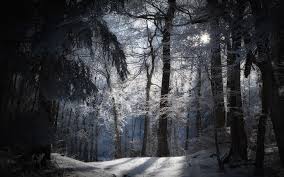
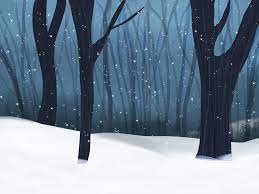
The Wolves of Willoughby Chase appears to be set in a mini ice age, with permanent ice and snow serving as a perfect backdrop to the wolf packs that are terrorising the country. This is very deliberately echoed in The Watcher and The Friend. One early chapter, The Frozen North sets an atmosphere that can be so powerful in children’s fiction, and descriptions of snow, in both countryside and “Georgian” towns and villages, are used to provide an atmosphere that is both beautiful and harshly challenging. For many children in the UK, apart from those who live in remote areas in the hills, snow is an unfamiliar occurrence and one which is mainly evocative of classic children’s books read or films (such as the Harry Potter series) seen. It’s a powerful motif of adventure, something that is both thrillingly beautiful and to be escaped from at the same time. The escape from a snow bound forest, and its attendant dangers, into a domestic setting with food and warmth and closed doors, fulfils a most basic human desire for security.
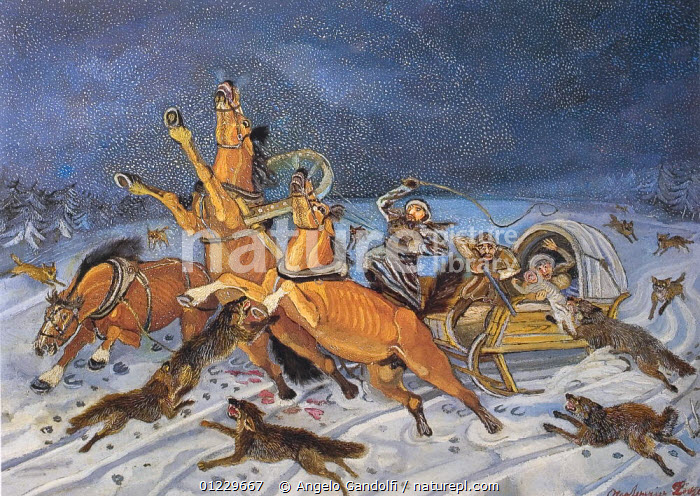
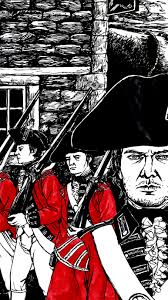
In The Wolves of Willoughby Chase, the early escape back to the big house after being pursued by wolves that descend from the hills into the estate is a key example of this. Lucy’s encounter with Mr Tumnus in The Lion, the Witch and The Wardrobe is another. In The Watcher, such snowy scenes of pursuit and escape play a significant role in the novel: in the wolf attack on the lonely snowy roads across the Moors to the coast; the scene where Della, Tom, Dan and Clara emerge from the smugglers’ tunnels high up on the top of the Moors, to encounter a group of Redcoats who have tracked them down in a thick, snowy forest; and the snowy streets of York on Christmas Eve, thronged with Redcoats nervously on guard outside the Queen’s Christmas Ball in The Assembly Rooms. All of these echo Aiken’s deployment of memorable settings to create a strong and vivid sense of place.
Creatures – Wolves, Steedhorns and Steedwings
The combination of a parallel world and a historic setting allows the writer to give full vent to their imagination as far as reality is concerned. Creatures that come from old folk and fairy tales naturally inhabit this land. The archaic setting gives permission for imagination to flourish. These creatures are surely the kind of things that would have existed in this strange alternative universe. Aren’t they?
And so, very real and very frightening wolves, are joined in my book by Unicorns (or Steedhorns, as Yngerlande terms them) and flying horses (Steedwings). Not the sickly pink, disneyfied versions. No, these creatures are large and rough and shaggy, with brown coats and matted hair. The Steedhorns are commonplace and considered a pest by the local farmers, because of the damage they do to crops and the environment whereas the Steedwings are rarely seen and thought by most people to be the stuff of old tales.
In Aiken’s version of England the same cast of wild and fierce animals are present as a source of danger: primal, terrifying, ancient in the shape of the packs of wolves that roam the countryside with a careless lack of fear as far as human beings are concerned. Casual references to bears abound, along with flocks of sheep, (rescued from the slaughterhouse) a pink whale and many individual creatures that tag along after Simon, a prototype eco warrior, years ahead of his time, is the future King of England with an uncanny affinity with animals of all kinds. For children, animals in fiction are both a blameless repository of affection, and an echo of an ancient wilder world than their own. Aiken taps into this unerringly – perhaps she was an animal lover herself?
Strong female characters
Dido Twite is possibly Aiken’s greatest creation. Missing presumed drowned in the North Sea at the end of Black Hearts in Battersea, she reappears mysteriously at the beginning of the next book in the series, Nightbirds to Nantucket, on board a whaler headed towards the Newfoundland coast. The story of her rescue does not detain the reader for more than a paragraph or so and no-one who has read Black Hearts needs to know more than that, so delighted are they that Dido has returned. The legend has it that readers were distraught at the end of Black Hearts at the thought that Dido might have died and wrote to Aiken begging for her resurrection. I love the fact that this was not part of a grand plan on behalf of the author but instead it emerged at the behest of her readers. Proof again that reading is a social act of reconstruction for each individual, and that once a writer has let their work go, it no longer belongs to them, but has an independent life of its own, being constantly regenerated every time it is read afresh. And once Aiken had been diverted down that path by her readers, a whole warren of paths and turnings sprang up that had not been envisaged when The Wolves of Willoughby Chase was being planned. This is the very nature of the writer’s imagination. The act of writing begets deeper, richer, better writing; better than could ever have been planned, no matter how meticulous the creator.
The Dido that returns does not disappoint. Feisty, independent, brave, loyal, she brings a young, and as yet unjaundiced, eye on the idiocies of the adult world. The book sings whenever she is on the page, not least because of Aiken’s fabulous inventiveness in terms of Dido’s language. Even without speech tags or description, the character is immediately identifiable through her dialogue alone. Croopus! What a creation!
Like Aiken’s books, the most important characters in The Watcher are female, despite the fact the protagonist, Thomas Trelawney, is a thirteen year-old boy. As well as a group of younger female characters (Tom’s sister Grace, the mysterious girl Clara, who trails stars in her wake, Della Honeyfield, the dashing coachdriver and her partner Dr Amelia Church) the book paints a positive portrait of an older woman, Mary Carruthers. As Silas Cummerbund tells Tom early in the book, “With age comes wisdom, Thomas. Most of the old women I know are fearsomely clever, and the world would be a better place if people listened to them a bit more often. Your world and mine.”
A world under threat – plots and rescues
First and foremost, The Watcher, like the Wolves Chronicles, is an adventure, an entertainment. The story carries important messages about the world we live in, but the book stands or falls on the story alone. If the reader is not engaged, no message of any kind, no matter how pressing and relevant it is, will have any purchase. In the alternative history that underpins the stories of the Wolves chronicles, the ongoing struggle for power of the Hanoverians versus the Jacobeans provides much of the drama of the plots. Revolution, counter revolution, plots hatched and foiled ( usually at the last minute), hiding places, treachery, chases, discoveries – all of these regularly punctuate the pages of the novels in a breathless chase towards a final resolution. They are exciting adventures and readers turn the pages eager to experience the next twist or turn.
And so it is with The Watcher, I hope. I make no claims by this comparison – it’s up to readers to respond. I’m just struck, after the event, of a similar technique, a similar structure that underpins my book. In The Watcher, Yngerland in 1795 is a diverse, tolerant society. The only hierarchy is that generated by money. Apart from that, all “minority” groups are treated with equal respect and have an equal place in society with equal status. It serves as a model for our own world, particularly when it comes under attack. The “old Guard” – white rich landowners, with the figurehead of the grandson of a King who had been deposed many years earlier – secretly try to mount a coup against the Queen, Matilda, a black woman who represents everything they despise. The old guard want to preserve their interests, establish their privilege and consign all other groups to servitude. The Watcher, The Reverend Silas Cummerbund, has an ancient role of guarding the portal between Yngerlande and England, and working together with the new “Friend”, Thomas, they work to foil the plot. Their struggle to save Yngerlande involves wolf attacks, invisible ghosts, chases through smugglers tunnels, capture in dank cellars and flight across a snowbound North York Moors, all against a background of a snowy five days in the run up to Christmas. They succeed, of course, winning this first battle, but the war is clearly not over.
This blog has been a musing on connectedness and intertextuality. If you’re a teacher, a reader or a writer, I hope you’ve got some inspiration from this reaffirmation of how important children’s fiction is and how what you read as a child resonates down the years. I loved writing The Watcher (and I’m looking forward to the next four volumes in the series) and it’s clear to me now that the enjoyment I derived was in part down to the pleasure I had had years before in reading Joan Aiken’s books. If you haven’t read them, let me enthusiastically encourage you to begin. You have a treat in store. And as a writer taking the first faltering steps towards a readership, it would be remiss of me not to encourage you to do the same with my Aiken-inspired first children’s novel, The Watcher and The Friend. See if you can spot the connections as clearly as I now do myself.
If you’re interested in The Watcher and The Friend, try a lttle more. Click the links below either to read the first few chapters, or, even better, to buy a copy.



 The Old Grey Owl