Romance is not Dead

The new album by Fontaines DC is alive and kicking
More than five years worth of water has disappeared under the bridge since Dublin’s finest, Fontaines DC, released their debut album, Dogrel. There have been two more since then – A Hero’s Death and Skinty Fia, but neither of them generated the same excitement as their first, with its originality and verve.

They arrived heralded as nouveau punk and although those comparisons are always inevitably flawed and misleading, there was something in that characterisation. That album was many things but, like the original punks, one thing it was not, was polite. There was an authenticity and a couldn’t-care-less attack to it. This is us, it seemed to declare, and we don’t care what you say about it. This was my review of it at the time:

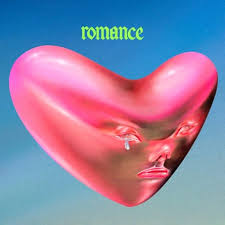
But now comes their fourth studio album, Romance, and it’s a game changer. Old heads with old hands now and they have produced something of rare beauty that triumphantly confirms what that first album promised: They’re gonna be Big. The start of the album generates fear of disappointment, with the title track, Romance. Moody, doomy synth washes with dark, dark lyrics: 

Into the darkness again,

In with the pigs in the pen

Don’t worry! It’s a deliberately misleading start. It’s not doom and gloom that await you in this album, it’s joy and beauty. This is not a band trying to curry favour with its potential new audience, playing it safe. It would have been so easy to start the album with Favourite for some uplifting poppy melody, but that is a trap they sidestep, preferring instead to make demands on their fan base. And they are demands that are worth responding to. After three listens, the subtle pleasures of vocals, lyrics and atmospheric layers lodge themselves in your brain, and you’ll wonder why you doubted them in the first place.

The album goes from strength to strength. The single, Starburst, is the perfect antidote to the slow gloom of Romance. First, strange mellotron is studded by liquid arpeggio piano notes that ooze a grave, poignant portent. Then the uptempo beat and word heavy, almost rapping rhythmic vocals – this will be the standout track on first listen. But that won’t last, as the subtle pleasures of all the other tracks begin to elbow you for attention.

The melodies are gorgeous, the lyrics subtle and clever, the vocals sweet, particularly the unexpected harmonies that punctuate many of the songs. It’s a repeat of the Black Keys scenario, back in 2011. After releasing three well respected hard electric blues rock albums, that clocked up mega critical approval but few sales, the Black Keys suddenly discovered how to write classic pop songs with killer hooks and choruses and came up with El Camino. Still quintessentially Black Keys, with their DNA pulsing through it, it was a compulsively fabulous commercial record. So it is with Fontaines and this album. It retains its Dublin accent, but uses it to tell better stories that will pull in a bigger audience. They look a little different as well. But then, don’t we all….

Fontaines now…

Fontaines then…

The two standout tracks for me at the moment have that unmistakable classic quality of great songs: they sound like they’ve been discovered, excavated in an archaeological dig rather than having been newly created. It’s as if they’ve always been here. Have a listen, first to the sublime “Bug”.

Then the closing song of the album, “Favourite”. In a pre-streaming age, this would have been the opener to pull the audience in, on vinyl or CD. Lovely shiny guitar riff and cleverly worked chorus, this is classic pop.

Do yourself a favour and follow these instructions.

  1. Play the two tracks linked here.
  2. Buy the record, or download it.
  3. Try and get a ticket to see them live.

You know it makes sense
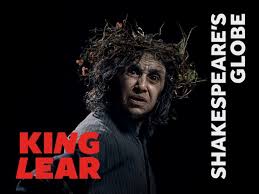
King Lear at The Globe – Shakespeare at its very worst

A first return to The Globe after a pandemic-induced absence of a couple of years made me long once again for lockdown. As someone who was an English teacher in London for about 35 years, I’ve been a regular visitor, both on my own and with students. In the days of Mark Rylance as Artistic Director it was invariably a thrilling experience, with the pleasures of the authentic setting enhanced by the quality of the productions.

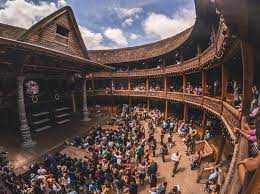
In recent years, however, a trip to The Globe (pictured right) has been something to be endured rather than enjoyed. More and more it has come to resemble just another version of famous world city tourism, an experience to tick off the list made by people on a schedule: The Colosseum in Rome, The Louvre in Paris, The Rijksmuseum and Anne Frank  in Amsterdam etc etc.

I knew nothing of the production before we booked. We originally wanted to see Much Ado, but that was all sold out. There were tickets for Lear and as far as I could  see, very little publicity for it. I was amazed to find out, when digging a little deeper into the production, that this was a reprise of a famous role for Kathryn Hunter, who first did the role back in 1997, also for director Helena Kaut Howson. That, apparently, was a groundbreaking, brilliant production and performance.

It was very hard to tell from this feeble revival. I have to begin this merciless hatchet job with a tiny caveat. We have both got to the advanced age where subtitles are necessary for us to be able to follow any drama on TV. That undoubtedly contributed to the difficulties we both had with this performance, but to be honest, by the time we walked out of the theatre at the interval, I was actually glad I couldn’t quite hear the lines clearly. That would have just served to underline just how much the play was being brutalised. 

We were also badly served by our seats -The middle gallery,  level with the two main pillars of the stage – so for seventy percent of the time, the speaking actors were facing away from us, and their lines drifted away into the summer’s evening air, to compete with the helicopters and jumbo jets that seemed to pass overhead every five minutes.

But all of this was just background annoyance. There are more substantial complaints to come. The story is complex, the language difficult, the characters and relationships hard to pin down. So a production has got to do the bread and butter of exposition much better than this. Clarity of verse speaking, costume, gesture, body language, props, scenery- all of these need to be used imaginatively to pin down what the scenario is from the beginning. Of course, the division of the kingdom, the three daughters and their declarations of “love” were established well enough (partly because they are so well known), but the subtleties  of the interplay between Edgar and Edmund, Gloucester and Kent, the husbands of the “bad” sisters, all of this and much more was abandoned to garbled verse speaking, knockabout comedy, and lots of stage business, with hammy actors walking around the stage for no apparent  purpose except to lend the lines some additional dramatic force. It failed miserably to lend any of it any dramatic purpose at all.

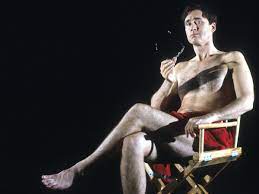
It was old fashioned  Nigel-Planer-Nicholas-Craig-style Actoring at its worst. (Nicholas Craig pictured left) Hand waving, strutting, movement across the stage with no discernible realistic purpose  – it all just screams, “We are doing serious Shakespeare stuff here.” This was also accompanied by full-on, shouting-the-lines,  Shakesperean declamation.

This was particularly the case for Regan. Or, in the case of Edmund, lines delivered in a softly spoken accent that made them very difficult to follow or to take seriously. He also seems to have been directed to play a lot of his lines for laughs, like his legitimate brother, Edgar, whose performance when he had “gone mad” was particularly ludicrous.

That appeared to be the default position. To give this difficult stuff more audience appeal, let’s make sure we mess about and crank up the physical comedy. It seemed to me to be totally inappropriate, and detracted from the drama and tragedy of the play. Unfortunately, on the night I attended, the groundlings seemed to be heavily stocked with the friends and family of the people working on the production, such was the enthusiasm of their laughter, like regular bursts from a machine gun. What on earth they were laughing at, and how that helped a complex, subtle, human tragedy was beyond me.

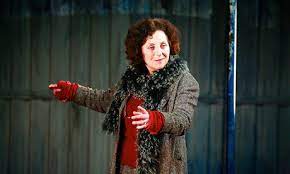
I don’t especially blame the actors for this. Presumably, they were responding to the director, and in Shakespeare in particular, the director makes (Nicholas Hytner) or breaks (Rufus Norris) a production. In this case, Kaut Howson (pictured right) absolutely destroyed this production. She has been recuperating from an accident, apparently, so perhaps that explains it, but nothing can reasonably excuse this exercise in painting-by-numbers direction.

It did occur to me, as I tried in vain to take my mind off the car crash as it unfolded in front of me, that actually, the play would have been much better suited to the dark, atmospheric candle lit magnificence of the Sam Wanamaker theatre. The Globe can manage knockabout comedy. A warm Summer’s evening lends itself to a lighthearted romp. The Wanamaker would certainly have helped Hunter, whose voice seemed lost in the open air setting.

During one of the many longeurs in the first half, I found myself looking down on a gaggle of young people, mainly boys, either on a school trip or on a foreign exchange arrangement. I lost count of the number of them who were surreptitiously messaging and surfing the net on their phones. My old-person-English-teacher instinct kicked in immediately, but I did manage to exert some self control and stop myself from scowling and tutting. By the time the interval arrived, I’d joined them, checking my messages. 

They’re not daft, kids today.