A major disappointment as the metaphors run out of road.
Spoiler Alert! Unhelpful plot revelations ahead!
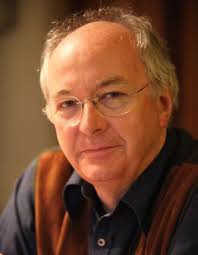
A new book by Philip Pullman is usually something of a treat. A literary event in fact. This one has particular significance – it’s the concluding volume of the Book of Dust trilogy, and as he gets older (he’s 78 now) there is always the fear that it is the last he will ever write. Before I go any further, it’s only right that I reveal myself to be a massive fan. Pullman is one of my literary heroes and an inspiration as far as my own writing is concerned. The Northern Lights trilogy is fully deserving of all the plaudits heaped upon it, not least for the fact that, by the end, it has become one of the all time great love stories.
So it’s with some sadness that I have to report that The Rose Field is a major disappointment. It’s full of lovely writing, and Pullman’s imagination (a key consideration in the light of one of the book’s themes) is in full working order, but as a coherent piece of story telling, it fails to land.
It comes in at a baggy 620 pages long, and I got the impression it could have just as well have finished after 1,620 pages, and we still wouldn’t have been anywhere near a satisfactory conclusion. Pullman, as a Great Man of Letters, has now achieved the status of “He Who Cannot Be Edited”. Pity the poor editor assigned to the task: “Phillip, do you really need all those bits with the characters discussing Dust?” is a question only a very brave soul, with no aspirations to a long term career in publishing, would ask. But it is the question that shouts out of almost every page. By the time we get to page 554 and Lyra and Malcolm start discussing Binary Absolutism, it’s screaming.
Equally unfortunately, lots of other things emerge, trade winds that blow the good ship Narrative off course, time and time again. Crucial developments occur completely out of the blue – the fact that the loathsome Olivier Bonneville is the half brother of Lyra is revealed towards the end, seemingly as another device to keep the pot boiling. Minor characters emerge and then disappear. Supposedly important characters do exactly the same. (I’m thinking of Leila Pervani here). Two thirds of the way through the book, the narrative drive of the book appears to suddenly come from a “battle” against a character who has sprung out of nowhere, the sorcerer, Sorush, involving armies of various creatures. There doesn’t appear to be any plausible reason for this development in terms of characters, relationships, or previous events, and is there simply to add a bit of action to keep the reader engaged. It seems Pullmann has taken a leaf out of Tolkien’s book, and emphasised the “quest” aspect of the story with this out-of-kilter battle. Oh the irony, after Pullman’s much discussed dismissal of Tolkien as being “thin” and not being about much. This is what he says about The Rose Field himself: “I think of The Rose Field as partly a thriller and partly a bildungsroman: a story of psychological, moral and emotional growth. But it’s also a vision. Lyra’s world is changing, just as ours is. The power over people’s lives once held by old institutions and governments is seeping away and reappearing in another form: that of money, capital, development, commerce, exchange.”
That’s one of Pullman’s greatest difficulties here. He makes the key mistake of thinking he is writing about something and Something Very Important at that, so the story takes a back seat. Tolkien could teach him a thing or two about telling a compelling tale.
Just a reminder of the greatness that is Lyra Silvertongue and Pan
All of this adds to the impression that Pullman is desperately trying to write himself out of several of the corners that the first two (five?) volumes have backed him into. One of these is the growing relationship between Lyra and Malcolm Poulstead. The awakening of friendship into love is something Pullman has form on. The changing of the relationship between Lyra and Will in the Northern Lights trilogy was beautifully done, and forms the backbone of the books. He attempts the same thing here, using the daemons of these two characters to add depth and subtlety to the development. Once again, it’s really well done (apart from the nagging suspicion he’s re-treading old ground), but then, right at the end, he pulls the rug from underneath his readers. It’s as if he’s just realised that the relationship between two characters who are eleven years apart in ages, where Malcolm used to be Lyra’s teacher, could be deemed a little problematic, a little too groomy. In one conversation, right at the end of the book, he trashes all of the careful build up, by having Pan tell Lyra that Malcolm was in love with Alice and that they (Pan and Lyra) “will have to put the idea in his head”. Job done. One more loose end tied up as if by magic.
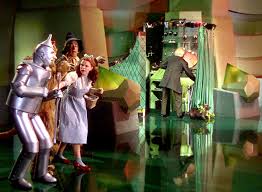
There’s similar botching when it comes to explaining Dust, “Alkahest”, Rose oil and Pan’s decision to leave Lyra at the end of The Secret Commonwealth to go in search of Lyra’s missing “Imagination”. It’s bound to fail, because they are ideas born of beautiful, powerful,vague metaphors. Their power and beauty comes from their very vagueness – that’s how metaphors work – through association and connotation. The minute you try to rationalise them, their power and beauty drain away and they are left like the Wizard of Oz after the curtain is ripped aside – small and a little pathetic.
By the end of the book I was torn. I couldn’t make up my mind whether Pullman should have stopped after finishing Northern Lights and turned to something completely new, or whether I should be grateful he started The Book Of Dust for the pleasures it produced. The trouble is that once you have set the bar so high, it’s a very long way to fall when you don’t quite get it right the second time around. Maybe it’s time to write another Ruby in The Smoke – short and punchy, and not a binary absolute in sight.
This is the long-awaited second installment of Pullman’s trilogy, The Book of Dust, a sequence that revisits the fantasy parallel England of His Dark Materials. Anyone interested in children’s literature or the fantasy genre as a whole, will have been counting down the weeks until this release, such is the power of Pullman’s fictional world, and the impact that the original trilogy had when first published in 1995. Those original fans will soon be joined by a whole new group generated by the BBC adaptation of His Dark Materials which is set to air on Sunday November 3rd. The trailer certainly suggests that it will be a much more successful rendition than the ill-fated dog’s dinner that was the 2007 blockbuster starring Nicole Kidman and Daniel Craig. Not that that would be too difficult mind you.
So Pullman is hot stuff at the moment. But what about the book? Let’s just get a few things out of the way first. Pullman is A Great Writer. His Sally Lockhart novels are glorious confections of London Victorian adventure mysteries, with pea-soupers and coal stained brick warehouses on the banks of the filthy Thames. Those alone would guarantee his reputation. But it’s the first trilogy, His Dark Materials, that moves him into the ranks of the genuinely great. Engrossing, believable, moving, challenging, Pullman creates a parallel world that is both restrained and oddly familiar. He asks big questions about belief, orthodoxy, law and punishment and democracy. But perhaps his greatest achievement is the creation of his central protagonist, Lyra Belacqua, and his invention of the notion of the Daemon, an animal- like creature that everyone in this world has as a lifelong companion, a representation of the soul, the quintessence of the individual. Lyra is one the most memorable characters in children’s fiction. In all fiction. Appearing first as an eleven year old girl in a version of Oxford University, she is resilient, loyal, brave, intelligent, and without any trace of snobbery or prejudice about race, class or gender. And she is one half of one of the greatest love stories ever told.
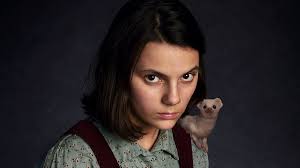
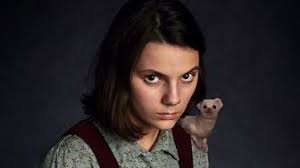
Dafne Keen as Lyra Belacqua in His Dark Materials
The first instalment of The Book Of Dust, La Belle Sauvage,
featured Lyra as an infant, rescued from the baddies by Malcolm Polstead, an
eleven year old boy. The second book moves us on twenty years. Lyra is now an
undergraduate at Jordan College. Malcolm, is a University Lecturer. They both
become caught up in the struggle between the CDD, the repressive state police,
responsible for rigorously enforcing religious orthodoxy, and the liberal
resistance. The struggle centres around the control of the source of a
mysteriously powerful species of rose oil that is grown in the Levant (the
equivalent of Syria/Turkey) Pullman uses this to reflect upon contemporary
struggles between the West and the Islamic world, on the issues of religious
wars, refugees, terrorism, populism. It dies s through the vehicle of a journey
eastwards from Oxford, to the Middle East. The journey has all the elements of
the classic adventure story: the main protagonists are split up and are all on
separate quests to find themselves and to find solutions to their separate
problems. Their journeys allow Pullman to paint a vivid picture of exotic
lands, full of bazaars, train stations, cafes and markets, serially escaping
dangerous situations, only to fall into more dangerous situations. It’s
exciting and mostly well told. Pullman can still knock out a page turner.
Mostly.
But. This is not a children’s book. It’s complex, dealing with real world issues of politics and prejudice. It is quite adult at times, in its language and depiction of relationships. It’s very sophisticated in the way it handles the growing awareness of sexuality of Lyra, following on from The Amber Spyglass. The depiction of a near gang rape is genuinely disturbing. Pullman himself would I think be quite pleased with that verdict. He has been very reluctant himself to categorise his novels as being for children. And there is a strength in that, because it allows him to break free of the constraints imposed by genre. The worst crime Pullman commits, however, is that, at times it’s a little ….dull. The political wranglings of the Pullman equivalent of The Vatican are arcane and convoluted, and I’d be surprised if they held the attention of many children. Certainly not the ones I know nor the ones I have taught. And it suffers, above all else, from the curse of the established writer. It’s far too long.
Weighing in at over 700 pages, this is a book that wouldn’t have got past the first fence had he been an unknown. That first book has to be absolutely tightly- wrought, like a finely tuned piano. Not a spare word out of place, coming in at under 300 pages tops, the draconian guidelines of publishers and agents at least produce economy and crackle. They impose discipline as much as formulaic writing. Look what happens when you’ve made it. J K Rowling’s Harry Potter books just kept getting longer and longer as no-one would dare to suggest to the behemoth, Jo, maybe you need to rein it in a bit, love. One can only be grateful that she had only planned seven of them. If she had kept going, we would have been at over the thousand page mark by now, no question. The same applies here. And this, for all its strengths and joys, is a little flabby and baggy.
I’m sounding very negative. It’s still a wonderful book and he’s still a titanic writer. The return of the Great Love, at least in Lyra’s memory and regrets, and the beginnings of a new love to replace it, is fabulous. Even so, it’s only a four star member of his astonishing list of achievements. And when you’ve set the bar as high as he has, that’s a little disappointing. If you’re an English teacher, or you just love books, you still must read this. And hopefully, you’ll love it more than I did.
For much of my career I was a moderator for one of the big
exam boards for GCSE English and part of the job every October was to chair a
regional meeting of schools to go through a variety of agenda items to help
schools to prepare their students to successfully navigate the exams and
coursework (or controlled assessments) in the coming year. They were to learn
the lessons of the cohort just gone and a key weapon in the battle to teach
them those lessons was the Chief Examiner’s report, which distilled the main
messages from the national data. It was a hugely useful process and was largely
responsible for the year on year improvement in outcomes achieved by students.
(I’ll draw a tactful veil over the canny manipulation of the marking tolerances
and the blancmange-like rigour of the Speaking and Listening moderation that
also played a part. That is, perhaps, for another blog, when I’m feeling
stronger.)
Year after year the Chief Examiner banged on about the same
issues. Every year he identified what he saw as the game changer as far as
English Language results were concerned. Every year I reinforced this message
in the regional meeting. Every year I strove to enact this pearl of wisdom in
my own classroom. What was it, this Holy Grail of GCSE English teaching, this
elusive crock of gold at the end of the rainbow?
Planning
writing.
They look so simple, those two little words written down in
black and white. Simplistic, even, as a panacea for underachievement in GCSE
English. But behind those two little words lies struggle, pain, resistance,
frustration, anger, resentment, incomprehension, stretching back years. If you
are an English teacher who has ever tried to prepare a class for an upcoming
English Language examination, you will surely recognise the following scenarios.
Put simply, I have never, in any of the last 35 years,
introduced the concept of planning writing as a step to writing better, without
it being greeted by students in the same way that every group of teachers in a
training session respond to the prospect of Role Play. With horror. Without
fail, the following questions are asked and points raised:
I can’t plan. I don’t know how to.
I never follow the plan, Miss, so what’s the
point?
Do you get marks for the plan?
Of course, as a fully paid up member of the liberal metropolitan elite, I have consistently delivered the standard, honest answer to this last question. That is, I have explained in painstaking detail that no, actually, no marks are awarded for the plan, but that writing that has been planned is always better than writing that has not. I’ve supplemented this with reference to the Chief Examiner’s report, sometimes going to the trouble of distributing copies of it, or in latter years, displaying the relevant section on the Whiteboard. This often leads to classic teacher sarcasm: “Of course, (insert student’s name), if you think that you know better than both myself and the actual Chief Examiner, who have been doing this stuff for over thirty years whereas you are barely out of nappies and have done the GCSE , let me see how many times is it? Oh yes, you’ve never done it have you? Then by all means go ahead and completely ignore our professional advice and just make it up as you go along and see what happens. This produces the following response, brutal in its logic:
So, I don’t really have to plan then?
On a couple of occasions, unable to bear this ridiculous
exchange another time, I just lied, and said, without skipping a beat, “Oh Yes,
of course you get marks for writing a plan.” Then I would put up with the
liberal guilt about ethical behaviour as a teacher before eventually going back
the original approach the following year, shamefaced.
Early doors, I used to be moved by the first of the examples
above, the idea that no-one had taught them to plan, so of course they would be
resistant. In this scenario, I could cast myself as the hero, who could save
the disadvantaged from their own lack of cultural capital by actually opening
the gate to the secret garden of middle-class academic knowledge and take them
through the basic steps of planning. This would inevitably furnish them with
the transferable skills that allowed them to structure their thinking and their
writing in English and every other academic discipline. And so, I devised over
time a series of imaginative approaches to planning, which resulted in this
terrible and embarrassing flowchart of the planning sequence:
Spider diagrams.
Amending
Deleting
Synthesising
Sequencing
Numbering
Ticking off
It was surely only a matter of time before a lucrative book
contract landed on my hallway floorboards to be followed by a regular series of
training events based on a whizzy powerpoint presentation and a glossy
ringbinder. Fame and fortune awaited.
I would spend a few lessons on this, only to find when I
received the exam papers, that out of a class of thirty students, only three
had written a plan. Did I dream that sequence of lessons? Was I actually in the
room? Or was I just a shit teacher?
This pantomime carried on for years, surviving a range of
different approaches, none of which had any discernible impact on the students’
practice. In the end, it was one of the many things that had ossified in my
teaching, into another example of stuff that could be categorised as, “Oh well,
that’s just the way it is in reality.” I kept on doing the same stuff, even
though I knew it didn’t work. It was a tired recognition that teaching is a
difficult process of alchemy, and that sometimes we have to acknowledge the
limits of our influence. The best laid plans (no pun intended) and all of that.
And then, eventually, I retired, satisfied that, all things
considered, I had done a pretty good job over the previous thirty-five years.
Early in my retirement, I started to dabble with creative writing: short
stories, poems, novels. I reasoned that the excuse of being too busy just
didn’t hold water anymore, so I did a bit of internet research (a classic
delaying tactic this) and then sat in front of my laptop staring at the screen,
not allowing myself to get up and walk away until I had produced some writing.
A paragraph or two, at least.
What did I have in my locker that persuaded me I might be
able to write creatively? I had not joined a writers’ group, I had not done any
kind of creative writing course. No, I was convinced by my thirty-five years of
teaching children to write, my three years of studying English Literature at
University and a lifetime of reading books of every type and genre. The craft of
writing? Pah! Either you’re touched by the muse, or you’re not. Ah, the
arrogance! I sat, staring at the laptop for a very long time.
Then it came to me. Of course! A plan! I had to write a plan
before I could come up with anything even vaguely coherent. Wasn’t that what
I’d been boring young people to death with for all those years? And if it was
good practice for them as writers, then surely it would be good practice for
me. I had read in the weekend papers many times, interviews with authors
promoting their latest book who talked about their meticulous approach to
planning. Index cards. Exercise books, colour coded for plot, character, theme.
Every last thread spun and tied up neatly by the end. And it was clear that
their planning process must work because they were proper writers, with books
on the shelves and everything. And once this intense planning had been
completed, with eyes closed and chin on finger tips, Sherlock Holmes style,
then the writing could begin. And now, it would be a doddle, simply a matter of
splurging all those great thoughts onto the paper, ticking off each subsequent
element of the plan as it was completed, just like I advised my students to do.
And then, with the wet slap across the face of epiphany, I
realised.
Planning doesn’t work. At least not the kind of planning I
had been teaching for years.
Obviously, it didn’t work. Leaving aside for the moment the
idiocy of testing creative writing via a 45 minute slot in an exam hall, even
with unlimited thinking time you couldn’t easily plan every detail of, say, a
short story. Or if you did, you would be planning out the magic that is
produced by the act of writing itself. Functional, sequential planning has its
place in producing transactional writing, when it is simply a matter of ordering
and clarifying one’s thoughts, but creative writing is a very different process
and does not bend to the same rules and regulations.
I’m with Philip Pulman on this. In a recent interview in The Guardian to promote his latest book, The Secret Commonwealth, he pleasingly berates the functionalists who are currently having a moment in the sun at the expense of school children across the UK. Their niggardly focus on the naming of parts and their slavish insistence that the main function of a piece of writing is to show off the writer’s grasp of the full range of punctuation is rightly blasted. But he is also very interesting on the notion of planning. It’s right at the end of the interview (link below). Have a look.
What I’ve discovered over the past nearly three years is
that the planning process for fiction does exist, but that it is bespoke to the
writer. I’ll tell you what works for me. It might work for some kids and some
other adults, but there’s no guarantee.
The impulse to write comes, for me, from a very strong image
of a situation. It could be anything – an atmosphere, a dilemma, a
relationship, a texture. From that a story emerges. First the characters and
their relationships. Then the skeleton of the plot. Then the next layer of
characters. In the course of that process, the story and the subplot start to
take roots, but as gardeners everywhere will know, plants are unruly beasts and
go where they want. So the vivid image of the starting point, (which may not
end up as the start of the story at all) is accompanied by a strong sense of
the end point. As a writer, I know where the thing is headed, I’m just open to
the route we take. There may be a couple of other definite waypoints (or Vias
as the SATNav would have it). Other vivid scenes that have to be navigated
around. And no, despite the scornful reaction of some of my friends when
discussing this, this is not just a pretentious version of making it up as you
go along. It’s surrendering yourself to the process. The act of writing
generates ideas that are generally better than those produced by the act of
thinking.
When I started the process of trying to write fiction, I read a piece by D B C Pierre, the Canadian author, on starting to write. It was extremely helpful, particularly his metaphor of compost, of all things. Just write, he advised. Enjoy the sense of your growing wordcount. At some stage you will hit a critical point where, like compost heap, you will have accumulated enough copy for it to start to react, to spontaneously breakdown in a process of decomposition, producing something entirely other than that which you started with. And then eventually, when it seems as if you have written something that you are pleased with, that means something to you, that you would like to read, you can begin the real work, the hard work of turning all of that compost into something that somebody else might conceivably want to read as well.
And so it has proved. From a strong image, a sense of the
resolution, and a couple more luminous scenes en route, fiction has emerged,
almost without my agency, and certainly without detailed planning. And how I
wish I could go back and rethink all of those well-meaning lessons on
students planning their writing.
Because, unfortunately, they are still saddled with the insanity of having to
produce some piece of “Creative” writing in about 45 minutes of exam silence.
And that means English teachers have a moral responsibility to prepare them to
do it as well they can.
So what practical lessons do I glean from this revelation? I
still teach English, as well as writing myself, and I still desperately want my
students to do well. I keep it much simpler now and focus on those key
elements:
An arresting scene, full of texture and
atmosphere. Often the opening paragraph.
Two or three characters, their relationships and
potential conflict
A final resolution. Even a last paragraph to
work towards, a pole star to help them steer the ship
A balance between description and dialogue.
Avoid back story
Show not Tell
And then, the last piece of advice to be ringing in their
ears as they enter the exam hall: Let the writing take you where it will, as
long as you reach that last paragraph. And it’s still a nonsense, to ask
children to write creatively in these conditions, as a means of ranking them.
It will produce a lot of stuff that wasn’t worth their bother: formulaic,
trite, cliched. Perfectly suited to an exam devised on exactly the same lines.
But at least they might enjoy it a little more and not be too worried about
synthesis and sequencing.
And some of them might, just might, want to keep writing.




 The Old Grey Owl