

Something weird is happening to films. It’s crept up slowly, revealing itself bit by bit, until now there’s so much evidence that it’s irrefutable. We are living through the Golden Age of Cinema, after the Wasteland of Pandemic Lockdowns and their aftermath. What’s driving this? Lockdown. Streaming. The unstoppable proliferation of narrative outlets and the demand for stories that will satisfy the gamut of tastes and preferences. The thirst for longer narratives with space to develop character, relationships, themes. The usual stuff.
It seemed, when we were in the middle of it, that Lockdowns were going to destroy cinema, as everyone got used to staying in and subscribing to a range of streaming services. The content was good and it was cheap. But by the end, we were all thirsty for the experience of going out again. In the same way that Zoom, at first a lifeline, became an annoyance, when it became obvious that the experience it provided was thin gruel compared to the Michelin-starred flavour of talking to real people in the same room, with eye contact, nuance and body language. You know, like properly being alive.
At first, it was hard, going to the cinema again. An act of faith, even. We went to see countless films in cinemas, to find that there were only six or seven other people dotted around the auditorium. It was only a matter of time, we agreed, that there would be a wave of closures to match the decimation of retail units in High Streets across the country. But, somehow they clung on.
And then, probably about a year or so ago, I began to notice something else, when watching the trailers. For at least ten years before Lockdowns, sitting through the trailers was usually a deeply depressing experience. I had become innured to the naked cynicism of the adverts. Corporations were desperately, unsubtly trying to sell me stuff. Millions of pounds of production costs, undercut by appallingly, clankingly obvious scripts, overlaid with equally grim music tracks. The combination of visuals (admittedly, often very beautifully shot visuals), terrible scripts, and obvious music overlays characterised all cinema adverts. Having to sit through them, always left me feeling vaguely unclean before getting ready to watch a film, usually with some kind of moral message.
During this period, it was difficult to distinguish between the ads and the trailers for films that were coming our way. They too, were just an extension of this appeal to the basest instincts of Homo Sapiens: Marvel adaptations, Fantasy CGI fests, endless, mindless, explosions, car chases (or spacecraft chases, Dinosaur chases, orc chases etc) It was like watching human evolution going backwards and I did despair of the celebration of stupidity it all seemed to represent. Don’t get me wrong. There’s a place for escapist/adventure/action type films. But a) do them well, and present a story with a plot that makes sense and respects your audience and b) make them as part of a wider, more diverse offering.
So the first time it happened, it was a bit of a shock. After the film, on the walk from the cinema to the car, the conversation was less about the film, and more about the trailers. Puzzled expressions and lines like, “There’s some really interesting looking films coming up”, were delivered hesitantly, as if it was just a scam to get us back, but really we would find that nothing had changed.
But it has. Every month there are great films and , on leaving the cinema, I think, “That’s the best film I’ve seen this year.” Over and Over again. I may be wearing rose tinted spectacles, but I can’t remember this happening before. They are long (sometimes too long), have stories, have interesting characters and believable relationships, are beautifully filmed in interesting locations, have significant human dilemmas to be resolved. I don’t know how long this is going to go on for. I’m just determined to enjoy it while it lasts. Because when it all blows over, and we are forced to trawl through mediocre shit on Netflix, recreating that Friday night visit to Blockbuster, where everything in the shop, could be pulped without adversely impacting the stock of human happiness, we’ll be forced to reminisce sadly about the time when going to the movies was great.
And what have been the films that have inspired this analysis? Well, since you asked so nicely, in no particular order…

Oppenheimer
Barbie
Saltburn
Poor Things
Zone of Interest
Killers of the Flower Moon
All of us Strangers
Anatomy of a Fall
Past Lives
The Holdovers

I can just about narrow this down to a top five:
5. Saltburn
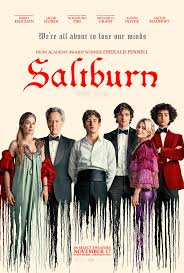
Saltburn
I’m amazed that this film divides opinion. It’s a funny, stylish Brideshead pisstake that turns the usual working-class-oik-adopted-by-the-bastard-Upper-Classes-at-Oxbridge-before- being-humiliated trope on its head. People who don’t like this are the same as those who didn’t get Don’t Look Up a couple of years ago – sadly very wrong.
4. Killers of The Flower Moon

Lots of moaning from the older cinema-goer ( my very own tribe) about toilet breaks needed because of its excessive length. Not for me. It flew by and I loved it. Fascinating, unknown (to me) story from American Twentieth Century history, with fabulous performances from De Niro, Gladstone (who really should have changed her name to De Gladstone) and the ever underappreciated Leonardo De Caprio. And if bladder control is increasingly a problem for you, there’s a range of remarkably effective, discreet products you can now buy. Next to the Maltesers in the cinema shop.
3. Poor Things
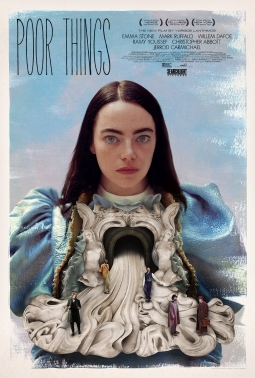
Wow! What a treat this film is. Visually stunning, steam punky Glasgow vibe, moving through Europe to Paris and back. Amazing performances from Emma Stone and Mark Ruffalo, who is hilarious all the way through and who should have won an Oscar, if that particular travesty of an award ceremony had anything to do with quality rather than promotion and virtue signalling. Is it a feminist epic? What a dim question – of course it is. How to learn to become a woman in a patriarchal society is a great premise and it’s delivered in an un-hectoring way. The scenes in the Parisian brothel are notable for the collection of highly unprepossessing men who make up their client list. In any other year, this would have been the best film of the year by a mile.
This brings us to the top two, and we move into a completely different league of experience. In Joint First Place are:
Zone Of Interest
This is an amazing film. The Second World War and the holocaust are strange subjects. In one sense, how can you go wrong? They naturally carry their own drama, their own horror so they’re a gift as subjects for people who are making stories. The downside, of course, is the fact that they’ve been done to death. How could you possibly find anything new or compelling to say, when confronted by the ultimate, still barely believable, example of the worst of humanity? But Zone of Interest pulls it off.
It’s a great premise. The mundane domestic arrangements of the Auschwitz commander whose family home abuts the death camp are an obvious way of exploring how absolute evil becomes commonplace. Generations of GCSE English students will also be familiar with the poem Vultures by Chinua Achebe on the same theme:

Thus the Commandant at Belsen
Camp going home for
the day with fumes of
human roast clinging
rebelliously to his hairy
nostrils will stop
at the wayside sweet-shop
and pick up a chocolate
for his tender offspring
waiting at home for Daddy’s
return…
Praise bounteous
providence if you will
that grants even an ogre
a tiny glow-worm
tenderness encapsulated
in icy caverns of a cruel
heart or else despair
for in the very germ
of that kindred love is
lodged the perpetuity
of evil.
Vultures. Chinua Achebe
Everything positive that has been said about this film is true. The soundscape is extraordinary and a compelling reason to watch it on the big screen. There are some wonderful scenes: the commandant hurriedly getting his kids out of the nearby river, running through idyllic woodland next door, when he realises that the water is carrying some horrific evidence from the camp next door. This is followed by frantic scrubbing of the kids in the bath. The commandant’s wife casually sorting through booty left behind after prisoners had been exterminated: fur coats, gold teeth, jewellery. The negative night scenes, of a young girl from the village visiting the outside work areas hiding food for the inmates, are both beautiful and haunting. It’s a film that will never leave you, once seen.
- All of Us Strangers
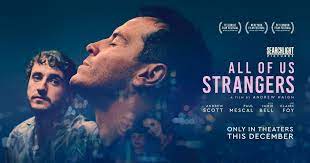
This is the film that sums up, for me, the new approach of adult serious films, for adult serious people. Please note: Adult and Serious does not mean Boring. Far from it. The four central performances are luminous: Andrew Scott, Paul Mescal, Clare Foy and Jamie Bell are all brilliant. It’s so good, you want a new category of Oscar: the ensemble acting award. People talk to each other. They struggle with their feelings, they show what it is to be alive as an individual in an alienating society. There’s a hint of lockdown isolation, but that is suggested rather than laid on with a trowel. It’s enlivened by some, beautiful, subtle magic realism, in the form of the Scott character going back to visit his childhood home as part of his research for a new film he’s working on and finding his parents, unaged, still living there. It uses this device to explore memories of childhood and regrets for all of the things that were not said. Tears are shed in the audience. Beautiful.

 The Old Grey Owl