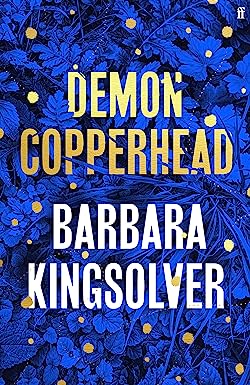
A Review of “Demon Copperhead” by Barbara Kingsolver
Ok so let’s cut to the chase. The only real question about this book is, how on earth did it win the Women’s Prize for Fiction? It’s not that it’s bad, it’s just that it’s not good enough. And in a reversal of the old Jewish joke, there’s just far too much of it. It comes in at about 540 pages, and were it to be trimmed to around 400, it would still be baggy, saggy and flabby.
There is a second, supplementary question. Why is it impossible to find a negative review in the whole of cyber space? Or even a luke warm one? After I didn’t finish the book, I trawled the internet for the reviews to see what the literary establishment thought about. And well whadda ya know? They all loved it. Of course they did. I am wearily used to lying firmly outside the mainstream when it comes to opinions about cultural products. The lonely furrow is the one I seem to plough repeatedly. And there is always the problem of reviews done by other writers where an institutional phenomenon of “You scratch my back, I’ll scratch yours” is in rude health. It’s not that I want to be negative about anyone’s work. Writing a novel is a major undertaking and all kudos to anyone who achieves it, but really, let’s not suspend our critical judgement. It’s not a hanging offence to publish something that’s not absolutely wonderful. Let’s actually read the book, and then be truthful about it.

The other possibility, of course, is that I’m just wrong, and that it is, in fact, a major piece of work.
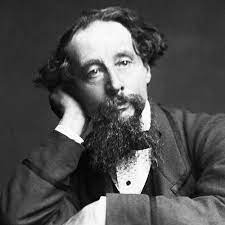
The problem here, the elephant in the room, is Mr Charles Dickens. Kingsolver is on the record professing her deep love and admiration for the Great Man and his works, and her determination to do a modern day version of David Copperfield. All well and good so far. The trouble is she seems to be so intent on her updated homage to her hero that it has elbowed out of the way all other considerations. You know, things like writing a novel that works on its own terms. One that engages, entertains and enlightens. One that leaves you moved by the plight of the protagonist and gives you some insight and empathy into a pressing social issue of the day. Set against that, pulling off a trick of adoring imitation seems a little shallow and pointless.
It’s not as if she didn’t have promising material. Setting the book in rust belt Virginia, looking at Blue Collar poverty and neglect, exploring the opioid addiction crisis of these left behind communities and exposing the seemingly scandalous mess of foster care and adoption in the US – all of these issues are worthy of a big novel. Unfortunately, I have to report that this is a big novel only in the sense of the number of pages it amasses. On all other available measures, it falls short.
To be scrupulously fair, there’s a lot of good writing here. KIngsolver has been around the block a bit and knows how to put together a sequence of well tuned sentences. And there are times in the first half of the novel when it seemed that it was on the verge of lift off, but each time proved to be a false alarm. Hope and expectation, time and time again, are throttled at birth by repetition, relentless accumulation of peripheral characters and scenarios, and an overall sense of meandering.
I wondered whether this was Kingsolver deliberately attempting to be Dickensian, trying to ape his characteristic gallery of grotesques and eccentrics in order to create a world where all human life is here. The trouble is, Dickens does it with great verve and style. Each diversion, when the reader is inducted into the lives of yet another group of oddballs and ne’erdowells, re-energises the novel as a whole. The prose sparks and fizzes, the subplots entertain, the narrative drive of the main plot is undiminished, Maybe it’s his skill at the episodic nature of monthly installments, where cliffhangers and structure drags the reader forward on a basic mission to find out what happens next. In this case, there is no sense of forward propulsion. Each diversion causes the book to sag. Each set of grim circumstances and terrible characters seem indistinguishable from the previous lot, until the reader starts to actively not give a toss about the fate of our hero. Or, at any rate, this reader didn’t.
It’s not helped by Kingsolver’s use of the first person. The voice of Demon Copperhead, the eponymous hero, (David Copperfield. Come on – keep up) is used throughout the novel. It’s his story, told by him. And it’s brilliantly done. There is an authenticity to it and it adds to the sense of place that Kingsolver achieves. But after a while, I found it rather relentless and rather limited. I wanted to see this world from some different perspectives, to hear another voice.
In the end, you can’t escape Mr Dickens, who is always there, looking over your shoulder as you read. Like Kingsolver, I love Dickens. I’ve read all of the novels and some of his stories. I love the plotting and the prose style and the characters. I love the vastness of them and the pleasure of the language. I love the fact that they are as much about a society at a particular time in history as they are about particular characters and relationships, and that Dickens’ voice and views are never far away. But they are from a very different time, and novels, and people and cultural consumption have changed utterly since Charlie’s heyday. What worked for him and his readership doesn’t really work for us in quite the same way. Dickensian is an adjective often used to describe modern narratives and it’s never used pejoratively, always as a quality kite mark of approval. It’s a go to for reviewers to “place the product”. Zadie Smith’s debut, White Teeth, gets the tag, partly for its London setting I suspect, partly for its teeming cast of characters, partly for its exuberance. My own novel, “Zero Tolerance” saw me dubbed as the “Edu Dickens of his generation” in one memorable review. I always feared that was a nod to the fact that it was too long, a little boring in parts and full of improbable coincidences. But enough of me, as no novelist ever said, ever.
Really, when you get down to it, the only person who does “Dickensian” well is, er , the man himself. But I do think this explains the prize winning. Just like any moderately famous actor who does a film playing someone with autism, or a mental health condition, or impersonates someone famous in a biopic becomes a shoo in for an Oscar, so a writer who tries to parallel a famous Dickens novel is aiming for the glittering prizes. Every parallel, every witty updating, every character name spotted by the discerning reader, each of these things generates more brownie points in the pot. We do love a writer who can help us feel a bit cleverer than we usually are.
Personally, I prefer a writer who writes a novel that grips and intrigues and excites and enlightens. A novel that I can’t put down, to take refuge in a familiar cliche.
“Demon Copperhead”, unfortunately, was a novel that I couldn’t stop putting down.
My week of faking it as an Actor on the professional stage
After having taught An Inspector Calls as a GCSE set text for more years than I care to remember, the chance of appearing in a professional production of it was too good an opportunity to turn down. And not just any production. This was the legendary Steven Daldry production, which had improbably revived an old creaking classic when it first burst onto the scene at The National Theatre in 1992. The play had been steadily falling out favour as an exam text, despite its many qualities. In stock cupboards of English Departments all over the country, dog eared copies of the play were left gathering dust. The main problem was that it is, essentially, a very wordy play. Not much happens. It takes place largely in one room, where various people tell their story under interrogation from the mysterious police man, Inspector Goole. It’s the ultimate example of tell not show. The drama of Eva Smith’s tragic suicide is conveyed at a distance via the relentless question and answer technique of Goole. This is usually resolved in TV and Film versions by setting up a series of flashbacks, with an actress playing the role Eva Smith, despite the fact that the play makes it clear that the stories the characters tell concern several young vulnerable women, not one.
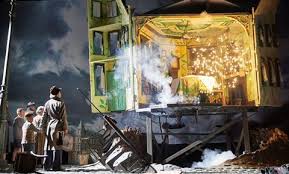
The Daldry production takes a radically different approach, honouring the text, and using, instead of flashbacks, scenery to ramp up the drama, and to underline the contemporary relevance. The ingenious collapsing house becomes a powerful metaphor for the collapse, not only of the cosy successful upper middle class world of the Birlings, but also of a society whose structures are rigged against the poor and the dispossessed.
Having ossified into a wordy exam text, at a stroke Daldry transformed it back into a drama that thrillingly presents issues of fairness, poverty, and class divisions in a vital and engaging way for audiences, not readers. For English teachers it has another compelling quality. It’s virtually the only time in a philistine curriculum, when fifteen year olds learn about politics: parties, ideology, structures of government. As a result, they also learn that boring old politics, despite what they are encouraged to think, produces significant material effects on everybody’s life. Your vote does make a difference.
Its relevance today is unmistakeable, when we have a government that is shockingly cruel, both by design and by outcome, to some carefully selected scapegoats. It’s impossible to sit through the Inspector’s last speech in the play without immediately thinking of our current shambolic set of charlatans who still cling to power. If they cling on for a further term, don’t be surprised to see it removed from exam specs. And in the Gradgrind world of the Tories, if it’s not examined, it may as well not exist.
So when I was sent a copy of the Facebook page of The Churchill theatre in Bromley, just round the corner from where I live, with a notice asking for “Community Volunteers” to take part in their forthcoming production of the play, I was intrigued. Reading it more closely, there was one detail that was the clincher: No Acting Experience needed. That was a selection criteria that I definitely met. Apart from a much talked about role as Jacob Marley in A Christmas Carol, in a school staff/student Christmas show, my last performance had been as a tree in my primary school nativity play. It was a role I reprised for several years for Hackney Red Star and then Acacia Dynamo, on the Marshes and Clapham Common, as a willing but limited Sunday League centre forward.
I emailed Charlotte Peters, the Company Director, and then promptly forgot all about it. And then, a couple of weeks later, the invite to take part was received. This provoked a strange mixture of regret, excitement and fear, all of which were in evidence when, as instructed, I made my way to the Stage Door of the Churchill Theatre in Bromley.
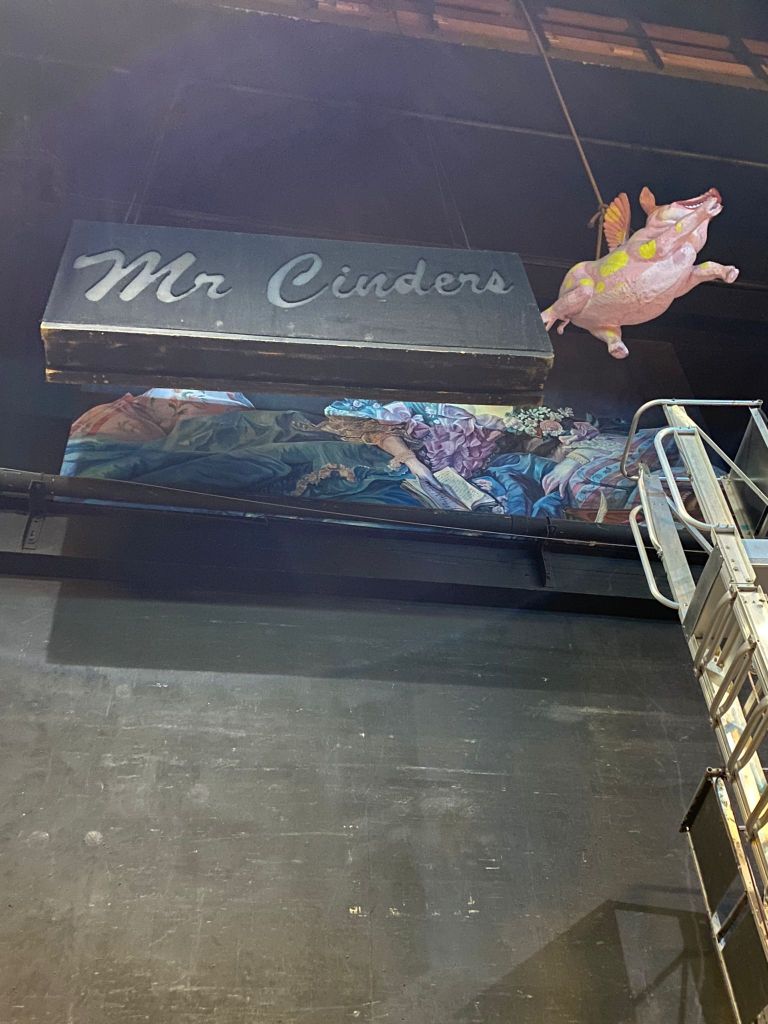
It’s a little embarrassing to report that that instruction seemed impossibly glamorous to me, a stranger to the world of theatre. The Stage Door! And even if the Stage Door at The Churchill is hidden in a nest of scaffolding and decay, it was still a thrill. The fact that we (the Community Company) were due to be taken through our part at about 3 pm on Tuesday afternoon and the first performance proper was at 7.30pm the same day, stoked all three emotions afresh.
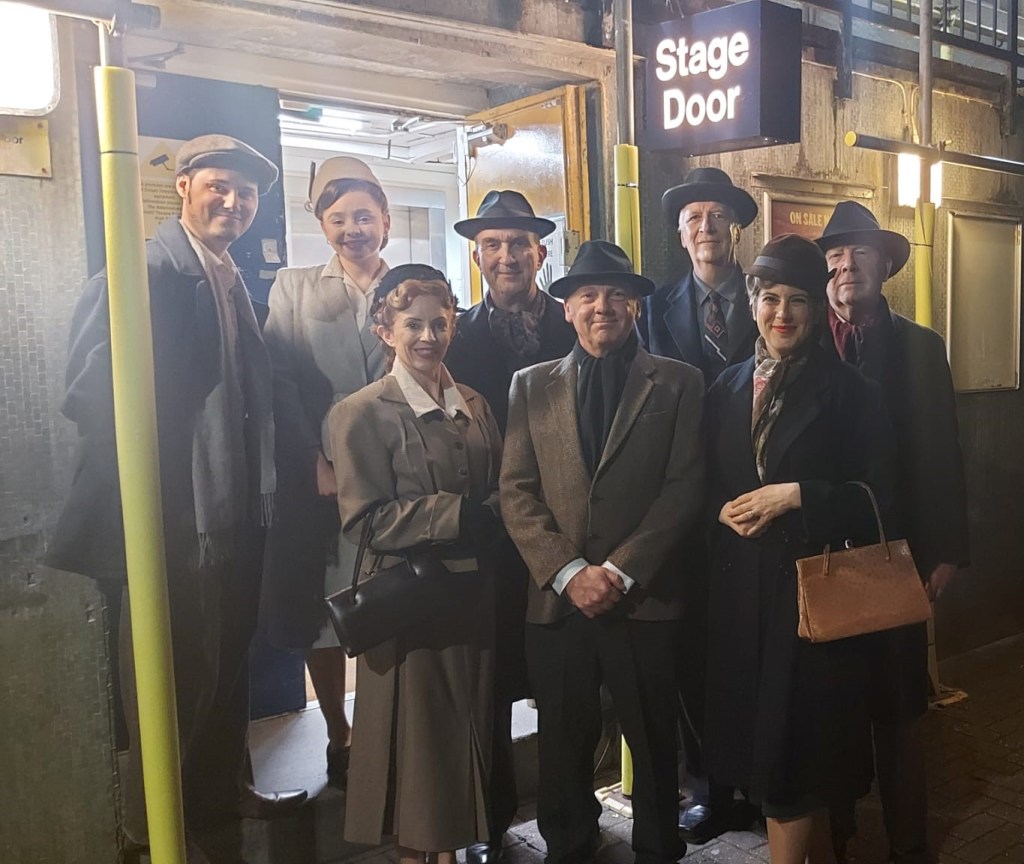
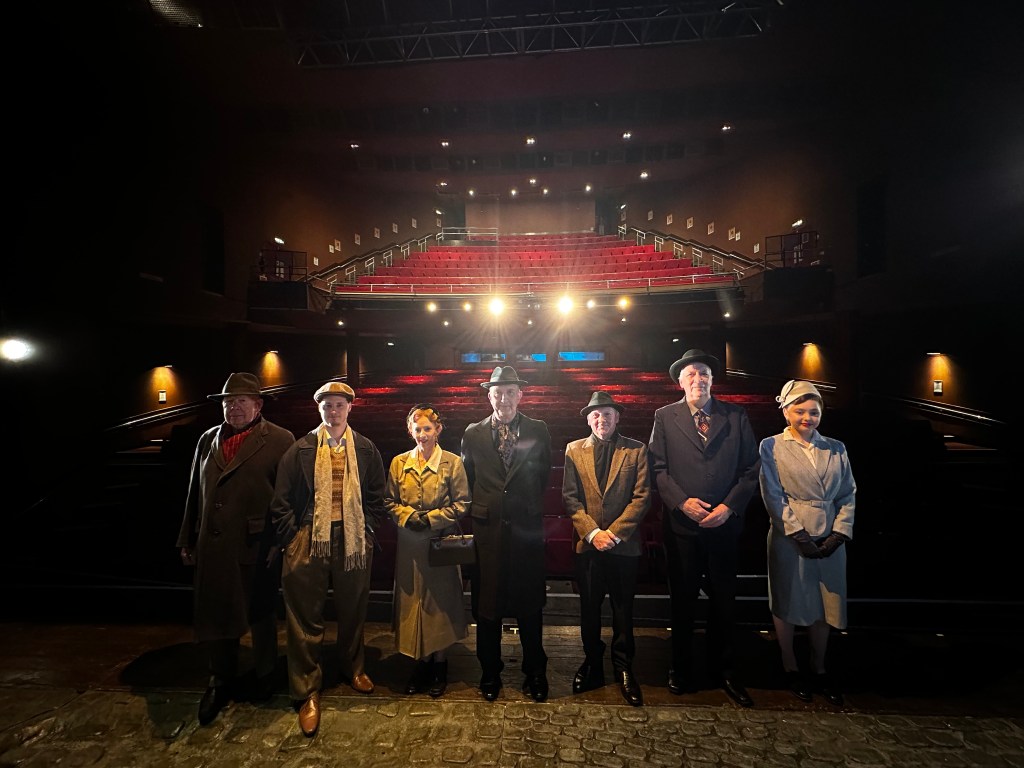
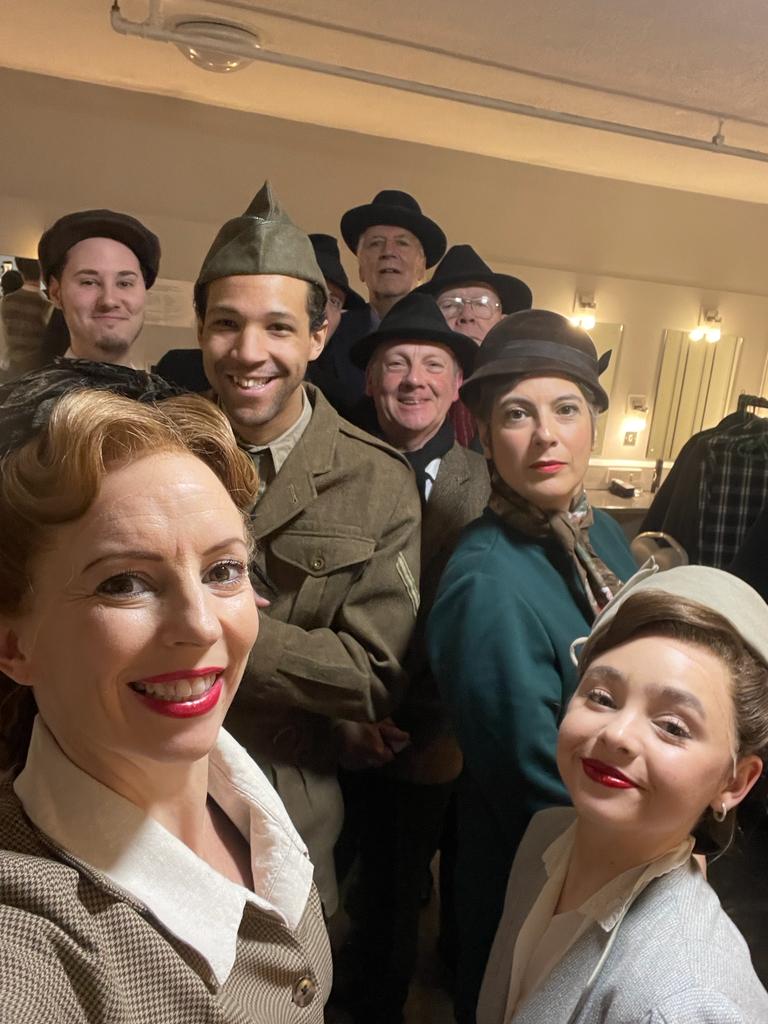
The Community Volunteers (left): Thomas, Rosie, Giselle, Peter, Colin, Sir Lawrence Olivier, Asti and Hugh
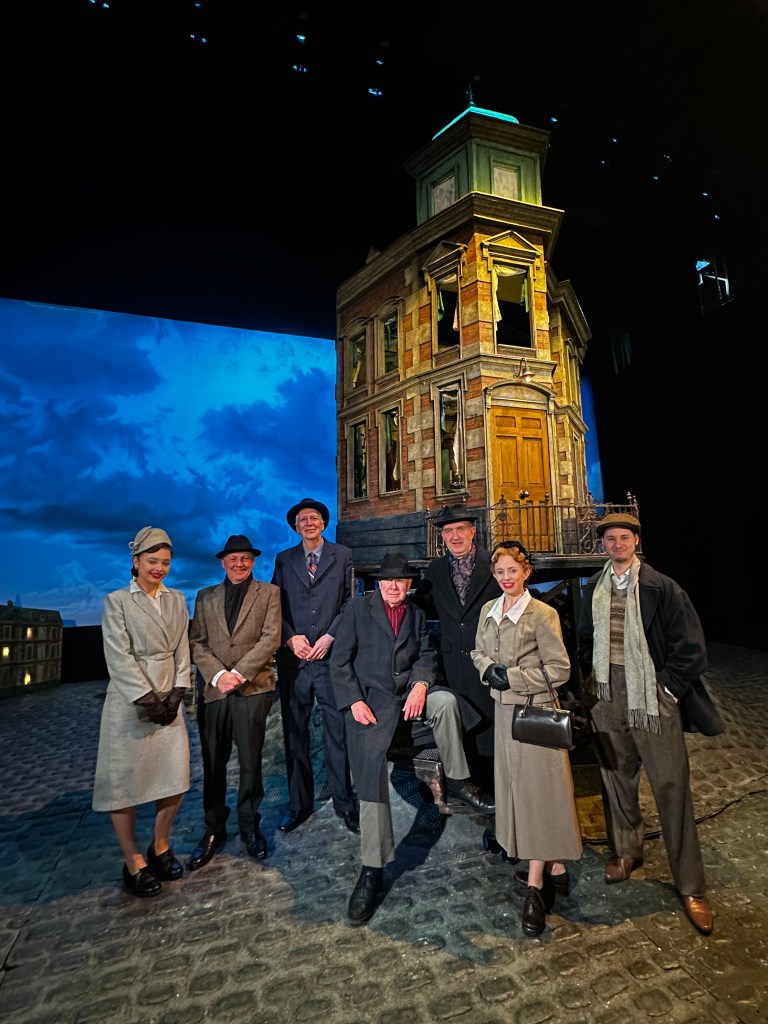
There were eight of us in the Community Volunteer group, and our role was principally to gather on stage in a cloud of dry ice to sit in judgement on The Birlings as The Inspector reached the climax of his investigation. This was done by taking our positions on stage, then, on cue, taking a threatening half step forward.
For all of our time on stage we were to be stony faced, staring into the middle distance. Then, we were to turn and walk off ahead of the Inspectors exit in the famous scene where the ingenious Birling House literally collapses on stage in a cacophony of fireworks, bangs and flashing lights. We stare at this spectacle over our shoulder, before leaving the stage.
The whole thing took about fifteen minutes. Sounds pretty simple, right? Wrong! In that fifteen minutes of hard-faced staring, one is left in stark isolation under the lights, in front of an audience, contemplating all manner of things to do with the workings of the human body. An itch on one’s nose. Cramp in one’s left leg. Cramp in one’s right leg. The first, frightening tickle of the beginning of an explosive cough. A tiny belch. A runny nose. Hold that fart in. The palpitations of the heart and laboured breathing that in your fevered, overworked imagination, are clearly the start of cardiac arrest. Actors have died on stage, haven’t they? And then one’s thoughts are overloaded with the practicalities of managing a heart attack on stage, such that you miss the cue to begin your exit turn.
The walk back to the dressing room after successfully getting away with it on stage is a heady cocktail of euphoria and relief. We gathered together downstairs for a 15 minute wait before going back on stage for our curtain call. For three or four of us, there was an additional scene where they investigated the ruined house, but clearly, the criteria for selection for this onerous task was to be young and pretty. (and less than 6 feet 4 inches tall so you could comfortably navigate your way around a crowded space). That left me, a reject along with 3 other losers, to assemble on one side of the stage to take the applause. Sounds pretty simple, but we had to maintain our stony judgemental faces, when every human instinct is to smile in recognition of the audience’s acclaim. Impassive silence is not as easy as Buster Keaton makes it seem!
Well, we spent an awful lot of time together. The role involves an enormous amount of hanging around in the dressing room, so it was very important that we all got on. It would have been disappointing if we had just retreated into the world of social media on our phones for hours at a time. We did do a lot of that as well, but there was a lot of chat and a lot of laughs.
Mobile Phones and the Art of Conversation, above
We did this for 8 performances over 5 days. It was a strangely exhausting week, notwithstanding the fact that, really, we did very little. If it was acting at all, it was definitely the Robert Mitchum version of acting – walk on and point your suit at the audience. But it was a fascinating, thrilling experience, and I finished the week with a huge sense of respect for the skill, teamwork and professionalism that underpins putting on a quality production such as this. That judgement is reserved for the professionals we worked with, but what of the other Community volunteers?
The other people were fascinating. The 8 divided into various groups. First the Young Ones – Rosie and Thomas, who were Front of house staff at the theatre, relishing getting back stage and on stage. Rosie did a great impersonation of an air stewardess in her costume and organised several attempts to get us to do a Tik Tok dance routine. Thomas took great pleasure in mimicking the main players in the cast and took particular delight in honing his Scottish accent to perfection. He was also responsible for most of the photographs.
Then came the AmDram squad, led by the extraordinary Hugh, aged 81, who reckoned he had done about 1500 performances as a Community Volunteer, and who was also a veteran of amdram productions going back years, to the silent movie days. (OK, not quite) Peter and Colin were also heavily involved in amateur productions, with Peter a leading light of the Bromley Little Theatre (Licensee, actor and set builder).
Then we had Giselle, a professionally trained ballet dancer and teacher, whose day job was as CEO of Darcey Bussell’s dance fitness brand, DDMIX. She had boundless energy and would often fit in classes or other work commitments even in days when we had two performances. Finally, there was Asti, who, in between stories about the ABBA hologram gig she attended during the run, brought her laptop into the dressing room, to keep on top of her, remote, day job. In discussion, it quickly became clear that there were no shows or plays of note in London’s Glittering West End that she hadn’t been to.
The Community Volunteers ( minus Asti who was partying with Abba that night) above, right.
In comparison to the others, as far as the theatre world was concerned, I wasn’t even a rank amateur, I was nowhere. I concluded that the only reason I got the gig was because I was retired and available, I lived a 5 minute bus ride away, and I knew the play inside out, having taught it for thirty years or more. To their credit, the others tolerated me and my pretensions to write a novel set in a provincial theatre, (Coming, but not soon, “Exit Stage Left”) and responded patiently to all of my rather obvious questions that were from the box labelled “background research”.
The chat ranged far and wide over topics that included:
Lower league football teams – Middlesbrough, Plymouth, QPR. Also Crystal Palace – yes, I know, they’re not lower league yet, but they soon will be. (sorry Colin, but simetimes you have to be cruel to be kind)
TikTok and what it’s like to have 500,000 followers
Superhero Comic Conventions
The history and origins of the Little Theatre movement
Agatha Christie and rescuing her reputation as a Playwright
The importance of having an expensive lightsabre
Jim Davidson and the importance of not being rude and offensive
Where to get the best Hot Cross Buns
Modern theatre audiences drunkenly abusing theatre staff
The Police Force and institutional Misogyny and Racism
Stage Fright
Where to get hold of cheap theatre tickets
Telly: Gold, Succession, Happy Valley, White Lotus
The relative merits of Greggs, Pret and the local Greasy Spoon
A guided tour of great performances we have given. (I was very quiet during these particular conversations, which happened approximately every five minutes. There’s nothing that actors, particularly amateurs, I suspect, like better than talking about their greatest performances of all time. Colin even brought his script for his latest play, so that he could learn his lines. What a trouper!
Back to the Professionals
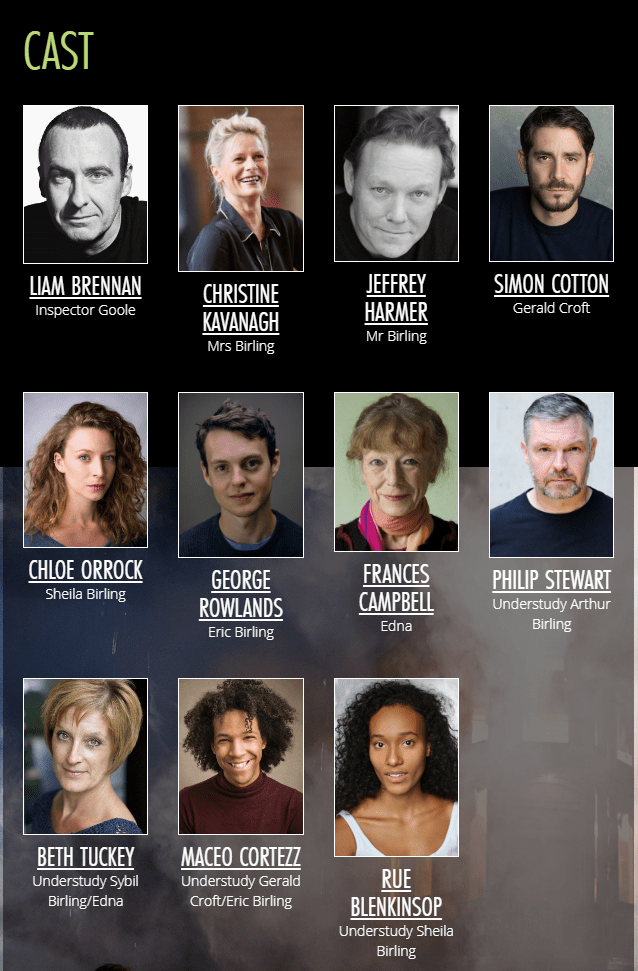
We were looked after for the week by Philip Stewart, who took us through the choreography of our scene, and checked in on us throughout each day to make sure we were alright. His main role was as the understudy for Mr Birling. Luckily, we got to see him perform the role in one matinee towards the end of the run. Like everyone else, he was excellent in the role: authoritative and convincing as a self-made, blinkered Capitalist. Birling is someone who has pulled himself up by his bootstraps to make something of himself and can’t see why all those who bleat about poverty can’t do the same. It’s hard to overstate how difficult being an understudy must be. They have to know the part inside out, and have the confidence to step in at a moment’s notice without it showing. Phil epitomised this – he appeared to have been doing the role for the whole of the run. The Company Stage Manager, Brad Fitt, was also very welcoming and helpful, making sure we got loads of photos of our experience.
Because we were onstage for only one scene, we got to know it inside out, and it was fascinating to see how the actors, individually and as an ensemble, varied it from night to night. We witnessed the Inspector’s interrogation of Eric, the young wayward son of Mr Birling, leading to the collapse of the family’s smug, pompous self confidence in a terrible physical confrontation between Eric and his mother, before his father smashes the whiskey tantalus, hits Eric and throws him to the ground. Eric was played by George Rowlands, a young actor in one of his first roles. We were privileged to watch him do this scene so close up. He changed it slightly every performance, but each one was as intense as the last. He’s got a big future, I think.
I’m sure all of the other actors were brilliant as well, it’s just that we didn’t see as much of them. We didn’t see the Gerald Croft character on stage at all, because of the structure of the play. Sorry, Simon!
I must confess that one of my concerns before the first day was how we would fit in with the professionals. I had a very stereotypical view of how that was going to go, assuming that we wouldn’t even register a flicker on the actors’ radar. After all, they had been together since August, and they see a new group of volunteers from the community every week. It wouldn’t have been a surprise if they had regally blanked us all. Nothing could be further from the truth. They were all extremely friendly and welcoming, and did everything they could to put us at our ease.
We (the community volunteers) were all struck by how much the audience communicate with the actors on stage, and how much they play a part, differently, in every performance. For the Am Dram crew, this was nothing new, but for the rest of us, it added a whole new dimension to the experience. I imagine we’re all familiar with the concept of a “Good House” or a “Good audience”, but to experience the reality of that was something else. During the matinees, and the evening performances to a lesser extent, in the first few days of the run, school parties, full of GCSE students and their hard pressed teachers, dominated.
For the kids, particularly in the matinees, this was as much an escape from the drudgery at school as it was a theatrical experience. And it was an experience they were determined to enjoy. They whooped! They cheered! They groaned! They showed their approval or disapproval of each character as they all told their stories.
As an ex English teacher with many such trips under my belt, this brought back many memories, some of them uncomfortable. Before we used to take a school group to the theatre, we would spend a lesson briefing them on theatre audience etiquette, emphasising that a trip to the theatre was not the same as going to the cinema, with its noisy, continual eating, and discussing the film (at best) or their social life (at worst). It wouldn’t have been fair to put them in an unfamiliar situation and expect them, instinctively to know how to behave. Even with the briefing, group hysteria and peer pressure would often take over, and we were left fielding disapproving looks and comments from all of the card carrying members of the Young People Today Are Awful Brigade. There were a few of them in attendance at The Churchill, several of them haranguing the box office staff for a refund because they were surrounded by kids. How terrible for them.
So, there were times when I winced at inappropriate laughter, chat, or whooping. But then, as the run went into Friday and Saturday, when the serious local theatre buffs attend, I began to long for some evidence of the audience’s engagement with the play. At moments of high drama, moments when the student-dominated audiences would gasp or groan or cheer, from the respectable burghers of Bromley, there was nothing. And on stage, even as a high class bollard, that was strangely deflating. For the principal actors, it must have felt like being ignored – chatting to someone at a party when you notice they are more interested in looking over your shoulder for someone more interesting. Not that that’s ever happened to me, you understand.
I was struck by the gruelling nature of life on the road for a jobbing actor. For the principal characters in particular, doing two performances a day must be physically very demanding. They’ve been doing this run since September, criss crossing the country, changing locations every week. Living in digs away from one’s family, only getting back for a break for a day every now and again – this is not an easy life. Nor a glamorous one.
As a tiny example, at the end of the last performance on Saturday evening, the thing I was really looking forward to about the return to normal life was the opportunity to eat something vaguely green in colour. A salad leaf. A broccoli stem. A green bean. Even a frozen pea would have been welcome. An unvarying diet of sugar/grease sludge, snatched between performances in a high street chain is not good for you, particularly when combined with a visit to the pub every night. I had expected the actors and crew to conform to the stereotype of the wild thespian troubadors, out on the lash every night in a carnival of excess, but in fact, they were disappointingly sober and professional. Probably why they were all so good at their jobs, on reflection. Or perhaps they just went, sneakily, to a different pub, away from the Hoi Palloi. Hmm.
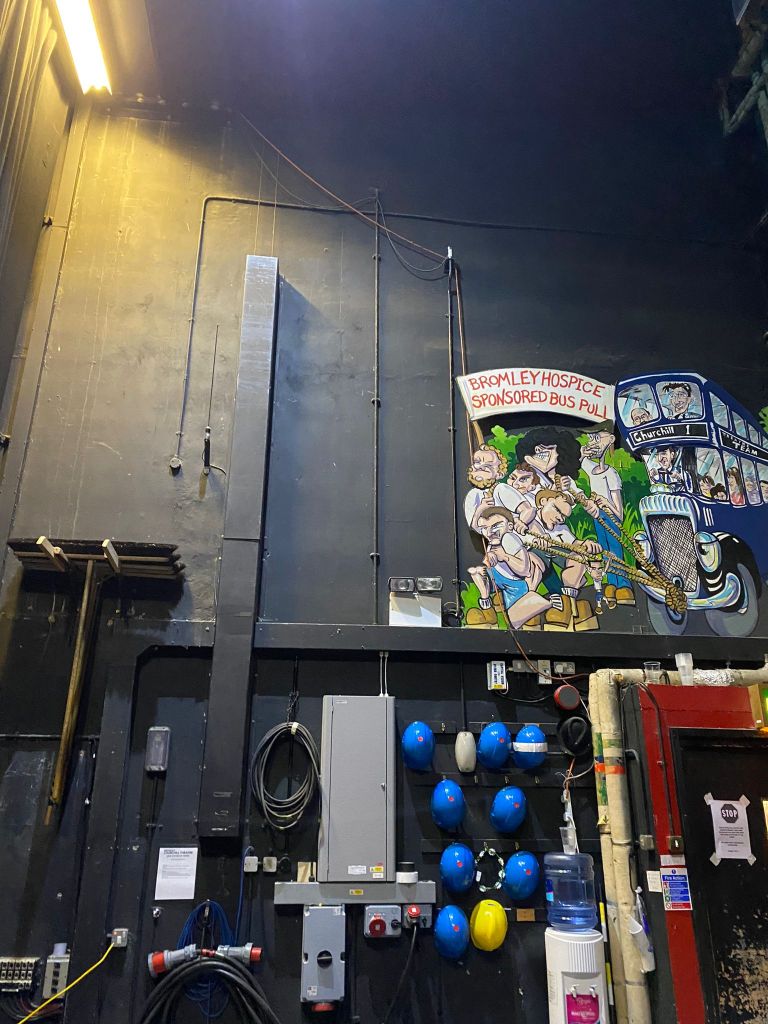
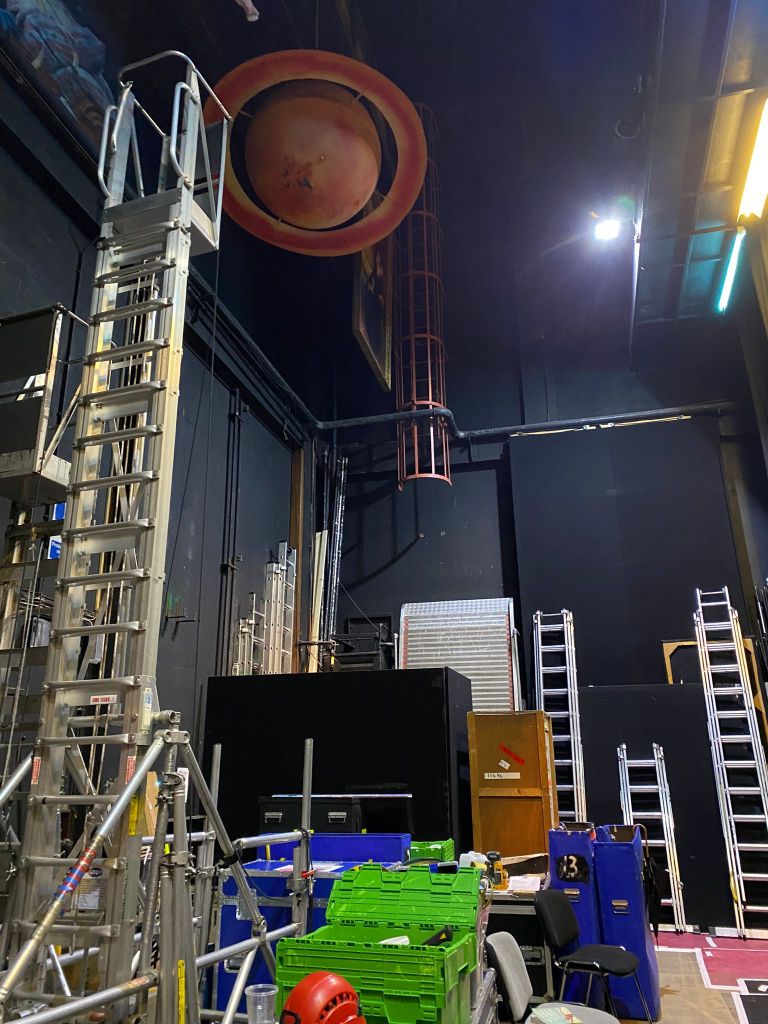
I was also fascinated by the innards of a professional theatre. Going through the stage door, and making one’s way down the stairs into the bowels of the theatre was real thrill. There was a warren of dressing rooms and ancillary rooms: rehearsal spaces, the wardrobe and laundry area, kitchen, the Company Stage Manager’s office, the Green room. I thought of all the great names that might have occupied the same rooms over the years. And Jim Davidson.
The wings and back stage were another mysterious area, full of shadowy experts silently going about their business to knit the production together. I was particularly struck by the member of the Company (don’t know if it was the DSM or ASM) following each performance on a monitor, in front of a Star Trek dashboard of knobs and controls, issuing instructions to the crew: “Open the house, please”.She was also the person who summoned us from the dressing room to the wings to be ready for our cue.
The strange world of “Back Stage” (above)
Overall, it was a wonderful, memorable experience, one I’ll never forget. It was the sort of thing that retirement, as a second playtime, was designed for. If only I’d followed up that performance as a tree in the Primary Nativity play, all those years ago, things could have been very different.
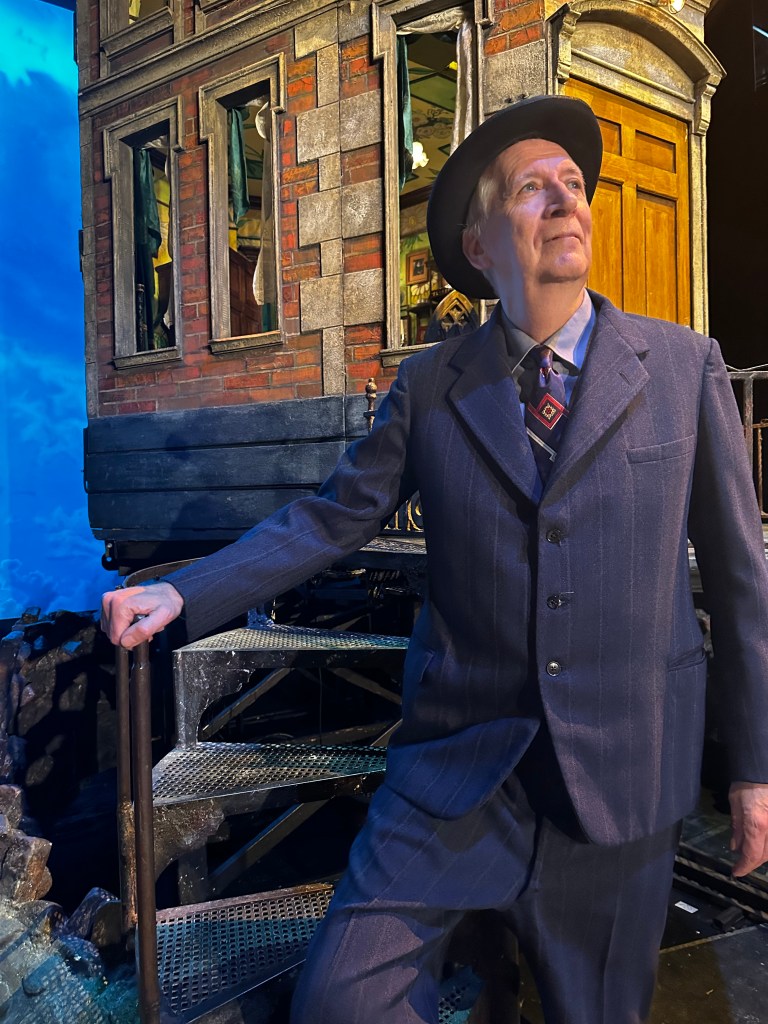
Me on set, a strange hybrid of a Tree and a Bollard
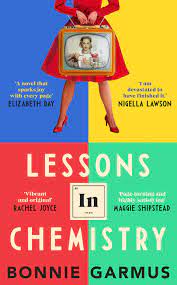
Bonnie Garmus’ debut novel in “surprisingly good” shock
When I was thinking about this review, I searched for something from the professionals, and came across this, from Stephanie Merrit in The Guardian. Merrit is the real name of the very fabulous S J Parris, writer of the Bruno Giordano historical detective thrillers. And just like in those books, she is right on the money regarding this new novel from Bonnie Garmus. This is how she starts her review:
“Every now and again, a first novel appears in a flurry of hype and big-name TV deals, and before the end of the first chapter you do a little air-punch because for once it’s all completely justified. Lessons in Chemistry, by former copywriter Bonnie Garmus, is that rare beast; a polished, funny, thought-provoking story, wearing its research lightly but confidently, and with sentences so stylishly turned it’s hard to believe it’s a debut.”
She’s exactly right. I started the book, primed and ready to savour its shortcomings. Not, I hasten to add, because I’m that kind of sour, narrow minded, mean spirited kind of person, you understand. No, simply because it’s an experience so common that it becomes an expectation. A couple of times a year, at least, a book rockets into the Literary Heavens, seemingly out of nowhere, and becomes the “Next Big Thing”. It’s endlessly tweeted about, suddenly all the weekend papers are splashing interviews with the author, and, in a sure fire sign that this is a genuine publishing phenomenon, it gets traction in mass market publications. The writer appears on the One Show, it’s featured in Hello! Magazine, and lo and behold, Reece Witherspoon has bought the rights and is making a 5 part mini series that can only be seen via some new streaming platform that requires you to take out yet another £9.99 monthly subscription.
I often read these literary meteors while they are still burning brightly. This is partly out of an interest in the Literary world in general, partly in an attempt to discern what the secret is to writing a best seller (though to be honest, I’d be happy with finding what the secret is to writing anything that other people – that’s people I don’t know, personally or professionally- might quite like. Maybe even read to the end of, one day. Well, one can dream.) And almost always, the result is the same. The book stinks.
OK, that’s a little harsh. Stinks is maybe pushing it. How about, the book is a little dull. A little obvious. A little lowest common denominator. A little, a book written for people who don’t really like books, in the same way that Ed Sheeran writes music for people who don’t really like music. Stop it. I’m just being deliberately waspish now. It is a weakness of mine. I often give into it and write damning reviews of these meretricious page turners, sarcastic and withering, condescending and judgemental by turns.
This has become so common, I was beginning to fear it was indicative, not of falling standards in the literary world, but of a propensity to clever cleverness on my part. Not wanting to be perceived as being a part of the common herd, who fall for any old rubbish as long as it’s being featured in the media. These lumpen members of the herd are incapable of forming an independent opinion of their own, having such atrophied powers of analysis and comparison that they can never step out from the pack and say what they think before checking it against the approved opinion. Was I just signalling my own credibility as a cultural consumer by automatically damning the latest literary blockbuster without even reading it?
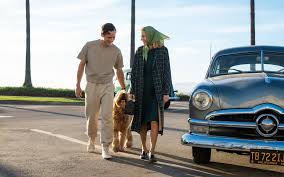
Still from forthcoming Apple TV adaptation, above right
With all of this in mind, it’s a relief and a pleasure to report that I can fear no more. It’s official – this is A Good Book. By the end, admittedly, it’s flaws have become more obvious, but the opening is so convincing, so welcoming, so right, that one forgives even the most jarring of errors that emerge as the story unfolds. Set in the dark ages of the early sixties, when the USA, outside of New York and San Francisco, was a stultifying, homogenous sludge of conformity. The promised land if you were male, white and Christian. A treadmill of lowered expectations and domestic thraldom if not. Particularly for women. And it’s that group who the book is primarily concerned with, via a series of likeable characters who the reader is rooting for right from the get go. The obstacles faced by the protagonist, the intelligent, resourceful, attractive career woman, Elizabeth Zott, are petty, ubiquitous and insuperable. It seems barely credible to our twenty first century eyes that such talent was so routinely and unthinkingly suppressed. Of course, we know the story. We know the progress that has been made. But it still has the power to shock and disturb when we see it dramatically presented through the operations of a woman we instinctively warm to.
So the setting, characters, relationships, plot and themes all tick boxes. This is a book that, from the beginning, enlists our sympathy and support. But often, even such a list of positives is not enough. The clincher in Lessons in Chemistry is the prose style. It’s gorgeous. Immaculate sentence after immaculate sentence aggregate into a steadily growing mound of pleasure: precise, economical, engaging. This is not firework prose. It’s not meretricious. It doesn’t show off, or shout its own virtues to the heavens. Instead, it’s quiet, unassuming and effective. It’s the sort of writing that sneaks up on you. You pick up the book because you fancy a bit of reading, and then, before you know it, you’ve read 90 pages in a flash. It’s like a long cold glass of water when you’re thirsty – just exactly what is required. And, miraculously, all of this occurs in her debut novel.
Bonnie Garmus, above left
And ultimately, it’s that that immunises the reader against the novel’s weaknesses. The characters, although engaging, sometimes strain the reader’s credulity. I simply cannot believe that Elizabeth’s neighbour, even though she is locked in a loveless marriage, would get up at 4 am to mind Maddy, Elizabeth’s daughter, to allow Elizabeth to go rowing with her husband. The bloody minded intransigence of Zott, in the face of the nonsensical demands of 1960s American daytime TV, aimed at the only female viewer the executives recognised, the housewife, doesn’t really ring true. Nobody, except perhaps someone a fair way along the spectrum, would continue not to recognise the commercial realities of both the university research world and the daytime TV world.
The other weakness is that the plot depends on more bare faced coincidences than even old Charlie Dickens himself tried to get away with. Again, the fund of good will the book has built up with the reader by the time we reach the home strait, generates a willingness to suspend disbelief, but the rope is a little too tight by the closing scenes.
Still from upcoming Apple TV adaptation (above right)
Then we come to the thorny matter of the dog. Yes, the dog. Not the one that didn’t bark, but the one that, apparently, as the arch rationalist Gormus tells us, has a vocabulary of nearly a thousand words. The same one that comments on the predicaments of Elizabeth, Calvin, Maddie and Harriet with more wisdom, insight and emotional intelligence than any human appearing on reality TV. I love a bit of Magic Realism as much as the next Joe, but this was a bridge too far for me. And yet, it does work, no matter how ridiculous it makes you feel as a supposedly discerning adult reader. The dispassionate observer role that the dog, Six Thirty, performs does bring something significant to the table. I just don’t know what, how or why.
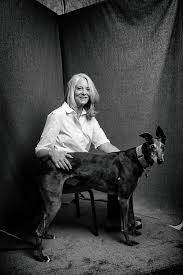
Garmus with her dog above left. The dog is, strangely, important
Maybe a little mystery about the mechanics of an engaging novel is a good thing every now and again. As an antidote to over analysing, perhaps one should simply experience a book, and take pleasure from it. After all, you can’t do a post mortem without killing the subject, so, just for once, let’s trust our reactions and let the book live and breathe without trying to find out why. Try it, and see whether you agree.
“Hamnet” was in my top five novels of the year in 2021, and many other people’s as well, if Twitter is anything to go by, so the announcement of her follow up, “The Marriage Portrait”, earlier this year caused great excitement. English teachers who have taught GCSE Literature in the last fifteen years will be very familiar with the source material: My Last Duchess by Robert Browning.
The poem, written in 1842, is a wonderful thing. It’s a long poem, a dramatic monologue, in the voice of an Italian Duke, Alfonso of Ferrara. The Duke is escorting a servant of a visiting nobleman around his palatial aristocratic pile. The visitor is there to negotiate a marriage between the Duke and his daughter. They stop at a portrait, hidden behind a curtain, of the Duke’s late wife. Browning brilliantly conveys, from his own lips, the cruelty and snobbery of the Duke.
By the end of the poem, the reader is left with an uneasy near certainty that Alfonso has engineered the murder of his young wife, seemingly because she was open hearted and friendly with people other than himself, specifically, people from a lower social class than himself. It’s master class of innuendo and suggestion. Without saying anything incriminating, the case against the Duke and the world he represents seems watertight.
It’s also a marvellous poem for GCSE students. It’s a great example of a poem that at first sight, and after first reading, seems impenetrable: obscure, dull, irrelevant. With a bit of reassurance, and a bit of skillful handholding, students can learn the fact that poetry, with its supercharged language, can be made to yield its secrets, like a tightly folded bud opening its petals one by one. Repeated reading reveals new insights, new possibilities, new pleasures. Once experienced, the joys of poetry seem just a little bit more real, a little bit more accessible, and students seem a little bit more willing to try another difficult one.
And so, given the magic wrought by O’Farrell in Hamnet, it seemed like a rich seam of material to mine. I started, with eager anticipation, a useful store of knowledge, and a fund of goodwill towards the writer. And there is a lot here to admire. I read it quickly, carried along by the narrative and the language. But…..
By the end, I was racing to finish for a different reason. How can I put this politely? It’s a little…..dull. The period and place are beautifully evoked. The language shimmers and sparkles. But the plot, which is the spine of any novel in my opinion, disappoints. The fact that, because of the original poem, the plot is so well known isn’t really the issue here. After all, O’Farrell starts the novel with Lucrezia, the Duchess of the marriage, realising she has been brought to an isolated rural loggia to be murdered. The rest of it is a procession of inevitability.
O’Farrell tries to use structure to shake things up a little, switching between the scenes at the end of her life, “imprisoned” in her husband’s country retreat, and incidents from her childhood in Florence. The scenes in Florence are more engaging somehow. The portrait of a privileged, but loving family, makes a sharp contrast with the Ferrara scenes. There’s a charm and an interest in the depiction of Lucrezia’s childhood, the eccentric younger child of the family. One luminous early section concerns the encounter between Lucrezia and the tiger her father commissions on a whim, to add to his menagerie of exotic creatures, kept down deep in the dungeons below the family home. Her determination to leave her bedroom and travel in the dark to encounter this magnificent beast radiates with poetry and significance. The idea that the Tiger allows her to stroke it through the bars without savaging her, imbues our protagonist with qualities that mark her out as a rare character of substance.
There’s also a pleasing attempt to use the plot to give the Duchess an escape route. No spoilers here, but it is plausible and the idea is satisfying. Ultimately, though, it is rather thrown away, as if O’Farrell herself felt a little uncomfortable about changing history.
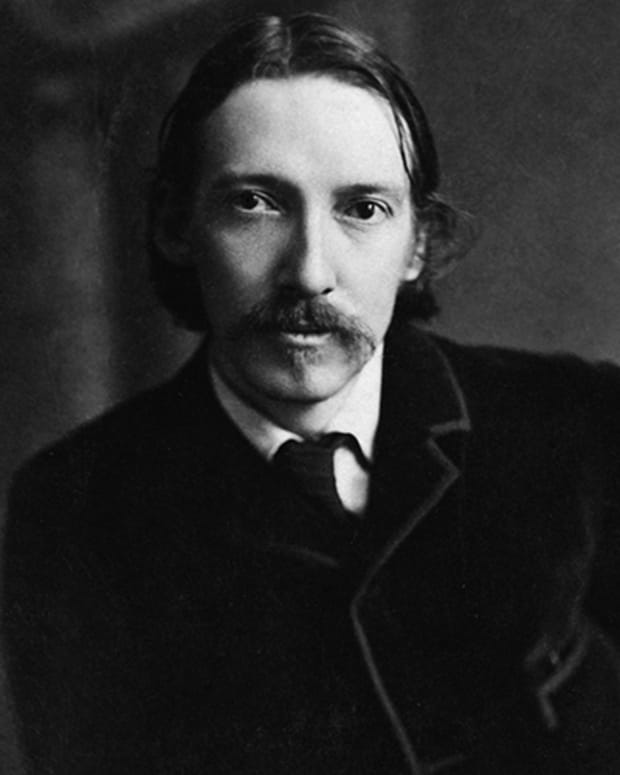
In the end, the problem is that O’Farrell, gifted novelist though she is, cannot compete with Robert Browning’s original. (Picture of Browning , right) The subtlety and nuance of his version of events requires readers to work hard to unpick its story. He pays them the ultimate compliment of trusting their intelligence to pick up the thread he has carefully woven through the verse. Somehow, it makes for a more satisfying read than O’Farrell’s four hundred plus pages of prose, no matter how beautiful much of it is.
I was left with a feeling of disappointment and let down. What promised much delivered very little. I’m hoping her next novel will abandon a reworking of our literary heritage and strike out with something new. It’s a difficult habit to kick though, once you’re in the grip of addiction. And there’s so much to choose from:
Goblin Market by Christina Rossetti (All that suppressed sex and oozing juice of ripe fruit. It could certainly stand a Game of Thrones mash up)
London by William Blake. (who was that mysterious man wandering around those “Chartered streets”?)
Dickens’ affairs with Ellen Ternan and Georgina Hogarth. (With the added Gothic bonus of the Great Man’s attempts to have his wife locked up in an asylum)
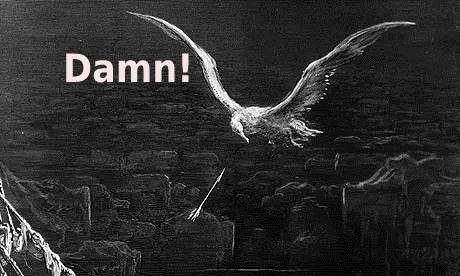
And, of course, that old favourite, beloved of English teachers of a certain vintage, from the days of 100% coursework and “creative responses”, a retelling of The Ancient Mariner from the point of view of the Albatross. That would be a challenge. It was certainly beyond the grasp of most of the Year 11 kids who attempted it in the Eighties.
On second thoughts, I have some advice for Ms O’Farrell. Just step away from your laptop, Maggie, take some time out, and come up with a contemporary tale set in the here and now. Now that would be worth waiting for.
Rick, Deputy Head at Fairfield High School, is the senior member of staff on duty at the annual leavers’ Prom. It’s a hot summer’s evening and resentment runs high over the Zero Tolerance regime instituted by the new Head, Camilla Everson. Meanwhile, a gaggle of Year 11 students, led by the notorious George Mason, who have been formally banned from attending for a variety of crimes and misdemeanours, have plucked up the courage to invade the event
Rick checked his watch again, and took a drag from his cigarette. He had slipped out of the house, weary of the thumping bass and flashing lights, and had made his way to the terrace at the back of the mansion. It was strictly out of bounds for the students as part of the licensing agreement, but it was understood that staff could use it for temporary respite throughout the evening.
He sat at a table on the terrace in the darkness, looking out onto manicured lawns, grateful for the cool quiet out there. Kevin had been there when he arrived, enjoying a solitary cigarette on his break, so he took the opportunity to ponce a cigarette from him, a treat all the more delicious for its rarity.
“Jo would kill me if she saw me with this,” he confided to Kevin, savouring the grey blue smoke whisping away into the night sky.
“Well, your secret’s safe with me Rick,” he replied.
“Another half an hour and that’s our lot, I think,” said Rick. “Music off, lights on and the wait for the parents to pick ‘em all up.”
“Yeah,” agreed Kevin, “All over for another year, eh?”
“It’s gone pretty well, actually. Better than I expected.”
“Yeah, it could have been much worse in the circumstances. At one point I thought we’d only have twenty kids here. Nothing like it used to be, in our heyday.”
“No. There’ve been a lot of changes.”
Kevin hesitated for a moment and then plunged in.
“I’m surprised you’ve stuck around, actually Rick. I thought you would have got a Headship somewhere else. It must be soul destroying, working under this regime.”
It was Rick’s turn to hesitate. He was normally very discreet when it came to talking about the leadership of the school, and had an instinctive professional loyalty, regardless of his own opinion. He had resisted the temptation to spend the last year slagging off Camilla and Pugh to anyone who would listen, and he would have had an eager and receptive audience, but it hadn’t seemed right to him to turn into that kind of Senior Leader.
But now, his resolve weakened by a long year of humiliations, and lulled into conspiratorial mood by the shared cigarette in the darkness, he cracked.
“Yeah, it is Kevin. It has been. And who knows? I might jump ship early next year if things don’t change. I’ve just tried to do my best and head off some of the madder innovations she wanted to introduce, but looking back, I’ve failed dismally at that. I might as well have gone to be honest.”
He kept quiet about his pact with the devil that was Alastair Goodall, but he was feeling increasingly tainted by it, and for what? There was no sign he was going to get any benefit from it, apart from his enhanced salary for the last year. It sat uncomfortably with him anyway. Maybe he should knock that on the head as well. The whirl of conflicting thoughts left him unable to say more.
He stood up, looking at his watch once again.
“Come on, no point moping around here. It’s time to wind this down, while we’re still ahead.”
“Yep, we’ll get no thanks for worrying about it. Let’s go, I think we’ve all done enough for one night.”
They walked back in. As they turned the corner, there, framed in the light spilling from the entrance, was one of the teachers peering into the dimly lit terrace.
“Rick? Rick, is that you?”
“Yeah, who’s that? Mary, is that you? What’s up?”
He screwed his eyes up at the figure obscured by the light behind her. He had correctly identified Mary, the Head of Art.
“I think you’d better get in here, quick. We’ve been invaded.”
She disappeared back in to the building. Rick and Kevin looked at each other, baffled.
“Invaded?” said Kevin, “What on earth does she mean?”
When they got back in the building the first thing that told them something might be amiss was the unmistakeable smell of marijuana.
Kevin wrinkled his nose.
“Is that what I think it is?” he asked.
“Who the hell is stupid enough to come to the Prom and smoke weed?”
Then one of the Promgoers burst from the disco room and ran towards them.
It was Jason.
“It’s George, Sir, George Mason. He’s gone mad.”
They ran to the door way and looked in. There in front of them, in the middle of the dance floor amidst a crowd of teenagers, was George, can of lager in one hand and enormous spliff in the other, swaying and dancing to the music.
“What the bloody hell..”
Kevin grabbed Rick’s elbow.
“It’s not just George, look,” he said.
Around the room, the rest of George’s crew were similarly engaged, smoking, drinking and dancing. Their dancing was not quite as hypnotic and dreamy as George’s. Instead, they were taking great pleasure in bumping into each other and anyone else who came within range. As Kevin and Rick watched in horror, this transformed itself into synchronised barging of other innocent dancers, who were sent flying across the dance floor, crashing into other. At the far side of the dance floor, the DJ, who ten minutes earlier had been looking forward to winding it down with couple of slow numbers, looked on at first bemused and then increasingly concerned. A series of teachers who had been supervising the dance floor had tried to intervene with the interlopers. They were at first ignored and then threatened by their former pupils, who were emboldened by their success so far.
Rick had seen enough.
“You stay here on the door, Kevin, I’ll only be a minute.”
He dashed out of the room and spoke first to the security man on the main entrance who had returned from his fag break and was blissfully unaware that anything was amiss.
“Hey, where the hell have you been? We’ve been invaded and you didn’t see a thing.”
“What? What do you mean, ‘invaded’? No-one has got past me without a ticket.”
“Never mind,” said Rick, “radio your mate on the front gate and get him up here, pronto and then both of you get yourselves to the dance floor. We need you to earn your money.”
“What about the police? Shall we ring for them?”
Rick thought for a moment.
“No, not yet. We don’t need them yet. Go on, man, hurry.”
Back on the dance floor the carnage continued. Then, like a bucket of cold water thrown over rutting dogs, the mood was broken. The music stopped immediately at the same time that the flashing strobe lights were replaced by the harsh overhead neon strips. The dancers stumbled and stood still, blinking in the unforgiving glare of the illumination.
A strange silence filled the room and the dancers and teachers looked round at the newly exposed hooligans, left like flopping fish gasping for breath out of the water. It was filled by a commanding voice from the doorway. All eyes were drawn in that direction.
“Alright everyone, listen up. The party’s over, I’m afraid. A little bit early, but I’m sure you’ll understand why? All students here with Prom tickets, you need to head next door with all of your stuff and get yourself ready. Parents and cars will be arriving in the next five minutes. Let’s make sure we don’t give them anything to worry about, especially on a night like this.”
There was an outbreak of grumbling abut the turn the evening had taken.
Rick held up his hands and started again.
“Yes, yes, we all know you’re disappointed, but we were nearly at the end anyway. There might even be a few keen parents already here waiting outside. So, let’s start to make our way through, please. And if I could ask a couple of members of staff to go through as well, just to make sure all is well?”
Three or four of the staff stepped forward and began to usher students out of the room. As they went, the invaders, looking round at each other began to put up their hoodies and fiddle with their bandanas.
“Oi, you lot. There’s no point hiding your faces, we’ve all seen you and we all know who you are. “
They stopped, embarrassed.
“Now listen. You’ve made a big mistake coming here tonight. You really shouldn’t have done it.”
One boy was bold enough to air his simmering sense of grievance.
“We should have been here anyway Sir. That old cow shouldn’t have banned us, she’s mental, you know she is Sir.”
“Eh, that’s enough of that. Whether you think you should have been banned or not, you were, and that’s all that matters.”
Two or three others joined in, adding their voices to the argument.
“It’s not fair, we get the blame for everything. Fucking teachers always think they’re right. We’ve had enough”
Rick hesitated. He had counted them. There were fifteen of them and about eight members of staff. They were drunk and stoned and very angry. He knew that it wouldn’t take much for this to turn ugly. Soon the two security guards would arrive, and they as a rule, did not do subtlety or negotiation. He knew that he would have to arrive at an agreed resolution in the next couple of minutes or risk disaster. He started again, hoping that his anxiety about the gravity of the situation did not bleed into his voice.
“No, no. no. that’s not going to get you anywhere. You need to start thinking sensibly about this, so that you don’t get yourself into any more trouble. The police are on their way. The security guards will be along in a moment. If I were you, I’d want to be leaving here as quickly as I could, without drawing attention to yourself.”
A familiar voice broke in, interrupting him. It was George.
“What’s the point of doing that, ‘cos you’ll just give all of our names to the police anyway? You’ve already said you know who we are. You must think we’re fucking stupid.”
This intervention stirred the pot again, and there was more rumbling from the mob.
“Language George, please. And, no, I don’t think you’re stupid and I never have done. For a start, I have no idea why you’re here anyway. This is not even your year group and not even your Prom. But let’s not go into that now. The point is this. I give you my word that if you all leave quietly now, taking all of your stuff with you, and there is no trouble with the parents or on your way home, then we’ll say no more about it.”
“See,” snorted George, looking round at the others, “He obviously does think we’re stupid. Don’t fall for this lads, he’s obviously gonna grass us up.”
“George, as far as I know, all you’ve done so far is gate crash a party and smoke a bit of weed and drink too much lager. You shouldn’t have done any of those things, but they’re not hanging offences. Or are you worried about something you’re not telling me?”
“No, course not,” George snapped back.
He turned his frustration on his colleagues. “See what he’s doing? Typical bloody teacher, he’s twisting everything. He’ll dob us in it alright, you see if he don’t.”
It hung on a knife edge. One voice from the mob piped up, “Nah, I don’t think so George. Mr Westfield aint like that, he aint like the others. He always does what he says.”
There was silence as they considered this idea and in that silence it was over. The first of them walked towards the door, followed by a couple more. Then, the rest of them followed. As they passed him to get through the doorway Rick said, “You could probably get a lift home with some of your mates, if you ask nicely.”
Finally, only George remained, standing in the middle of the dance floor. Rick said to the last few members of staff, “Do you guys want to go and help outside, while George and I have a chat?”
They slipped quietly out of the open door through to the hubbub beyond.
George clutched his lager and stared with a set face at Rick.
“So, George” Rick began “Are you going to go along with this and leave quietly? I meant what I said about not taking it any further.”
“Nah man,” George sneered, “don’t come it with the concerned, caring chat routine. Why should I listen to you? You’re the one that got me excluded. You and that Syrian cunt.”
“No, George, you got yourself excluded, you know that as well as anyone.”
“You got an answer for everything, aint you? If my Dad were here, he’d batter you for what you did.”
“Yes George, you’re right, he would. And he’d do a pretty good job of it as well. He’s good at battering people. But who would he go on to batter after he’d finished with me George, eh? And then what would happen? Because there comes a point where using your fists just isn’t enough. But you already know that, don’t you?”
George’s grip on his can of lager had been steadily increasing as he had listened to Rick, his knuckles whitening as he squeezed in rising anger. Without warning, hurled the half empty can with all his strength at Rick’s head with a roar of rage. Rick ducked and the can thudded into the wall behind him, spray spuming everywhere with an angry fizzing. George started forward and grabbed Rick by the lapels.
One of the qualities that had served Rick well as a teacher in a tough urban school was his unflappability. He had ice running through his veins and the capacity to exude calm when all around him were panicking. He knew that George was a very big, powerful lad who didn’t need the amount of alcohol he had consumed to make him dangerous and unpredictable. But Rick himself was tall and well-built. Years of sport and the gym had left him with a confidence that he could look after himself.
He put his arms through George’s and laid his hands on his chest, firmly exerting pressure on him.
“George, man, calm down. Don’t make things any worse than they are.”
George, still incensed, tried to wrench Rick towards him by the lapels, but found that Rick was too strong for him.
Rick’s voice was quiet and even and he looked George directly in the eyes
“George, come on. You’re your own worst enemy. Give yourself a break. Let go and calm down.”
There was one final attempt to overpower him. When that failed, with Rick looking steadily at him throughout, he gave up and with a howl of frustration and despair he pushed Rick to one side and stormed out of the room, barging past students and teachers alike, some sent flying like skittles as he turned the air blue with an extended volley of industrial language. He snatched up his carrier bag of lager from behind the desk and charged through the ground floor until he found the doorway to the terrace. He crashed past the two security guards who were skulking around, desperately trying to avoid being called into action, and disappeared into the cool darkness of the gardens.
Sign up to the blog to get an email alert every time a new post is issued. You can buy a copy of the novel, Zero Tolerance, using the links below:
An extract from “Zero Tolerance” by The Old Grey Owl
Rick, Deputy Head at Fairfield High School, is the senior member of staff on duty at the annual leavers’ Prom. It’s a hot summer’s evening and resentment runs high over the Zero Tolerance regime instituted by the new Head, Camilla Everson. Meanwhile, a gaggle of Year 11 students, led by the notorious George Mason, who have been formally banned from attending for a variety of crimes and misdemeanours, have plucked up the courage to invade the event
The disco was in full swing and under the strobe lights, Rick could just about make out the identities of the gyrating bodies. Occasionally, the pursuit of teenage kicks led to Rick and some of the other senior members of staff in attendance having to remind a few people that snogging should be restrained and controlled. The air inside was thick with pheromones, Lynx and Babe Power. It was at moments like these that Rick was most glad that there was a no alcohol policy. Add that to the mix and there would have been carnage.
The familiar and comforting tropes of the Year 11 Prom were being replayed in front of him. He had been asked several times to “Show us some moves” and had dutifully provided appropriate dad dancing to keep the students amused. He had chatted to staff about their summer holidays. He had taken a thousand photos and had photobombed a thousand selfies. Ties and jackets had long been removed, to be replaced by sweat stains and flapping shirts. Expensive gelled and sprayed hairstyles had started to wilt, mascara to run, and regular missions to the toilets were undertaken for running repairs.
Even better, O’Malley was about to go. Rick had had the delicious experience of walking in to the main dance area with him, to be met with a subtle but unmistakeable outbreak of hissing. To his credit though, O’Malley had stuck it out, even though he was snubbed by both staff and students alike, so that he ended up drinking orange juice on the door with the Security guard. Eventually, after braving several laps of the venue, hissed at wherever he went, he finally came up to Rick and said, straining to be heard above the music, “I think I’ll make a move now.”
“Ok,” Rick replied, “See you on Monday”.
He watched as O’Malley picked his way through knots of people chatting and taking photos, inching his way to the exit. He was about to go and have a sit down in the quiet room when Jason came over to him and shouted, “Eh Sir, come on, it’s the conga.”
He hauled himself to his feet. “Alright Jase, if I absolutely have to,” he said and followed him back into the dance room.
*
On the main road by the entrance, a red double decker bus stopped and about fifteen raucous youths got off, George in the vanguard of the battalion. Twenty minutes earlier they had mooched around in the street outside the Trafalgar, George still smarting at his humiliation in the pub and the ruination of his Friday night.
“This is fucking rubbish man,” George had pronounced, “What are we gonna do now?”
“There’s always the Prom,” ventured one of the others, “Why don’t we go up there and try and get in? It’d be a laugh.”
“Come on George man, they shouldn’t’ve banned me in the first place, and you never went last year. They’d shit themselves if we all turned up there mob -handed. They’d have to let us in.”
“Yeah come on,” George agreed, “Let’s go shop and buy some more cans and then get on the 165. We’ll be there in fifteen.”
Their spirits rose with the advent of this new plan and by the time they boarded the bus they were loud, aggressive and objectionable in equal measures. It was an uncomfortable journey for those passengers who had made the innocent mistake of getting that particular bus at that particular time.
The driver was relieved to see the back of them as they all piled off at the stop. Although it was only fifteen minutes away from the Trafalgar they found themselves on a lushly wooded fast road with detached houses set back behind long, mature gardens. It was golf course territory. They stared at the houses and breathed in the fragrance of money.
“Fucking hell, look at those houses, fam. Why do they have the Prom here? Talk about fucking rubbing our noses in it.”
They all stared, each of them lost in a vision of their own. Some were consumed with jealousy, some anger, some inferiority, some acceptance, of a world that existed and that they couldn’t change. Eventually they roused themselves. They started off down the road towards the entrance to the mansion when George, out in front, stopped dead.
“Shit. There’s security. We’ll never get past him without a bit of trouble.”
Illuminated by a solitary street light up ahead was the unmistakeable figure of a bouncer. Shaven headed, with sunglasses and a walkie talkie. They all ducked tightly into the trees by the side of the road and began talking quietly.
“Listen,” said George, “I aint going back after all this. If we go over the fence here, we can get in that way, go through the woods and end up on the drive way that leads to the big house.”
After a prodigious session in the Trafalgar, topped up on the bus with a few cans, this seemed to them the most reasonable plan ever devised. Without any hesitation, the rabble began to shin up the fence and over. Two minutes later, with a few barked shins and bruised arms and legs, they were all over the top and in the woods. Clutching their carrier bags full of lager, they tracked the path while staying in the woods until it turned a bend, so that they would be invisible from the road.
Under the canopy of the trees, the warm night air was soupy with pollen and earthy scents and there was a strange quiet, with only the distant hum of the traffic leaking into the undergrowth. They were an unlikely crew, with baseball caps, trainers and carrier bags, crashing through brambles and whiplash sappy branches. Occasionally, they stopped to get their bearings and they listened to the eerie sounds of snuffling, scurrying wildlife yards away from them.
“Fucking hell, man, what was that?” exclaimed one of them after a particularly piteous set of cries came from a thick clump of rhododendron bushes up ahead. Something was meeting a brutal end in this lush Surrey woodland. They all pulled up and looked around, peering through the swirling blackness. Suddenly, the Trafalgar, with its comforting brash lights and noise, seemed many miles away.
“I hate the fucking countryside,” George pronounced, “Come on, let’s get on the path.”
They didn’t need telling twice. They spotted a light in the distance, winking intermittently through the branches, and they set their sights on that, pushing aside branches and thorns that whipped back in their faces when released by the person immediately in front. When they emerged from the trees onto tarmac they presented a sorry sight: faces and arms scratched, out of breath and sweating, they resembled the apocryphal lost soldiers emerging from far eastern jungles unaware the war was over. They were thirsty, tired, disorientated and in dire need of something resembling entertainment to make this great trek worthwhile. Recriminations were beginning to bubble to the surface.
George leaned forward his hands on his knees, wheezing, red faced, slicked with sweat. This was the furthest he had walked since he was seven years old, and his head was spinning.
“Jesus,” he gasped, “whose fucking idea was this? This better be worth it fam, or there’ll be trouble, I’m telling you.”
As they filled their lungs with the night air and wiped the sweat from their eyes, they surveyed their surroundings. They were a little confused to see, not the imposing splendour of eighteenth century architecture, but a car park, and a few out buildings.
“Shit,” said Adam, “we’ve come the wrong way. This aint it.”
“Fuck, that’s all we need. I’ve had enough of this, man. This fucking sucks.”
There was a general murmuring of agreement when George said, “Hey, look over there. Who’s that geezer?”
The car park was flooded with lighting and they squinted their eyes to adjust. It was Adam who said, “I don’t believe it. It’s that cunt O’Malley. He was the fucker that had me excluded and banned.”
They all looked at each other, each of them thinking the same thing, but waiting for permission to act. George, still bubbling with resentment from earlier slights gave it to them.
“Come on, let’s get the fucker.”
*
O’Malley looked up at the sound of running and a shout. On the far side of the car park was a group of about twenty youths, all with hoodies up and bandanas on, charging towards him, shouting. He froze.
“What the ..” he exclaimed, but before he could do anything they had surrounded him, shouting and taunting him.
He was petrified. There was nothing he could do, so thinking as quickly as his terrified brain could, he played for time. Surely, someone else would come to the car park soon. He wondered whether the security guard would hear him if he took a chance and started to scream, and he concluded that no, they probably wouldn’t above the insistent thumping of the disco. His only option was to talk.
He held his hands up, outstretched in supplication. “Lads, let’s not do anything silly now. Let’s just calm down, and talk this through.”
George, his voice muffled by his bandana, walked towards imitating his voice, as if it were that of a little girl. “Oooh, lads, let’s not do anything silly now. Let’s just calm down because I am shitting myself here.”
The circle of his accomplices laughed and joined in. George took a few steps towards him and began poking him in the chest.
“I hear that you banned some of my mates from the Prom, Is that right?”
“Look, you need to think about what you’re doing. You’re on CCTV and the house is full of people who can identify you. I think you should just turn around and let me go before you do something you’ll regret.”
O’Malley had mustered as much calm gravitas as he could. He hoped that they couldn’t see he was panic stricken. He was mistaken.
“Nice try, but for once, it’s the kids who are gonna tell you what to do, bruv.”
The circle tightened around him and his cries were muffled by the press of bodies. A few minutes later he had been bound and gagged with some of the bandanas and locked in his own car.
“That’ll do for now ,” said George through the open window. “We’ll be back, so don’t go away. Oh, sorry, I forgot, you can’t.”
This provoked a chorus of laughter and jeering. George wound the window back up and locked the car.
“Come on,” he announced to the triumphant group, “It’s round two.”
They followed him, hoodies and bandanas still in place, carrier bags stuffed with cans swinging in their hands, as he skirted the car park in the direction of the thumping bass of the sound system. They rounded a corner and saw the mansion. In the light that spilled from the open doorway, a second bouncer was clearly visible.
“Shit,” cursed Adam, “another one. Now what?”
They huddled together hard up against the wall of the building, out of his eye line, waiting for inspiration to strike. Just as they were beginning to lose hope, they saw the familiar flare of a match, followed by the glowing tip of a cigarette. The bouncer, taking a drag from the cigarette, stretched and began to walk away from the entrance, away from them and around the corner.
George looked in, a smile spreading across his face. “Yes! He’s on a fag break. Come on lads, we’re in.”
He sprinted to the door, keeping as close to the wall as he could, weaving in and out of the bushes, in case the bouncer returned early. The others followed and they all piled through the entrance into the warm yellow light of the foyer. One or two students, taking refuge from the dance floor, or en-route to the toilets, looked up in alarm as the rag tag army burst in, euphoric after their successful kidnapping of O’Malley, and the ease with which they had gained entry. It seemed to them that there was nothing they could not achieve.
And then, reality dawned on them. They looked at each other with their carriers of lager, hoodies and trainers, and then at the Prom goers, who gaped at them open-mouthed, in their shiny suits and tight dresses.
“Look at the state of us, man,” whined Adam, “we stand out like a sore thumb. What are we gonna do now?”
George considered for a moment and then pronounced his judgement.
“We’re gonna blend in, bruv, blend in. And, we’re gonna have a little drink, and a little dance, and a bit of a laugh, for as long as we can get away with it.”
Adam’s face registered disappointment and the rest of the crew looked sheepish.
George felt like a lion leading donkeys.
“Or, you can bottle it and all just fuck off home. You’re on your own.”
He took a can from his carrier, cracked it open and, and took a long, deep draught. Then he placed the bag behind the reception desk, the open can in his pocket, and he sauntered towards the dance hall. The others watched him go. When he had disappeared into the flashing lights and pulsing shadows, the others looked around at each other, leaderless and unsure.
It was Adam that was the first to crack.
“Oh, fuck it,” he said, “might as well.”
He went through the same series of actions as George, and followed his route towards the promised land. One by one the others all followed.
The two prom goers, who had observed the whole scene with a growing sense of fascination from the corner, watched them go. They turned to each other.
“We’ve got to see this, come on.”
“First things first,” said the other, reaching for his phone.
He opened Instagram and, in a blur of texter’s fingers and thumbs, he messaged, “Prom just been invaded by George M and his gang!”
The news spread like wildfire.
Part 3 will follow in a day or two. Sign up to the blog to get an email alert every time a new post is issued. You can buy a copy of the novel, Zero Tolerance, using the links below:
A first return to The Globe after a pandemic-induced absence of a couple of years made me long once again for lockdown. As someone who was an English teacher in London for about 35 years, I’ve been a regular visitor, both on my own and with students. In the days of Mark Rylance as Artistic Director it was invariably a thrilling experience, with the pleasures of the authentic setting enhanced by the quality of the productions.
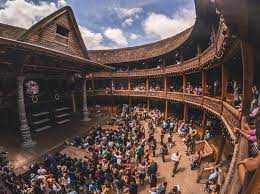
In recent years, however, a trip to The Globe (pictured right) has been something to be endured rather than enjoyed. More and more it has come to resemble just another version of famous world city tourism, an experience to tick off the list made by people on a schedule: The Colosseum in Rome, The Louvre in Paris, The Rijksmuseum and Anne Frank in Amsterdam etc etc.
I knew nothing of the production before we booked. We originally wanted to see Much Ado, but that was all sold out. There were tickets for Lear and as far as I could see, very little publicity for it. I was amazed to find out, when digging a little deeper into the production, that this was a reprise of a famous role for Kathryn Hunter, who first did the role back in 1997, also for director Helena Kaut Howson. That, apparently, was a groundbreaking, brilliant production and performance.
It was very hard to tell from this feeble revival. I have to begin this merciless hatchet job with a tiny caveat. We have both got to the advanced age where subtitles are necessary for us to be able to follow any drama on TV. That undoubtedly contributed to the difficulties we both had with this performance, but to be honest, by the time we walked out of the theatre at the interval, I was actually glad I couldn’t quite hear the lines clearly. That would have just served to underline just how much the play was being brutalised.
We were also badly served by our seats -The middle gallery, level with the two main pillars of the stage – so for seventy percent of the time, the speaking actors were facing away from us, and their lines drifted away into the summer’s evening air, to compete with the helicopters and jumbo jets that seemed to pass overhead every five minutes.
But all of this was just background annoyance. There are more substantial complaints to come. The story is complex, the language difficult, the characters and relationships hard to pin down. So a production has got to do the bread and butter of exposition much better than this. Clarity of verse speaking, costume, gesture, body language, props, scenery- all of these need to be used imaginatively to pin down what the scenario is from the beginning. Of course, the division of the kingdom, the three daughters and their declarations of “love” were established well enough (partly because they are so well known), but the subtleties of the interplay between Edgar and Edmund, Gloucester and Kent, the husbands of the “bad” sisters, all of this and much more was abandoned to garbled verse speaking, knockabout comedy, and lots of stage business, with hammy actors walking around the stage for no apparent purpose except to lend the lines some additional dramatic force. It failed miserably to lend any of it any dramatic purpose at all.
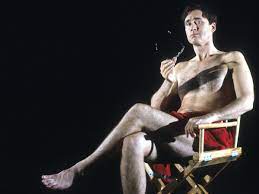
It was old fashioned Nigel-Planer-Nicholas-Craig-style Actoring at its worst. (Nicholas Craig pictured left) Hand waving, strutting, movement across the stage with no discernible realistic purpose – it all just screams, “We are doing serious Shakespeare stuff here.” This was also accompanied by full-on, shouting-the-lines, Shakesperean declamation.
This was particularly the case for Regan. Or, in the case of Edmund, lines delivered in a softly spoken accent that made them very difficult to follow or to take seriously. He also seems to have been directed to play a lot of his lines for laughs, like his legitimate brother, Edgar, whose performance when he had “gone mad” was particularly ludicrous.
That appeared to be the default position. To give this difficult stuff more audience appeal, let’s make sure we mess about and crank up the physical comedy. It seemed to me to be totally inappropriate, and detracted from the drama and tragedy of the play. Unfortunately, on the night I attended, the groundlings seemed to be heavily stocked with the friends and family of the people working on the production, such was the enthusiasm of their laughter, like regular bursts from a machine gun. What on earth they were laughing at, and how that helped a complex, subtle, human tragedy was beyond me.
I don’t especially blame the actors for this. Presumably, they were responding to the director, and in Shakespeare in particular, the director makes (Nicholas Hytner) or breaks (Rufus Norris) a production. In this case, Kaut Howson (pictured right) absolutely destroyed this production. She has been recuperating from an accident, apparently, so perhaps that explains it, but nothing can reasonably excuse this exercise in painting-by-numbers direction.
It did occur to me, as I tried in vain to take my mind off the car crash as it unfolded in front of me, that actually, the play would have been much better suited to the dark, atmospheric candle lit magnificence of the Sam Wanamaker theatre. The Globe can manage knockabout comedy. A warm Summer’s evening lends itself to a lighthearted romp. The Wanamaker would certainly have helped Hunter, whose voice seemed lost in the open air setting.
During one of the many longeurs in the first half, I found myself looking down on a gaggle of young people, mainly boys, either on a school trip or on a foreign exchange arrangement. I lost count of the number of them who were surreptitiously messaging and surfing the net on their phones. My old-person-English-teacher instinct kicked in immediately, but I did manage to exert some self control and stop myself from scowling and tutting. By the time the interval arrived, I’d joined them, checking my messages.
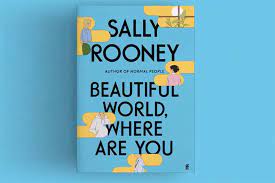
Sally Rooney’s third novel frustrates and disappoints in equal measure.
The View from The Great North Wood
I’m sad to report that the answer to the question posed by the title of Rooney’s third novel, “Beautiful World Where Are You?” is, “Well, not here, at any rate.”
I had looked forward to this for some time, keenly anticipating more of the glorious writing that characterised “Normal People”, a novel I loved, with great surprise after finding her first effort, “Conversations with Friends”, a full blown example of the Emperor’s new clothes. The critics gushed, and told us we were witnessing a new kid on the block who was authentically chronicling life and love as experienced by the middle class, educated twenty-somethings of Dublin (and by extension, everywhere else). I found it tediously thin and empty. “Normal People”, on the other hand, is one of the great novels of the twenty first century, a subtle and beautiful story of an enduring and evolving relationship between a “difficult” middle class young woman and a talented working class young man.
So I come to this with some perspective. Neither an adoring fan, nor an anti-woke critic, I really wanted to love this book. And there is much here to enjoy and admire, but ultimately, it disappoints. It tells the story of four young adults in Dublin and some unspecified Irish seaside town, and their attempts to find meaning in their lives and relationships, doing so via different perspectives, omniscient narrator and text/ digital message exchanges.
Rooney seems at pains to demonstrate how much she really is the voice of a new generation by laying on with a trowel the importance of social media to all of these characters. Time and time again, scenes are punctuated with exhaustive (and exhausting) descriptions of tapping on social media icons, scrolling through news feeds, checking messages etc etc. Sally, we get it. You don’t need to do this. We all do these things, even old fogeys like me. It’s a bit like Charles Dickens droning on about closing the doors on that new-fangled train type thingy. Interestingly, the key relationship, the friendship between Eileen and Alice, only seems to work digitally, when they are writing to each other. Whenever they are together physically in the real world, they fall out, and their friendship seems false and unsupportive.
The social media stuff, and the painstaking, repetitive description of the physical choreography of sex, shows that Rooney seems to want to challenge Knausgard in her relentless accretion of the mundane details of the business of living. Again and again, we are battered with flat, colourless prose recording hands resting on limbs, legs touching and not touching. And just like Knausgard, it is draining and dull and says nothing, a mere inventory masquerading as an insight into a new configuration of millennial sexual relationships.
It’s also hard to love a book that focuses on such unlikeable characters. The two women, Alice and Eileen, apparently best friends, are tiresome in the extreme. Alice is a thinly-veiled portrait of Rooney herself, a young female Dublin novelist who is lionised from her debut novel. This in itself is a little depressing. It’s like the Rock Band who have made it big. Their first album is sparky, innovative, full of energy and ideas. The difficult second album is more of the same with greater technical competence. Then, when they’ve broken through and are established in the mainstream and are selling out stadiums in America, the third album is written in hotel rooms and includes songs about the emptiness of life on the road in endless hotel rooms. The songs reflect their changed circumstances, but who gives a toss? It’s very difficult to empathise with the neuroses of the creative rich and famous.
After a vague nervous breakdown, she now clearly despises the trappings of fame and despairs of the emptiness of her life and world. No matter how hard I tried, I really couldn’t summon any sympathy for a woman afflicted by wealth, fame and privilege. Her friend Eileen, from their university days, is presented as the junior partner in the friendship. Less successful, less confident, her relationship with Alice mirrors that with her elder sister, Lola, despite the fact that Eileen loathes Lola and idolises Alice. Her lack of agency, her diffidence in articulating clearly what she wants, her self-pity about her life, is after a while, simply grating, generating annoyance rather than empathy. A key narrative thread in the novel is her long-standing love for Simon, five years older than she is, who she has known from home since childhood. They have had a history of almost, but not quite, falling into the relationship that clearly both of them want, but circumstances and other relationships, and bad timing have prevented from happening. Simon is probably the only likeable character out of the four, and is in some sense, a rehash of Connell from “Normal People”. Committed to social justice, modest, strikingly fit and handsome, and successful in terms of a career in the political world, he seems like a nice self-effacing kind of chap. Obviously he is markedly inept in terms of opening himself up to intimacy, but dear readers, there are worse crimes to be indicted for.
There is an element of their relationship that works well for me and it’s another echo of “Normal People” which was a tour de force on tentative, awkward communications between people who really like each other but are scared they might say the wrong thing and ruin it all. This is beautifully done there and once again, the conversations between Eileen and Simon are toe-curlingly awkward and realistic, leaving the reader wanting to shout at them, “Just tell each other straight, for God’s sake” Rooney is brilliant on this kind of self-sabotage through embarrassment and feelings of lack of self-worth.
“Telling each other straight” is the one positive quality I could discern in Felix, the final character of the four. He seems to be the partner of choice for Alice so that Rooney can signal her right-on ness yet again. He’s an unskilled working-class chap who she meets on some Tinder-type dating app. Their first date is a disaster but she is intrigued by him. As the novel progresses, we learn that he was a low achiever at school, and does not read, so has little idea of her career as a novelist, but it is clear from Rooney’s descriptions and his dialogue that he is intelligent. The dialogue between Alice and him is refreshing and thought provoking. They fence around like all of the others, but Felix’s great strength is that he is fairly clear and straightforward about what he wants from her. He’s respectful about asking though – this is not a portrait of an abusive man – but Rooney deliberately muddies the waters by including a scene where Alice finds some particularly nasty, violent pornography on his phone. The fact that she does not judge him negatively for this seems to be part of Rooney’s schtick that modern love and sex is different somehow.
I don’t buy it I’m afraid. He lets her know he is bisexual and makes a mockery of his own name by making it very clear he’d like to have sex with the gorgeous Simon, right in front of Alice and everyone else. Rooney seems to be saying that, these days, for these fabled millennials, sex is just another appetite and is disconnected from other emotional connections. Loyalty, fidelity, exclusivity in relationships seems so last century. The ghastly Felix, appears utterly selfish on one level, such that, in a scene late on in the book, when he gets back home to be reunited with his beloved dog and there is a detailed description of him lovingly stroking it, I feared for the dog’s honour. We were genuinely just a short step away from a bold depiction of the love that dare not speak its name. Fear not, gentle reader, the dog survived, honour intact. As did Felix’s relationship with Alice, which just did not ring true to me.
There are some redeeming features. The opening 4 or 5 chapters are wonderful. She is a beautiful, precise writer, and effortlessly draws the reader in to a scenario. I was expecting something magnificent, but ultimately, I was disappointed. She is also brave enough to tackle big ideas. The email/message exchanges between Alice and Eileen have them dissecting weighty themes about the meaning of life. What is important? What really matters in life when climate change and populism threaten our very existence? Rooney concludes it is the connections we make with other people and the pursuit and enjoyment of cultural beauty. The trouble is, after a little while, one’s heart sinks when yet another musing whatsap message exchange about the meaning of life hoves into view. In the end, I just flicked to get to the narrative. Ideas are all very well, but let’s not forget about the story.

Speaking of the story, very early in the novel she gives us ten pages of back story, telling us about the childhood connections between Eileen, Simon and Alice. It’s a curious pause in the proceedings. On its own, it’s a masterful bit of plotting which could have been the outline of a very satisfying, better novel. And then I realised that it was too close to the plot/milieu of Normal People, so she couldn’t just repeat that again. So in effect, it’s a what-happens-next continuation of Normal People in disguise.

The weirdest aspect of the novel for me, given that I think that Rooney is a great stylist, is the curiously flat, perfunctory prose that sucks all of the life out of every description. There is a distance set up between the reader and the characters, and in effect, between the characters themselves, because the style makes it so hard to care about what happens either way. At times it’s like reading the shipping forecast, or a clinical psychotherapist’s academic report, holding up a mirror to the participants.
She’s a wonderful writer, but at the moment the scoresheet reads won 1, drawn 1, lost 1. She needs a big result from the next book. I’ve got my fingers crossed.
The Great American Novel: the weight of expectations and current US obsession with Christianity is too much for Franzen’s latest effort to bear.
For a certain type of contemporary fiction lover, there exists a fascination with the pursuit of The Great American Novel. The very idea seems to me born out of a longing for old school respectability in the ranks of American commentators. American pre-eminence in the new cultures of the Twentieth century only serves to sharpen the longing for recognition of their excellence in proper culture – fine art and literary fiction – rather than the bubble gum worlds of the movies, TV and pulp fiction.
It speaks to a notion of America being both looked down on for its cultural poverty at the same time as being lionised as the world’s major superpower, politically and economically. “Give us some respect”, it seems to shout, “we’re just as good as you failed old Europeans. You’ve had your day -it’s our turn now”
This is the mindset that periodically proclaims someone to be the latest carrier of that torch. The writer in question (usually a white man) needs to have written a very long book, to be able to bear the weight of cultural expectation. It is, after all, The Big Country. The Great American novelist has been subject to regular reinvention – now a woman, now someone of colour – but the essential premise is the same: this is a great stylist, working on a large canvas, to portray some quintessential truth about a great country.
Jonathan Franzen has laboured for a good few years under the burden of this label, ever since The Corrections was published in 2001, and Crossroads is his latest epic that lays claim to the title, Great American Novel. So, how does he fare?
Well, two out of three isn’t bad, I suppose. It’s just a shame that the one he fails miserably to reach is the most important. Let’s be clear right from the outset, this novel is a long way from being great. It is certainly a novel, of sorts. And unquestionably, it’s American. Looked at from the outside, at a distance and standing in the shadows it could be mistaken for TGAN, but it really wouldn’t pass muster in an ID line up under harsh neon strip lighting. It’s big (540 pages) and it deals with a WASP family from the Midwest, with the usual stresses and fault lines just under the surface, that break out with dramatic consequences in the second half.
So far, so good. If it sounds like a duck and smells like a duck and moves like a duck, it’s probably a …well, you get the picture. Except not in this case. Because despite all the approximations, this is quite clearly not a duck. And the breathless, positive reviews it has garnered all smack of lazy journalism from people who have not actually read it, but have, instead, gone on Franzen’s back catalogue and The Duck thesis. It’s not that Franzen has phoned this in. I think he thinks he was writing a significant opus. He wouldn’t have bothered to churn out 540 pages or so if he didn’t think he was writing a book that said something important and insightful about contemporary American Society. But in a sense, that’s the problem. The minute you start to write with posterity in mind you’re holed below the waterline. Rather like sublime pop musicians who don’t have the confidence in the validity of their genre and then try to write something proper to prove their cred. And before you know it, you’re Emerson, Lake and Palmer.
Some previous Great American Novels
The frustrating thing is that much of the essential material is good. The extended family unit and their dysfunctional dynamic works really well. The patriarch, Russ Hildebrandt, is the head honcho at the local church and has had a reputation of late sixties counter cultural credibility. This makes his later fall from grace, at the hands of a younger, newer version of the hip vicar even harder for him to take. He loses interest in his wife Marion and starts sniffing around a young widowed member of the congregation, the foxy Frances, all the while oblivious to the travails of his various children: Clem the favoured son who having discovered sex at college is on the verge of dropping out and volunteering for service in Vietnam; Becky the well-balanced, beautiful and successful girl who also discovers sex and religion (though not in that order) and Perry, the genius rebel who is quickly disappearing down the rabbit hole of his many, undetected (by Russ at any rate) drug addictions. The characters are well drawn and there are some entertaining and well-drawn set piece scenes, with some sparkling prose at times. But for much of the time, particularly after about a third of the way in, it is painfully dull and repetitive and I found myself flicking the pages of yet more back story to get to the meat of the here and now. It’s far too long. Structurally, it’s a mess, with the momentum of the narrative repeatedly disrupted by really hefty expositions of the back stories of the main characters. In themselves, they are quite interesting, but the overall effect is of having three or four related novels clumsily stitched together to make one mega novel. As avoiding this to protect the reader’s interest in the drama of the main story is a basic rule drummed into wannabe writers by all of the agents, mentors, and creative writing tutors out there, it comes as something of a surprise that Frantzen, a veteran, seems to think the “rules” don’t apply to such as him. If this had been a first novel by a nobody, it would have garnered little but rejection slips.
And then there is the American obsession with religion. Or rather Christianity. Readers of faith may have to turn the other cheek here and forgive me, for I know not what I do. Not really, obviously I know what I do, but you’ll have to forgive me anyway. This is a portrait of a culture, of a community, a family and myriad individuals steeped in the conventions of the established Christian church. And what a stultifying, suffocating, irrelevant, dogmatic portrait it is. What possible attraction does this religion have for anyone? And where were the naysayers? Why are there no characters that push back against this rigid conformity? Becky shows admirable lack of interest at the beginning but then is tempted to join the ghastly Youth Group, the Crossroads of the title. This is initially to get closer to the boy of her dreams, but then after a ludicrous encounter with cannabis, she embraces Christianity with missionary fervour. It makes Cromwell’s puritan Britain in the seventeenth century seem like a liberal enlightenment. By the way, Frantzen’s description of what happens when you smoke a joint, reads like an extract from the reefer madness propaganda of the fifties. Ironically, he manages to serve up the most powerful anti-drug message imaginable. If this is what smoking weed does to you (turn you into a swivel-eyed Christian zealot) then no-one will want to touch it with a barge pole.
The Crossroads youth group is a terrifying manifestation of the brainwashing of vulnerable young people. Given that never -ending revelations about child abuse undertaken under the cloak of respectability provided by The Church are so familiar to us these days, it beggars belief that Frantzen offers no caveats about this highly dubious organisation led by the classic, “charismatic” young trendy religious leader. At its most innocent, it’s a portrait of a nauseatingly smug hero leader basking in the adoration of his teenage congregation. At worst, it’s a lot more sinister, but not for the author, who seems to see it as a force only for good. I imagine he had some sort of similar experience as a teenager or young man. Whether as the Messiah or the Disciple, I’m not sure.
The characters spend so much time agonising about whether they have lived up to the expectations and teaching of the scriptures, that they seem to have little left when it comes to actually treating their friends, family and community with love and respect. If they could just forget about doctrinal regulations, and put the same amount of effort into their own therapy and a better understanding of their fellow man, their lives, and those of the community, would be so much better.
Franzen appears to be aware that he could be accused of being obsessed with the emotional travails of the white American middle classes, and that these days in 2022, he runs the real risk of being cancelled, or worse, thought to be irrelevant. To counter this, he throws in a couple of tremendously awkward sub-plots, one involving the poor black community that are the focus of Russ’ do-gooding endeavours and the other centred on his relationship with a Native American community out in the wilderness of the reservation where as a young, firebrand preacher he had earned his radical, alternative stripes. There is some sense that Frantzen has the self- awareness to satirise white American liberal guilt, but only some. The overwhelming feeling is that these scenes are only there to provide a smidgeon of cred.
Finally, thankfully, the whole towering edifice collapses exhausted at the end. I have no idea why it ended where and how it did. The last third dribbles on in a meandering ineffective way. It could have ended at the full stops of any of the final several hundred sentences, but on it ploughed, as I listlessly flicked the pages praying for the end.
I’m sorry to have been so negative. Buried deep underneath the layers of subcutaneous fat here, there probably lurks a decent, interesting novel. But it’s the job to the writer to do that preliminary archaeology, not the reader. It’s what the editing process is for. 540 pages that could so easily been 280 and so much the better for it.
And guess what? It gets worse. In preparing to write this review , I discovered something I was not aware of when reading the book: Franzen plans this as the first of a trilogy. Oh dear.
Here’s an extract from my novel, Zero Tolerance, a satire on toxic schools and Government policy on refugees, published by Matador books. It’s the last day of the Autumn term and an exhausted group of staff gather in the staffroom for farewell drinks. Sound familiar? See how many characters and scenarios you can recognise. If you enjoy this chapter, you can buy the book from the following link:
14
It had been the kind of December day that never really gets light, a smudgy, damp greyness having hung over the day for hours. It was completely at odds with the manic, unhinged hysteria that had reigned at Fairfield from the moment the first students had arrived at about 7.30 am. A non-uniform day, strictly in aid of charity of course, the last day before the Christmas holidays was traditionally a day to be endured. Damage limitation was the name of the game. Students were arrayed in tinsel, hats and flashing festive jumpers and nearly all of them were toting huge bags full of cards and sweets and presents. The whole day was a battle between staff and students to keep them all off the corridors and in classrooms. This had always been a struggle, but since the advent of mobile phones and messaging in all its forms, it was now nigh on impossible as students were alerted to the best party (Miss has got pizza for everyone!), the best DVD showing or when and where the assembly entertainers were rehearsing.
Just after the lunch the final students were escorted off the premises, the last bus duty had been completed and the last angry phone call from a local shopkeeper or resident about behaviour on the buses had been taken. Senior Team and the long-suffering Heads of Year had answered the calls and patrolled the local area, trying to keep a lid on high spirits. Now, at about two o’clock, with early darkness closing in, everyone congregated in the staff room for the farewells and drinks. The first couple of drinks took the edge of the empty-eyed, numbed exhaustion that pervaded the room. This first half an hour at the end of the autumn term was almost painful, so exquisite and acute was the sense of release from torment. So much time stretching out in front of them, with no early starts, no marking, no planning, no late meetings.
There were just a couple of staff leaving, so the event would be mercifully short, allowing the younger staff to pile down the pub before going out on the lash for the rest of the evening and the older staff time to get home early and have a nap on the sofa before a quiet night in in front of the telly. The real victims were those in between with young children, who would have already calculated the amount of Christmas shopping they could get in before getting home to play with the children and make the dinner.
As they were waiting for everyone to arrive and for the speeches to begin, staff congregated in their friendship groups, staking out territory in comfy chairs around low tables, hoovering up twiglets and warm white wine. Charlotte, found herself in between Kevin and Kwame.
“So, you going away in the holidays either of you?” she asked.
“No such luck,” grumbled Kevin. “We’re hosting this year. We’ve got a house full for about five days. It’s costing me an arm and a leg.”
“What about you, Kwame?”
“Yeah, we’re taking the kids to my sister’s in Leeds. We’re not setting off until Christmas Eve. So I’m looking forward to a few days of sleep before then. She’s a great cook, my sister, and the kids really get on well with her kids so it should be good. Then it’s our turn next year.”
“Lucky you,” said Kevin. “Enjoy this one while you can. What about you, Charlotte?”
“We’ve got John’s mother staying with us for the week, so that’s a week of back-breaking hard work, with no thanks and constant moaning from the Queen.”
“Difficult, is she?”
“Nightmare. She thinks I don’t look after him properly and that I’m a mad career-obsessed harpy who couldn’t wait to farm the kids off to childcare.”
“Knows you well then, by the sound of it.”
She shot him a look. “Hmm, very funny. Honestly though, it’s just a week of torment. I’ll be glad to get back to school, I’m telling you.”
“See, I told you, she’s got your number perfectly,” retorted Kevin, warming to his second glass of wine.
“Oh, I’m not talking to you anyway, Kevin, after you let us all down so badly with the snow. What was it you said? Definitely snow before and after Christmas. I can’t tell you how that promise has got me through some tricky days in the last few weeks. And for what? Absolutely nothing. Not even a bit of frost. I thought you said that Norwegian site was infallible.”
“Sorry guys, believe me no-one’s sorrier than me. I don’t know what went wrong.”
Kwame changed the subject. “So, who’s leaving today then? How many speeches do we have to sit through?”
“Just a couple,” said Charlotte. “That young technician, Matt, I think his name is, you know the one that looks about twelve years old and that woman who was on long-term supply in science.”
“Plankton, then,” said Kevin. “Good, we’ll be out of here in twenty minutes.”
“Ey up, here she comes,” said Charlotte, as a quietening of the crowd indicated that something was afoot.
Jane stepped up to the front of the room, waited a second for quiet to descend and then encouraged it on its way.
“Okay, colleagues, the sooner we begin the sooner we can finish. I know we’re all desperate to draw a line under this term and to have some quality time with our nearest and dearest.”
The hum of chatter subsided and all eyes were on the front. Jane, normally so easy and generous with her end of term addresses, that had become something of a local legend for their humanity and good humour, was strangely clipped. The two speeches and exchange of gifts for the two admittedly minor departures were rattled through and almost before people had settled in, they were at the end.
Almost before the departing IT technician had mumbled his thank-yous and farewells Jane was back out front, resuming her role as Mistress of Ceremonies.
“So, not long to go now,” she started with a smile. Encouraged by the ripple of laughter this created she pressed on. “I don’t want to keep you much longer. I just wanted to take this opportunity to thank you all, particularly those of you who have been with me on this journey for the past ten years, but all of the rest of you as well, for all of the hard work and dedication you show to the children in our care every day you come to work. We don’t get much thanks these days for the work we do with our client group, our students, as they used to be known. And since no-one ever went into teaching for the money, thanks are an important currency in terms of morale. Our kids are frequently described in the outside word as problems, burdens, difficulties to overcome. I’m quite used to that lack of understanding from the media, who frankly get just about everything wrong that they report, but it gets harder and harder to take when the people who should know better, our glorious leaders, seem to revel in their own ignorance and parade their prejudices as if they were great new insights to be proud of.”
Jane’s voice had dropped and the audience, raucous and irreverent minutes before, were enveloped in an air of intense concentration. What was happening here? This was not the speech they had been expecting. She continued.
“I want to thank all of you for your outstanding work during Ofsted, but more than that, the outstanding work you do day after day, not to get a pat on the back from Big Brother, but because it makes a difference to our kids, many of whom arrive at our doors looking for respite from damaged and difficult family circumstances. The kid who has spent the night in emergency accommodation. The kid who has not eaten since free school meals the day before. The kid who lives in fear of a family member coming into their room at night. The kid who watches their mother battered and brutalised. For those kids, we are the nearest thing they have to love and security. And on their behalf, I want to thank all of you for that.”
Rick, standing to the side, felt a lump rise in his throat. He battled his stinging eyes and wondered where this was going next. If he hadn’t known better, he would have sworn this was a resignation speech.
“Many of you will have worked out that this will be the last ever farewell speech I will give…”
What? Rick’s heart skipped a beat and his mouth fell open. Avril, standing next to him, held her breath.
“…in a Fairfield High that is a local authority-controlled school.”
They both began breathing a little easier. Rick remembered to close his mouth.
“Now, I’m sure you will all agree that Longdon have been a signally useless local authority for much of that time, but at the very least, they have been our useless local authority, with human beings we know and can talk to and have some kind of productive relationship with. With some sense of accountability and transparency. From January, we move over to the control of the Bellingford Multi-Academy Trust, and things will change, inevitably. So far, I am reassured by what Alastair Goodall and the Trust have been saying about their plans for the future, and I hope that this marks the beginning of a prosperous and harmonious new relationship.”
She paused and looked around the crowd. The gap she had left grew, and in it everyone in the audience mentally inserted the next part of her speech for her: “But I don’t think it will.”
She left that unsaid, of course and pressed on. “So, I am sure that the Trust has lots of additional work lined up for all of us in January. That makes it even more important that we all have a relaxing and enjoyable holiday. Spend quality time with those you love, family and friends. Just in case, in January, work takes over, and it becomes harder to give those people the time they deserve. Merry Christmas to you all.” She raised her glass to the audience, who did the same and chorused, “Merry Christmas.”
While conversations carried on, mostly about the weirdly affecting tone of Jane’s speech and everyone’s holiday plans, and people decided to have one last drink or another sausage roll, Jane slipped out of the staffroom before Avril or Rick could buttonhole her. Avril was about to follow her, when she was collared by someone who was rather exercised by a mistake in her December payslip that had just materialised in her pigeonhole. She watched her go, over the shoulder of Joyce, who was worried about how she was going to pay for Christmas without the correct salary. Just in time, Avril averted her eyes from Jane’s departure, and gave Joyce her full, smiling, yet concerned, attention.
By about four in the afternoon the school site was just about deserted, with a mere handful of cars left in the car park. Rick and Avril both found themselves outside the closed door of Jane’s office.
“You as well?” said Avril, as Rick rounded the end of the corridor.
“I just wanted to check she was all right. I’ve never heard her give a speech like that before.”
“Me neither. But she’s gone. I knocked and tried the door. It’s locked.”
“Gone? But she’s always the last to leave. Without fail.”
“Listen, it’s probably nothing. I’ll ring her later, just to check. Don’t worry about it. Go home and start the holiday.”
“Yeah. Yeah, you’re probably right. I will. Have a good Christmas.”
“You too. See you in January.”
By four-thirty there was only one car left in the playground. Tony, the site manager, was stomping around jangling a huge bunch of keys. He was desperate to lock up and put his feet up. The school was a much pleasanter place to work when there were no students in it and a positively delightful place to work when there no teachers either.
“Bloody Kevin. What the hell is he still doing here?”
Up in the top floor observatory that was his classroom, Kevin was putting the finishing touches to his leaving preparations. He had spent the previous twenty minutes doing last-minute checks of the Norwegian weather site. This was partly because Kwame and Charlotte had spent the twenty minutes before that mercilessly taking the piss out of him for his snow closure obsession and the failure of his predictions.
He stared at the screen, an expression of triumph on his face. “Ha! I knew it! It was right all along.”
Then triumph turned to disappointment. “What a bloody waste of a fall of snow. What a criminal waste,” he lamented.
Five minutes later he passed Tony jangling his keys as he went through the main entrance to the car park.
“Sorry mate, didn’t mean to keep you. Have a good Christmas.”
“Same to you,” he grunted, rattling the doors as he locked up behind him.
Kevin loaded up his boot with marking and a bag full of cartons of Celebrations and bottles of wine his grateful students had given him for Christmas and opened the driver’s door to get in. At that moment, the first fat snowflake floated down from the lowering darkened skies and landed on the bonnet of his car. By the time he drove through the car park entrance onto the road, the air was thick with flakes.
Kevin peered out of his window at the sky full of silent white feathers. He shook his head as he drove off. “What a terrible waste,” he muttered.