This is for all those teachers, of whatever stripe, that have ever held a class spellbound, and more particularly, for those English teachers who have ever read fiction aloud to a class of students. My very last thoughts on retirement, honest.
Casting Spells

I have loved casting spells
In the gathering gloom of wet November Friday afternoons
As yellow lights held us all in a web of careful, bold words.
Thirty pairs of eyes wide and gleaming in the dusky, chalk-dusted corners.
Thirty breaths held in a cloud of concentration above our heads.
Yes, that was worth the whole shebang.
But I did not like
The Marking, that squatted on my life like a Toad.
There will come a time, on a wet November afternoon, when a pile of bruised and scribbled purple books might be the object of my wildest dreams.
But not yet.
Not for a long, long time.
And come September, when Summer’s warmth begins to fail and blistered leaves turn yellow,
I will watch the lines of scrubbed children laden with heavy bags,
Proceed to school with first day nerves, and think, with sadness and relief, that no bell summons me,
To cast the old spells
 Afresh for them.
The sky was still dark, with flurries of snow carried in fitful gusts of the wind that knifed through him. He crunched his way along the footpath to the main road.
Sam Stringer was on the verge of something, that much was obvious to everyone. It wasn’t clear to anyone who came across him whether it would be a nervous breakdown or greatness, but it was definitely something.
At first glance he had it all. He was good looking, with a generous covering of hair on his head and he dressed as if he vaguely knew what he was doing. At work he was amicable, witty and warm. Someone who the rest of the staff had an instinctively good feeling about, though they would be hard pressed to say exactly why. He was effortlessly impressive in the classroom. The kids loved his enthusiasm and knowledge and care and lightness of touch. The staff loved his self-deprecating comments, the fact that he was the go-to-guy on SLT who never let anyone down, his ability to switch from seriousness to sarcasm without anyone ever mistaking that as a sign that what they all did, every day, for the kids, didn’t matter.
And yet there was an unmistakeable air of detachment about him, a coldness and a sadness that seemed the essence of him, unreachable and alone. He was not in a relationship and most of the staff could not remember a time when he had been. He had friends, but they were more like acquaintances, like those university groups that allowed for companionship without intimacy, conversation without revealing. No one knew a thing about his family, and in idle conversation in the pub after work, or in the staffroom over lunch, no one would have been able to answer the questions, “So, where is Sam Stringer from? What does he do with himself? What happens to him at Christmas?” The fundamental question that these more trivial queries masked was, of course, “Who is Sam Stringer?” And to that unasked question there was no ready answer.
And so, people stopped asking, stopped wondering. And his life at work went on, in the flurry of frenzied activities that characterised life in a busy, inner city Secondary school, where one reached the shores of the next weekend, the next holiday, in an exhausted daze, never quite being able to remember how, exactly, one had made it through. This unexamined life went on apace, until one day, Sam Stringer found that he had reached the dizzy heights of Deputy Head, almost without realizing it. It had not been the next step in some carefully considered Machiavellian plan, nor the logical outcome of ruthless careerism, it was simply the place and time and position the conveyor belt of his life had taken him to. At the age of thirty-eight he had earned the respect of his colleagues, the affection of his pupils, a significant and welcome pay rise, and a rather nice, spacious office, with his name on an acrylic door sign: Mr Stringer, Deputy Headteacher.
One of his many responsibilities was Snow. It wasn’t mentioned in his job description and it did not figure at his interview, but as far as the staff were concerned, it was, by a country mile, the most important. The closure of the school because of snow was officially his call. This was partly because he lived ten minutes walk away from the school, so he was the only member of Senior Team who could make an informed judgement based on local weather conditions early enough to set in motion the text and telephone tree, announcing the closure. The real, unstated reason was that Elizabeth, the Headteacher, could trust him to make the correct decision, resisting all pressures from the staff to close at the fall of the first snow flake. She knew that Sam had so little else in his life apart from his job, that a day off was something to be avoided at all costs. He had only ever had to do it once, in his first year as a Deputy, and he had resolutely kept the school open, notwithstanding the traffic chaos and misery that staff and students had to endure. This had garnered Elizabeth valuable brownie points with the local authority, and took her to the top of the league for local headteachers’ macho posturing. It had cost Sam some of his popularity, but he did not seem to notice and carried on as before, charming and effective in equal measure.
And so it was, one Tuesday evening early in December, the Senior Leadership meeting closed with a discussion on meteorology.
“So, are we all clear about the procedure?” Elizabeth scanned the members of her team around the table with her familiar, raking glare. “Sam, as usual it’s your call, but the earlier the decision, the better. We don’t want any complaints about people getting stuck in traffic only to find the school is closed after all. When do you think you’ll be able to get it on the website?”
“Definitely before six. The weather forecast seems pretty certain. The beast from the east is back, with ten feet of snow and freezing temperatures, or that’s what is said when I looked before we started tonight.”
Elizabeth frowned. “Hmm, whatever you do, any of you that is, don’t give the rest of the staff the impression it’s already decided. Weather forecasts have been wrong before and no doubt they’ll be wrong again. I want everyone going to bed tonight thinking that they are coming to school tomorrow as normal.”
The assembled team were suitably poker faced, controlling the sense of disappointment they all felt. All except Sam who, deep down, knew he would find a snow day at home rather dull in comparison with a day managing the fall out of a snow day at school.
Hesitantly, a voice broke in.
“Do the staff just have to look at the website then? Sorry, this hasn’t happened since I’ve been here and..” Caroline, the newest member of the team, trailed off, feeling more than a little silly.
Elizabeth forced a smile. “Of course, Caroline, forgive me. I forgot, this is your first time.” She looked over at Sam. “Sam, could you?”
“Yes, of course. It was actually in the email I sent out to everyone. There’s a mobile telephone tree and an automatic text message cascade, with some back up calls to key members of staff, so they can ensure everyone in their section of the tree is informed. I thought that everyone would have read that, but…”
The minute he said it, he felt it had come out wrongly, as if he were annoyed at having to explain something he had already dealt with. As someone who loved getting more emails, and felt a little cheated and out of the loop if there was nothing new to deal with, he was genuinely baffled whenever he came across someone who hadn’t checked their own inbox. The expression on Caroline’s face, a mixture of annoyance, embarrassment and incredulity, just confirmed it.
She glowered at him, her eyes stinging. “Sorry,“ she said, “I haven’t been in my office. Teaching all day.”
An awkward silence spread over the meeting and people were left shuffling their papers and looking down at their notes. Thankfully, it had been the last item and the meeting broke up, the various members of the team drifting off in different directions to offices spread strategically in all four corners of the school. Sam hung back to make sure that he and Caroline were the last to leave.
She sensed that that was what was happening and at the last minute she tried to scuttle ahead. Sam called out to her. “Caroline, sorry, can I have a word?”
She turned and forced a thin smile. “Yes, sure,” she said, “What is it?”
He looked around to check everyone else had left. “Sorry, I didn’t mean it to sound critical at the end there. I was just surprised you hadn’t seen the message. It just came out a bit wrong.”
“You should have said that in the meeting, “ she replied curtly and turned tail and left before he could reply. As she walked down the corridor towards her office she wondered if she had been a bit rude. “At least he apologised,” she thought, “Not many men would have done that.”
Back in the meeting room, Sam was left alone, mouth open. He felt a little crushed. Was it him? He went over what had happened in his mind, knowing that he would do the same thing over and over again before the end of the day. Despite appearances to the contrary, Sam was a worrier. He hated for people not to like him and to give them any reason for doing so. Even worse, he always thought the other person was right, and that he had behaved badly, regardless of the situation. It was made even worse by the fact that it was so unusual. Most people warmed to Sam. But that just served to make Caroline’s obvious dislike of him so grating. She, a newly appointed Assistant Head, had only been in post since September, and no matter how hard Sam tried, he couldn’t seem to hit it off with her. There had been a series of awkward encounters, of misunderstandings and, at times, open arguments. They always ended with Sam apologising, vowing to himself to be more careful next time. But, apparently, he never was.
In the midst of these repeated bouts of self-recrimination lurked something even more disturbing. A feeling so unfamiliar to him that he struggled to keep it buried and whenever it surfaced, which was far too often for his liking, it left him feeling even worse. From the first moment he had seen her, when she had arrived in the school foyer for her interview in the summer term, he was overwhelmed with the strangest, strongest feeling that he had ever had for anyone. She wasn’t stereotypically attractive, but she had something. A warmth, a spark, something indefinable but definitely there. There was no doubt about that. Short, glossy dark hair, green eyes, lovely golden skin and long, long legs. And she dressed well. He wasn’t sure about that last thing. He didn’t really notice people and certainly not their clothes. He would not have been able to describe anything that anyone at the Senior Team meeting that had just finished had been wearing, but he knew, with a painful and insistent certainty, that Caroline Taylor looked just right in whatever it was she had chosen to wear.
He also knew, with equal certainty, that Caroline thought that he was a bit of a joke. Whatever he had managed to do to fool everybody else, Caroline wasn’t falling for it. She could see right through him and obviously recognised him for what he was. An imposter. A charlatan. A phoney. And for Sam, that merely served to increase her charm. Judgement as well as Beauty.
With these thoughts churning around his brain, he collected his stuff, locked up his office, and made his way down to the car park. He sighed as he opened his car door. He knew he couldn’t go on like this and had made a sort of decision to look at Headships in other schools, ready to start applying next Summer. He shivered as the car fired into life, a blast of cold air shaking him from his thoughts back to the here and now. He looked up into the sky through the side window. Dark and cloudless, the stars glittered with an intensity unusual in the city sky. He could feel the gathering hard frost, but as yet there was no sign of snow. Maybe the clouds would roll in later, direct from the Siberian plains, with their gift of plump, feathery snowflakes.
Caroline had lingered in her tiny office for longer than usual, just to make sure she didn’t encounter Sam in the car park. She couldn’t bear another awkward conversation. God, what was wrong with her? Why did she always snap at him? He was perfectly OK as a Deputy Head. Better than most actually. He didn’t pull rank and didn’t mansplain. He was sensitive and respectful, without seeming horribly pleased with himself for being so right-on, so PC. It was just that everyone liked him. He was so popular with the staff, foot soldiers and the powers that be, that there must be something wrong with him. No-one could be that perfect. And, even worse, he was breathtakingly good looking. Men like that are always insufferable bastards in the end, she told herself, remembering an unfortunate dalliance with an equally chiselled and toned master of the universe type who had been big in the city. His sensitivity, worn like an Armani suit at the beginning of their fling, was soon cast aside to reveal the sixteen carat bastard lurking underneath, as she was unceremoniously dumped for someone creative at the BBC at the beginning of the summer holidays. Six weeks of self-pity had not repaired the damage caused by her innate suspicion of handsome men.
The worst occasion with Sam, the one that made her feel hot and uncomfortable whenever she recalled it, was back in September, just a couple of weeks after she had started work. She had popped to the local shop on Sunday morning, looking an absolute fright in tracksuit bottoms and no makeup. When she could make herself face the truth of it, she remembered that she had been in such a rush that there was a breakfast stain on her top. Oh God, how embarrassing. Because out of the blue, Sam saw her across the road and waved at her. Mortified, she had turned away hurriedly, and had blanked him. She had marched away down the road, not stopping until she had shut the door of her flat firmly behind her. Blanked him. Oh My God, she thought. How uncool is that?
It had never been referred to since, and Caroline had discovered in conversation in the ladies’ staff toilet, that Sam had a flat round the corner from her, in Mountcastle road.
“Do you know Mountcastle road?” Samira had asked her. “You know that big posh road with all of those massive Victorian villas in them. The ones that back on to the woods. He’s got a lovely flat there. Got a massive garden.” She lowered her voice. “Beautifully decorated, actually”
Like many of the conversations she had so far had in the staff toilet, this one was not making her feel any better about the worst social gaffe she had ever committed. She had put two and two together and had come up with a number nearer infinity than four. “So,” she thought, “Mr Stringer is a bit of player as far as the female members of staff are concerned. Well not me, oh no.”
She looked at the pile of marking on her desk. She had dug it out purposely so that she could work through it on her snow day at home. It was an ideal opportunity to catch up, from the depths of her duvet, but, somehow, she couldn’t bring herself to put it in her bag. At the doorway, as she turned to switch the light off, it stared back at her, until it disappeared as the darkness flooded the room and she closed the door, relieved, with a click. Tomorrow, the duvet would be enough to sustain her.
*
The alarm jolted him awake. He scrambled in the heavy darkness, pawing at the table for his phone, and finally managed to turn it off, jabbing frantically at the illuminated screen. Five forty-five am. A thick silence flooded the room and he lay back, enjoying the quiet stillness. After a minute or so, the silence began to weigh heavily on him and he swung his feet around and out of the bed. Jesus, it was cold. He inched his way over to the radiator to check and was puzzled to find that it was on full blast, pulsing heat into the air, yet it seemed to have made little impression on the room. There was a strange silence, as if he had cotton wool stuffed in his ears. He continued to the window and opened the curtains a crack. The window looked out onto the back garden, and beyond the fence at the back, the beginning of the woods. He gave a sharp intake of breath. The sky in front of him was full of swirling heavy flakes of snow and the garden was blanketed in a thick covering, blurring all of the familiar shapes. Already, the perfect layer was marked with animal tracks, criss-crossing the lawn.
His heart leaped. Even at this hour, in this cold, with his breath steaming in front of him, it was a beautiful, strange, otherworldly sight. Clearly, this was one occasion when the snow closure would not be controversial. Nobody would be making much progress in the world in that, not, by the look of it, for a couple of days at least.
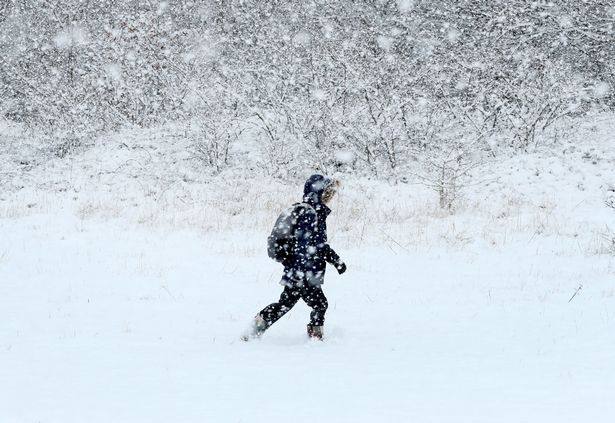
Fifteen minutes later it was all done: notice of closure on the website, texts sent via the telephone tree, a message left for the Head, local media contacted and the Local Authority alerts system triggered. He spent the next hour on a leisurely breakfast, enjoying the film of snow Armageddon on breakfast news, before rousing himself to get dressed and ready to brave the world outside. The woolly hat, thick scarf, gloves and padded coat seemed to dissolve into gossamer threads as he made his first tentative footsteps down the path from his front door. The sky was still dark, with flurries of snow carried in fitful gusts of the wind that knifed through him. He crunched his way along the footpath to the main road.
The road was eerily deserted, and the yellow cones of light from the street lamps bathed everything in a mysterious wash of amber. He passed a couple of abandoned cars, left at crazy angles to the kerb, buried and undetectable under the volume of settled snow. There were just a few other people out and about, their breath steaming into the dark skies as they laboured through the snow, preparing for their stories of heroic attempts to get to work that would dominate the news for the next few days.
It took him an hour to do what normally would have been a twenty minute walk. The school was suffocated under a thick blanket of snow, and as he struggled with the lock to the car park entrance, he could see the thickly mufflered figure of Ray, the site manager, his breath steaming outside the main entrance. Sam crunched his way towards him through the untouched snow.
Ray looked up and flashed a broad smile, enjoying the camaraderie of pioneers. “Mornin’,” he called from a distance, “Nice day for it.”
“Good morning, Raymond. What’s it like inside?”
“Boiler’s buggered. It’s freezing in there.”
“What do you reckon?”
“A couple of days at least. Maybe more. Weather forecast after that is a bit hazy. And even when the snow clears, there’s no guarantee of when the boiler’ll be fixed. If ours has gone, you can bet your life they’ll be swamped with callouts from loads of others.”
“Oh well, at least it’s a clear call. I’ll put it on the website after I’ve spoken to Elizabeth.”
“She’ll be tucked up warm in deepest Surrey somewhere no doubt.”
“The privileges of high office, Raymond, my good man. The privileges of high office. Not for the likes of you and me.”
Ray snorted. “You’ll be there soon, sunshine, you’re not fooling me. Another couple of years and you’ll be El Presidente, ordering everyone around from under the duvet.”
Sam was momentarily taken aback. Was that what everyone thought, that he’d be a Head somewhere? And soon, from Ray’s tone. He roused himself and the flicker was gone.
“Listen Ray, I wouldn’t bother with clearing the grounds, not yet anyway. Give it a day or so and keep an eye on the forecast. There’s no point shovelling it all up if there’s a ton more snow on the way. If we keep in touch, then we can manage it from this end. You concentrate on the boiler. I’m just going to do a bit of work while I’m here. I can lock up if you want.”
Ray didn’t need telling twice and strolled away whistling. His snow day had just started to look up.
It was about ten o’clock when Sam finally called it a day. He locked the gates behind him and leant into the knifing wind that had sprung up, whipping thick, fat snowflakes into his face. He gasped in pain and shock. The journey back was clearly going to be harder than the voyage out in the quiet darkness of early morning.
An hour later when he finally turned the corner onto the home straight, he had lost all feeling in his feet, his cheeks were red and numb, and all thoughts of the charm, beauty and romance of the snowy landscape had disappeared. For the previous fifteen minutes he had sustained his spirits by fantasising about the bacon sandwich he had promised himself, with coffee and the paper. This was the thought in his head, as he peered through the swirling snow over the road to the blocks of flats on the other side. He did it every time he walked past, and the extreme conditions of the morning made no difference. Caroline’s flat.
He was about to press on, head down into the wind, when his eye was caught by a huddled figure in the entrance hammering on the door. Defeated, the figure slumped to the ground and sat, head in hands and began weeping. He stopped and stared, shielding his eyes from the driving snow. He took a step towards the kerb, almost indistinguishable now from the road surface and kept on going, picking his way gingerly over the compacted snow on the road surface. Halfway across he called out.
“Caroline? Is that you, Caroline?”
The figure leaped up as if stung, or caught guiltily in the middle of some heinous act. She wiped her hand across her face. When she recognised who had called out to her, her face fell.
“Caroline, what the hell are you doing out here? Are you alright?”
“Sam, er ..Hi, yes, yes , I’m fine. I’m just…”
She hesitated, as if deciding what to say next. Her face was red and blotchy and streaked with tears.
“No, you’re not,” Sam insisted, “You’ve been crying. What’s the matter? You look terrible.”
A wry smile creased her features and she started again.
“Yes, terrible, I can imagine. It’s just that my boiler’s broken down, and I came down to go to the shop and I…er..well, I got locked out. And I haven’t got my phone with me, or my keys and there’s no-one else in the building and I, er.. I didn’t know what to do and I..”
The sentence collapsed into a further outbreak of sobbing. Sam reached out instinctively and took her hand.
“God, Caroline, you’re freezing. How long have you been out here? You need to get inside.”
“Oh, I dunno, half an hour maybe. It’s just that I don’t know what to do and why did you have to come along again and I’m looking a state and being pathetic and, oh, I don’t know, I..”
The words tumbled out in an incoherent torrent until the heaving sobs came again and she wrenched her hand away.
“Look, come on, come round to mine. It’s only five minutes away. You can get warmed up and sort yourself out and we’ll work out a way through this.”
She hesitated. The use of the word “We” was suddenly hypnotically alluring, the idea that someone could help her manage this. But not him. Of all people, not him.
He reached out and took her hand again.
“You can’t stay out her, you’ll freeze to death. Come on.”
Gently, he pulled her hand and she took her first step, and annoyance was gradually replaced by relief as she allowed herself to be led towards a solution. The two figures, hunched against the wind, melted into the blizzard as they made their way slowly down the road.
*
By the time she woke up, the grey light outside had begun to fade. After they had arrived at Sam’s flat, he had made her eat and drink and then insisted she get some sleep in the spare room. Her blank, red-eyed silence, as she methodically chewed her toast and drank the coffee he had handed to her, had convinced him that she had been exhausted and had been outside for longer than she had said.
She got dressed and tentatively made her way out of the room and into the hall way.
“Hello?” she called out, “Anyone here?”
The nearest door opened.
“Aha, Caroline. You feeling any better? That was one hell of a sleep. You obviously needed it.”
Sam smiled at her and ushered her into the room.
“Come in, come in. Come and have a seat.”
The room was not what she had been expecting. It was beautifully proportioned. Elegant, with high ceilings, polished floor boards and Persian rugs. She almost gasped when she walked in, her eyes wide and bright. There were three sofas arranged around an open fireplace, which had a gently flickering log fire. She stopped herself from telling him what an amazing place it was. She suspected that many people had told him that over the years.
“No, I won’t thanks. I really had better be getting back. Thanks, though, you’ve been very kind.”
“Getting back? Getting back where? Have you found your keys then? Or your mobile?”
“Well, no obviously, but..” She trailed off unconvincingly.
“Come on Caroline, I know you don’t really like me and you feel a bit uncomfortable here, but there’s not much else you can do, is there? Just give in to it and stay. You’ve already sampled the spare room. You can spend most of the time in there if you prefer. I’ve got loads of work to be getting on with anyway and so have you, I imagine. I’ll even lend you my laptop, how’s that?”
He couldn’t work out whether he was more annoyed or disappointed at her evident eagerness to leave, so he straddled the two. He thought himself rather bold for naming the fact that he clearly made her feel a little awkward, but there was little point in being overly polite. At least it was out in the open now. And she couldn’t go anywhere else, that was undoubtedly true. The weather was getting worse, if anything. Even if there were hordes of friends or family in the area, it would be impossible to get to them, unless they lived next door. Public transport, as is the custom in Britain in the bad winter weather, had closed down, and the country had returned to somewhere in the nineteenth century. Like it or lump it, they were stuck together for the foreseeable future.
Caroline submitted to the inevitable and perched on the end of the sofa furthest from Sam. She felt that she had to make some kind of attempt at conversation, at least for a while before she could take up his offer and retreat to a separate room with a laptop. She looked again around the grand living room, and took the least line of resistance.
“This is an amazing flat. It’s like a stately home.”
Sam gave an embarrassed laugh.
“Hardly. It’s the ground floor of the building.”
He saw the expression in her face and admitted, “It is very nice obviously. I’m very lucky.”
“Are you rich then? People who say that they are very lucky usually mean they were privately educated and daddy is something in the city”
“Rich? God, no. I, ..er.. we bought it a long time ago when it was a dump and we did it up, a bit at a time. So, yeah, lucky.”
“’We’? Are you divorced then? Didn’t you have to divvy it up after you split up?”
A pained look flashed across Sam’s face and he stumbled over his words.
“Well, no, not exactly. Umm, I , er..”
Caroline immediately interjected. “Sorry, none of my business. Just putting my foot in it as usual. Ignore me.”
“No, no. It’s me. It’s just that…” He stopped, as if uncertain about how to go on.
“What? What’s the matter? Can’t be that terrible, can it?”
“I was married, but I’m not divorced. My wife died. Yes. She died.” He pronounced the words, awkwardly, as if it were the first time he had ever said them out loud.
Caroline looked horror-struck.
“Oh God, I’m so sorry. I didn’t know. I would never have asked if I’d known. Sorry, that was a terrible thing to say.”
Sam’s blank face shivered into a near smile. “It’s alright. It was a long time ago. A very long time ago. So, yes, not rich, just lucky.”
A silence hovered and settled on the room. The thick snow had dampened down what little noise there was in the streets outside. There was virtually no traffic, just the occasional gust of wind that whined through the window frames and rattled the panes. Caroline looked up in the direction of the noise, grateful for any distraction. At the far end of the room, a pair of French windows looked out onto a long back garden that disappeared from view in the gathering darkness. The garden melted into the thick trees of the adjoining woodland.
“Goodness!” she exclaimed, a little too eagerly, “What a great garden.”
She sprang up, went over to the windows and peered outside. Sam followed her and looked over her shoulder. There were a few flakes of snow drifting down form the grey skies. This was probably the mildest the weather had been all day. Soon, when the sun completely sank beneath the horizon and darkness settled, the temperatures would plummet again. Outside the blanket of snow across the lawn was untouched, thick and even. Only a few lines of bird and animal tracks criss-crossed the canvas.
“Look at that,“ she breathed, “It’s perfect. When I was a kid and our garden was like this, we’d spend hours in it building snowmen.”
She looked back at him, over her shoulder, and smiled. The memory was real and alive for her. Their eyes met. And then Sam, gestured out into the garden with his eyes and back again.
“Well, shall we?” he asked, grateful for the distraction.
“What, go outside? Really?”
She stopped and thought for a moment. “Yeah, come on. Why not?”
The next hour and a half flew by, as they constructed a family of snow people with accessories, stopping occasionally to discuss tactics and take part in an ongoing snowball fight. When they finally came back inside, it was it was velvet black in the garden, the icy darkness shrouding the mysterious group of snow people who were huddled together as if posing for a family photograph at the back by the woods. Their fingers were numb and wet, their cheeks red, their breath steaming into the night air.
He thought of that moment, many times later over the years that followed, as the moment his second life began again. By what a slender thread our lives hang. Choices made, corners turned, things unsaid. Even in the later contemplation of it, its randomness, its chance, its serendipity, brought fear as much as joy. For who knew when similar happenstance would unravel all that had been tightly woven?
Much later that evening, in front of the dying embers of the fire, when two bottles of wine had softened their defences, they sat on the floor side by side wrapped in a filmy gauze of wonder and disbelief. They had talked for hours, discovering on the way, a shared love of The Strokes, The Arctic Monkeys, The Wire, The Sopranos (with a guilty pleasure of The Gilmore Girls admitted under pressure), William Blake, Patti Smith, lower league football, The World Cup, roses and clematis. At one point in the evening, when it seemed to both of them that this had all been supernaturally prearranged, they discovered that they had both taught English as a Foreign Language in Spain at the same time, Sam in Madrid and Caroline in Barcelona.
Before they knew it, it was 1.30am, the last bottle was empty and the embers had ceased to glow in the grate. A sudden awkwardness descended from nowhere.
“Well,” said Sam finally springing up to gather the glasses and bottles, “That was nice, but it’s probably way past bed time.”
“Oh“, stammered Caroline, taken aback, “Yes, of course. Will you have to do the snow thing again tomorrow?”
“No, thank God. The message this morning made it clear that we’d be shut for at least two days, so at least I’m spared a 5 am start. Might be different the day after though. Forecast is for a big thaw.”
“Nothing good ever lasts, does it?” she asked, looking directly at him.
He looked away. “No. No, it doesn’t.” he muttered and busied himself with clearing up. When Caroline followed him into the kitchen with some token clearing, he said, “Oh thanks for that. I’ll do the rest. You know where everything is, don’t you?”
She looked puzzled. “What do you mean?”
“Oh, you know, toilet and bathroom. You can use the room you were in this morning.” He stole a glance at her. “It was alright, was it?”
“What was?”
“The room. This morning,“ he explained patiently. “The room was alright?”
“Yes,“ she said finally, “The room was just right. Like the three bears.”
She turned to go, so he couldn’t see the look of absolute humiliation on her face. The three bears? What was she like? “Ok, good night then,” she said to the wall and carried on walking. Sam stacked the dishwasher.
Later, in the strange snow -dampened silence of his room, Sam lay rigid under the duvet, eyes wide open, mind racing. There was a full moon outside, and it silvered the far end of the room through a crack in the curtains. Why had he mentioned Donna? Why hadn’t he made a move or done anything about it? Anything at all. She was wonderful, there was no doubt about that. And she quite liked him, or was she just a great actress? Liked him? Not any more, he thought bitterly. What is wrong with me? Why can’t I just reach out to someone? Will it always be like this, for years and years and years? The questions raced through his mind, over and over again, and not for the first time, his eyes were wet when he finally slipped into sleep.
When the knock came at his door, gently, he woke up, instantly alert. The door opened a crack and there was a rustle, as a soft breath of wind passed through. The kiss, when it finally came, was everything he had been waiting for, for such a very long time.
The next day, whenever it started, was centred on that room. It was for hours and moments the centre of their universe, with the outside world a memory or a distant rumour, a story told by children but not believed. Occasionally throughout the day, noises came from the other world: a distant train, children playing a few doors down, and when the sun fell, the hoot of an owl and the bark of a fox, but they paid little attention to anything other than the adventure of discovery in front of their eyes.
In the silvery moonlight of the next night she turned to him. “Will we have to go in to school tomorrow?“
It felt warmer and the noises outside their window had included a steady dripping of the promised thaw.
“I don’t know,” he replied, “I think maybe it’s going to freeze over again before morning. Sleep now. I’ll sort it out.”
They both knew he was lying.
*
He lay back under the plump clouds of duvet, her arm across his chest, and looked at the clock. 5am.
He thought of marking 11C’s Mock exams.
He thought of planning the INSET day for the first day back in January
He thought of how he could link performance management with teaching repertoire.
He thought of her arm, its downy golden hairs individually picked out against her warm brown skin.
He thought of how he could encourage teachers to observe each other
He thought of the end of term reports he had to write for the trainee teachers and how he could make them sound a little more positive.
He thought of her smell, like vanilla and caramel.
He thought of the paper he had to finish, to present to SLT, on coaching for development.
He thought of her eyes, strangely green with little grey flecks. And white, white, white, like her sparkling teeth.
He thought of the way she wiped away the crumbs of her toast from the sides of her mouth, moist with tea.
He thought of her lips…..
He swung his legs out from under the duvet, perched on the edge of the bed and reached for his phone.
Sam Stringer was on the verge of something. It was not a nervous breakdown. It was not greatness. He stood on the edge and peered over the sides, dizzy and breathless. Finally, he scrolled down, hit the send button, and slipped back under the creamy warmth of the duvet. The school would be closed again that day.
Sam Stringer was on the verge of falling in Love.
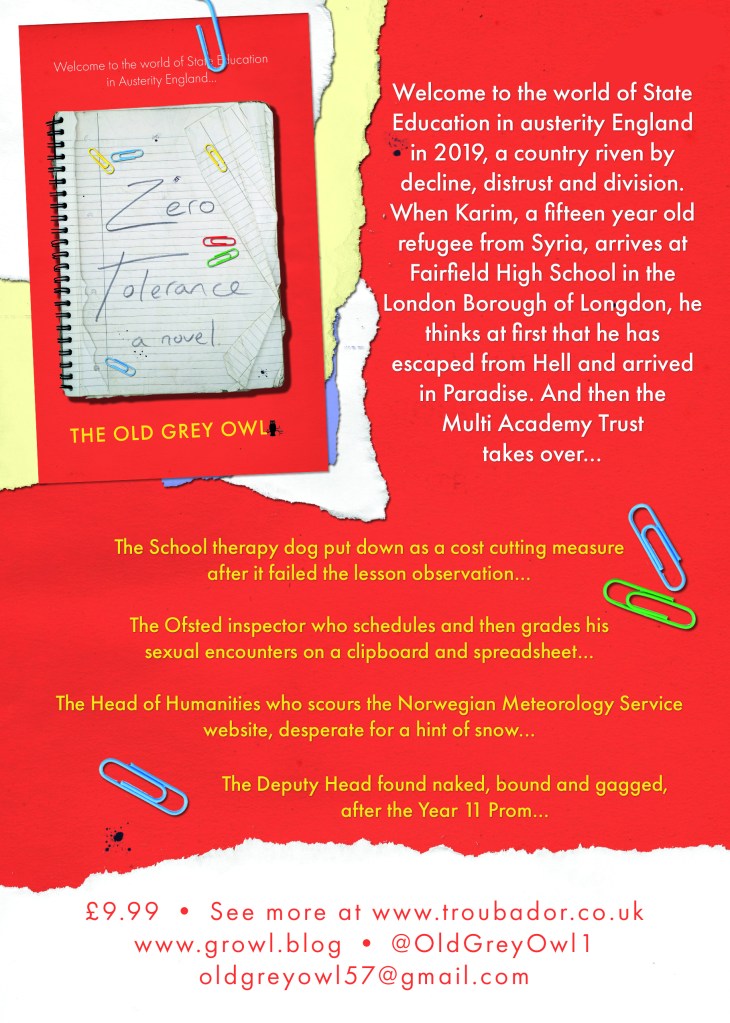
If you liked this story, try my first novel, Zero Tolerance, available from the following links:
The following text is part of the #FoldingPaperProject. The project, set up by Molly (www.mimmerr.co.uk) aims to spread productivity, creativity and fun amongst the world’s current bleak state.
It works like the folding paper game we played at school, where one person draws the head of a character, the next person the body and so on. Whereas, we’ll be continuing a story.
You don’t need to be an accomplished writer. You don’t even need to be any good! You just need to be able to continue the story in four- five hundred words and post it on your site. If you don’t have a site, I’ll put it on mine for you.
If you would like to get involved, contact Molly @mimmerr or at molly@mimmerr.co.uk If not, read on and share the story via the #FoldingPaperProject hashtag. Happy reading and writing!
Oliver slammed his fist down on the desk top, rattling the stained coffee cups, the fruit bowl and the corporate pastries.
“Look, how many times do you need to be told? The whole economy is in free fall. Everywhere. Now is not the time to be thinking of expansion. It’s probably the time to be thinking of cutting our losses and closing.”
There was a pause. Everyone around the table found something to do with their hands, somewhere to direct their gaze, shuffling papers, spreadsheets and projections, while the fan of the projector hummed in the back ground. Anything but look at Felix, his mouth open in disbelief, his brow furrowed.
“Close?” he finally managed to splutter. “You can’t be serious Oliver, we can’t close, not after everything we’ve done. We’re so close to making the breakthrough. If we can just get through this temporary cashflow problem, pay the suppliers and salaries, we can make this thing work. Trust me, I know we can.”
Oliver, smiled as if talking to a difficult but charming child, his tanned face crinkling around the eyes. When he spoke his tone was calmer, a singsong of patient explanation.
“And who is going to pay the suppliers and the salaries, Felix? It’s not going to be you is it?”
“Well, no, but..”
“Exactly. And there is no “but”. That is everything. The bottom line. And as usual, it’s me that has to be the adult in the room and deal with the reality of the situation. The money.”
“But Oliver, there’s always money to be made in a financial crisis. You just have to keep your nerve. If you make the case to the bank, they will lend us the money. The business plan is sound Oliver, you know that. This will be a top end, luxury destination for the A listers and it has the backing of some of the world’s leading conservationists. It’s a winner, Oliver.”
Oliver sighed and shook his head. He turned to the woman sitting on his left, a tall, elegant black woman with braids and a flawless complexion. “Connie, do you mind?”
She leaned forward in her chair, tapped the keyboard and the next slide in her presentation came up. It was a graph with all of the coloured lines heading south.
“We’ve been to the bank, Felix. Several banks, actually. Not to mention some rather more dubious sources of capital. They don’t want to know. I’m sorry” she said.
“But the business plan..”
Connie cut across him. “The business case was strong, before the world economy tanked. Now, cash is king. And we haven’t got any. Look at the graph.”
Felix had heard enough. It was his turn to bang his fist down on to the table.
“Fuck the graph. All you ever want to talk about is graphs. What about the animals? What about the bats?”
Oliver smiled a smooth, thin smile.
“You’re the clever zoologist, Felix. We’re just simple business people. I suggest we move to a vote.”
Fifteen minutes later, after the vote had been taken and lost, by five votes to one, Felix was left alone in the room, surveying the debris still in place across the table, his dreams in tatters. The expression on his face hardened and his knuckles whitened as he clenched and unclenched his fists repeatedly. Finally, he came to a decision. Reaching for his mobile, he jabbed in a number and waited.
“Gareth, it’s Felix. We need to talk about Dad. And money.”
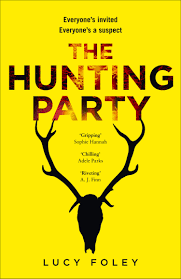
This squeaks into the last days of 2019 as one of my Christmas presents. It’s been riding high in the best seller lists for a few weeks now, and I wanted to recreate Christmases of my youth when I would always treat myself to an Agatha Christie or an Alastair Maclean. They were the perfect books to bridge the wasteland years between 12 and 15 – short, immaculate lessons in plotting and manipulating an ensemble of characters. Foley was a Literary agent who has clearly learned the lessons of what makes a best seller. I was unsure when I started: there was a repeated phrase on the same page and I couldn’t think of a reason for that to have been done stylistically for effect, so I assumed it was a sign of a formulaic, crappy pot-boiler. The other black mark was the first person narrative, beloved of literary agents and consultants as being more intimate and immediate. So boring, so cliched , so wrong. But actually, in the end, that was me. Boring , cliched, wrong. And probably a little jealous that an agent can knock off a book and make such a success of it. Yes, they actually can walk the walk as well as talk it. I finished it in a day and a half and it’s an enjoyable read. It’s a variant on the houseparty detective novel. There’s a small group of characters thrown together for a few days, snowed in to their exclusive Scottish Highland holiday mansion, when one of them is murdered. It can only be one of the others whodunnit. The first person narrative extends over named chapters that cycle around the main six or seven characters and there’s a clever timeslip element to the structure. A snowy, scenic setting and some ghasty middle class yuppie type characters and a murder. I can see the ITV miniseries now. And, I imagine, so could Lucy when she was planning it. A nice festive palate cleanser.
Drive your Plow over the Bones of the Dead by Olga Tokarczuk
Another whodunnit, but of a very different kind this time. This is a bit of a cheek because I’m only three quarters of the way through it (another Christmas present), but it was too good to leave out. This book is delicious. From the cover which is brilliantly, brutally Stalinist in its stark functionality, to the first person narrative (see above) which is an authentic insight into the mind of a genuinely interesting, unusual character, to the evocation of the freezing snow-bound wilderness on the Czech/Polish border, via the unravelling of a series of bizarre murders, everything about this book is a treat. The main character’s musings, as the story unrolls, reveal her thoughts on the poetry of Blake, astrology, militant animal rights, illness (Her “Ailments”), nature, children versus adults and much more besides. A short, lovely book.
The Nix by Nathan Hill
This was my favourite book of the year. If you want something that will wrap you in a warm embrace for several weeks, so that you eventually deliberately slow down to delay the awful prospect of it not being part of your life, then this is the book. It’s engaging, affective, moving, clever, thought provoking and entertaining. Its got a clever time slip element between the civil rights movement of the sixties to contemporary America, romance, and social commentary. It’s a straight 9 out of 10. Lucky you if you haven’t read it yet.
There were some Turkeys as well as Crackers…..
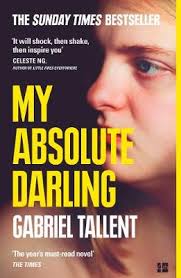
My Absolute Darling by Gabriel Tallent
I got this out of the library on spec, after having spent much of the previous year seeing its distinctive yellow cover in bookshops prominently displayed. It’s a chunky hardback with some hardcore recommendations on the front and back from the great and the good. About third of the way in I thought I had discovered a major new talent. The prose was extraordinary: sinuous, inventive, poetic, but unlike some of the more experimental writers around, Tallent seemed able to combine those figurative qualities with clear communication of meaning. He is particularly impressive conveying a sense of the rural location in woodlands by the California coast. But the last two thirds were dreadful, as it slipped into being a horribly exploitative book about male violence, power, child abuse riddled with cliches, improbable plot twists and action sequences. Avoid at all costs.
Lanny by Max Porter
I haven’t read Grief is a Thing with Feathers but was aware of Porter’s reputation. I started this and couldn’t manage more than about 35 pages. I’m a big fan of experimental, inventive prose, so don’t get me wrong and think I’m dismissing this because it didn’t tell a straight linear narrative. It just seemed to me to be willfully obscure and difficult for its own sake. Thankfully, I’m old enough now not to make the mistake of thinking that if I don’t like a book then it means that the book is bad. The act of writing a novel is a labour of love, involving long hours of sweat and brain ache and self-doubt, followed by an agonising period of public exposure to possible humiliation. The book is not bad – there are far too many distinguished people who loved it for that to be true. It just didn’t speak to me. You might be luckier.
Paris Echo by Sebastian Faulks
I’ve loved many of Faulks’ books in the past (Birdsong and Charlotte Gray are two of my all-time favourites), so this was a particular disappointment. This was a novel that was phoned in. It is one big nothing, that exists because of what he has done before. It would never have made it past any Literary agent had it been a debut novel. A complete waste of everybody’s time. Sorry Sebastian.
Mentioned in despatches
Honourable mentions must go to, in no particular order:
Washington Black – Esi Edugyan
The Mars Room – Rachel Kushner
Everything Under – Daisy Johnson
How to be Right – James O’Brien
The Overstory – Rchard Powers. (although there were too many trees for my liking. I know you can never have too many trees these days. Except in a book)
So, what a year it was. And I’m already looking forward to the treats in store in the year to come. I’m depending on them, actually. The horror of the election result can only be managed by retreat into culture and pleasure. I’ll emerge sometime later in 2020, hopefully refreshed, re-energised and ready for the struggle. But not just yet.






 The Old Grey Owl