
I’ve always believed the hierarchy of fictional respectability is just another manifestation of keeping the oiks in their place. Like the concept of a fine palate when it comes to food, having good literary taste is a device to be able to confidently feel and express your own superiority over the lumpen masses. At the top of this pyramid of worth, sits Literary Fiction, smoking a fat cigar, and flicking the ash at the lower classes s/he straddles: reading group fiction, detective novels, romance, horror, sci fi, through an ever-multiplying collection of genres and subgenres, ending in the sludge of graphic novels and comics.
You just need to give your head a shake to see that literary fiction is just another genre, with its own conventions and expectations. Language is privileged over plot, obscurity is King (or Queen), ideas rub shoulders amiably, sides are resolutely not taken, and difficulty is wholeheartedly embraced. If you can make the reader feel they are missing the point, that they just don’t get it, you’re on your way to the shortlist of some prestigious literary competition or other.
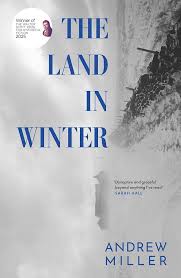
But then, every now and again, a literary novel comes along that stops me in my tracks and gives pause for thought, as previously unshakeable theories begin to teeter and the cracks spread. This one is the latest offering from Andrew Miller, The Land in Winter. He’s carved a niche for himself as a writer of historical fiction, comfortably sitting at the literary end of the spectrum, rather than the Brother Cadfael end. Novels such as Pure, and Now We Shall Be Entirely Free showcase his undoubted talent as far as establishing interesting characters and subtly drawn relationships in an entirely authentic and credible historical setting.

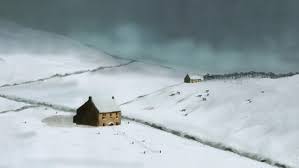
He’s done it again in The Land in Winter, but this time he has chosen an era still within living memory: the early 60s. To be more precise, his novel is located in the winter of 1962/63, a period that has entered the myth of our island story as the hardest winter since the frost fairs of the early 19th century.

This was a time when the whole nation was cut off under Impossibly deep snow drifts for months on end, from December until March/April. I was about six years old at the time and have vivid memories of walking to school through trenches dug in the snow on the pavements that went above my head.
It was a time before the swinging sixties. Pre-Beatles too, at least as far as their impact on broader society. Miller captures the grim, narrow atmosphere perfectly. This was a black and white England, before technicolor, still uncomfortably close to rationing, still in the grip of deference, hypocrisy and snobbery.
The book starts obliquely, in the grand tradition of literary fiction, with one patient at a residential psychiatric hospital, unable to sleep in the middle of the night, discovering the body of another, a patient who has committed suicide. Then they disappear from the novel completely. They do reappear, much later, after four other characters have claimed centre stage for themselves. By the time they do come back, the book has turned into something rich, deep and powerful via Miller’s quiet, subtle prose.
They are two recently married couples, Eric and Irene Parry, and Bill and Rita Simmons living in the middle of the countryside in the west country. Eric is the village doctor, Irene a middle-class Londoner more used to a life of art galleries and literary discussions. Bill Simmons is a farmer, trying to make a go of his recently acquired smallholding with his recently acquired wife. His father is an Eastern European immigrant, vaguely connected to London gangland, who has tried to remove all traces of his origins, while Bill is trying to cut himself off from his family and set out on his own. His wife, Rita, a working-class girl who met Bill when working as an escort in a dodgy bar in Bristol is troubled by the voices she hears, left alone on the farm all day as Bill works all hours to try and make a success of what is likely to be a doomed venture. The two women, bored and lonely, become unlikely friends.
The stresses that Miller has rippling beneath the surface become heightened as the snow falls and an isolated community is even more cut off than before. everyone is confined to their own homes and the stifling conformity and boredom reaches a pitch.
Everything is set up for a drama centred on women being oppressed by conventional men, but one of the novels great strengths is its subtlety. There’s a lot more going on here than that. Each of the four characters is given equal weight – there are no victims, no baddies and goodies here. Miller manages to create sympathy for each of them.
It’s also, for all of its quiet understated subtlety, a book that, by the end, has been full of action. The difference here, though, is that in Miller’s hands, there’s not a whiff of melodrama over twists and turns that wouldn’t be out of place in a soap opera. The plot developments are all the stronger, and more impactful, because he turns the volume down. It’s an object lesson in getting the balance right: plot, character, ideas and language are complementary threads in a pleasing whole, producing a novel that continues to resonate long after the last page is turned. So, yes, there’s life in the old dog yet. Literary fiction can still prove its worth and relevance – just don’t diss the rest while you’re enjoying it.
 The Old Grey Owl